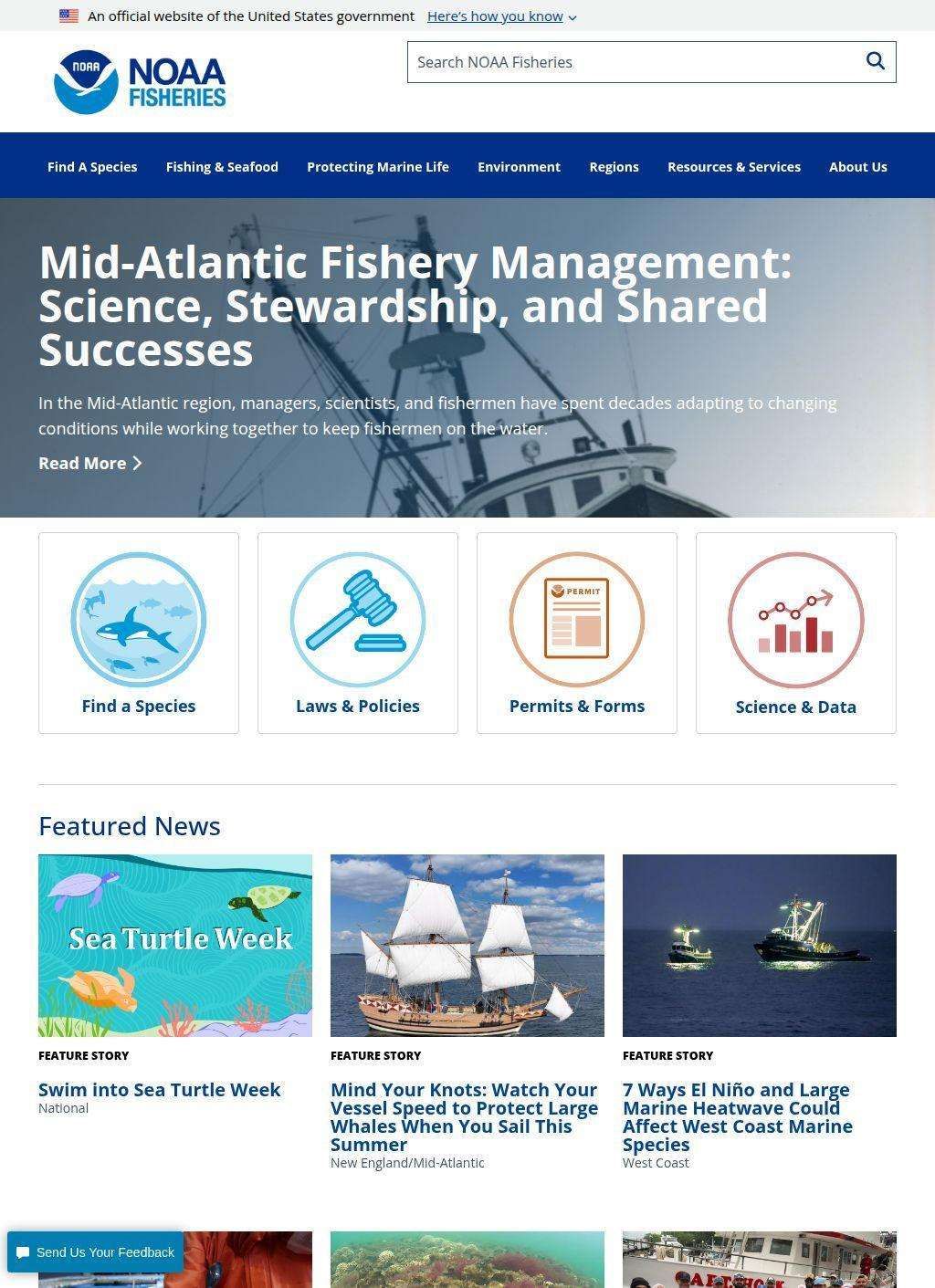
Want to know whether the cod on your plate came from a fishery that can sustain the pressure? FishWatch, one of the public-facing tools on this site, was built to answer exactly that, with seafood profiles that lay out where a species is caught, how it is managed, and whether the population is holding up. It sits alongside a much larger body of work run by NOAA Fisheries (National Marine Fisheries Service), the U.S. agency charged with managing the country's ocean fish stocks, marine mammals, and the habitats both depend on. The seafood tool is the friendliest entry point, but most of what NOAA Fisheries (National Marine Fisheries Service) publishes is aimed at people who need the science. Seafood profiles are a small window onto something far wider.
Species directory and regional management
Start with the species directory and you get a sense of the scope. It covers the fish a commercial boat or a recreational angler would expect, then keeps going into dolphins, whales, sea turtles, seals, and marine invertebrates, and it can be browsed by category or by region: Alaska, New England and the Mid-Atlantic, the Pacific Islands, the Southeast, and the West Coast. Fishing rules and stock conditions differ enormously between, say, the Gulf and the Bering Sea, and the regional split mirrors how the agency itself is organized. Each profile ties back to the science behind it, which is the part I found most useful, since the regulations are not floating free of evidence.
Fishing rules for commercial and recreational sectors
For people who actually fish for a living or for sport, the regulatory material is the spine of the place. There are fishery management rules, permit applications, and guidance written separately for commercial and recreational fishing. Around that sit the sustainable fisheries programs: bycatch reduction, catch shares, and the seafood profiles already mentioned. The agency does not pretend management is settled, and the documentation on ocean noise impacts and vessel strike mitigation reads like the work of people still arguing out the trade-offs in real time.
Public access to population data
A lot of federal data ends up locked behind formats nobody outside the field can open. That is largely avoided here. Population assessments and research survey data are published, there are interactive maps and GIS tools, and the scientific publications and data portals are open to anyone willing to dig. Stock assessments, the unglamorous statistical backbone of every catch limit, are treated as something the public is allowed to inspect, a number you can trace to its source instead of one handed down from above.
Marine mammals and habitat protection
The protection side, the part of NOAA Fisheries (National Marine Fisheries Service) that draws the most public attention, runs in parallel. Programs for marine mammals and endangered species include practical channels such as reporting a stranded animal, which turns a member of the public into part of the monitoring network. Habitat restoration and broader ecosystem management get their own programs, as does the question of how a warming ocean reshapes all of it, filed under climate change solutions for marine environments. None of this is presented as solved; it is presented as ongoing, which is the honest way to present it.
Grant programs for marine research
Funding is documented too, and concretely. The site lists grant programs by name, including the Prescott Grant, the Saltonstall-Kennedy Grant, and habitat restoration funding. For a researcher, a coastal nonprofit, or a tribal organization chasing money for marine work, having the specific programs spelled out is more useful than a vague promise that support exists somewhere.
Education and recruitment fill out the rest. There are teaching materials aimed at students and educators, citizen science opportunities for people who want to contribute observations, and listings for internships and careers for those eyeing the field as a profession. A multimedia gallery rounds it off with videos, podcasts, and story maps, a reasonable way to translate stock assessments and bycatch policy into something a non-specialist will sit through. NOAA Fisheries (National Marine Fisheries Service) treats outreach as part of the job, not an afterthought.
Does this site work for casual visitors?
If there is a fair criticism, it is one of volume. The sheer breadth means a casual visitor arriving to check one seafood profile can find themselves several clicks deep in regulatory PDFs and regional sub-portals before they realize they have wandered off the path. The material is excellent; the route through it asks for patience. Anyone treating this as a quick reference should expect to spend longer than they planned, because the depth that makes the resource valuable is also what makes it sprawling.
Who is this genuinely for? Commercial fishermen working out a permit, anglers checking a regional rule, researchers pulling survey data, educators building a lesson, and conservationists tracking a species recovery will all find their corner well stocked. Someone who only wanted to know if a particular fish is a sound dinner choice gets a clean answer from FishWatch and can stop there, never touching the heavier scientific layers NOAA Fisheries (National Marine Fisheries Service) maintains underneath. NOAA Fisheries (National Marine Fisheries Service) is the primary source other sites cite when they discuss American fisheries, so the verdict is straightforward on substance even if navigation costs you some time.
So where does that leave it? Positive but qualified. As a reference, NOAA Fisheries (National Marine Fisheries Service) is close to indispensable for the audiences it names, and the openness of the underlying data sets it apart from agencies that hoard it. The caveat is purely practical: this rewards the determined more than the curious, and the seafood-shopper use case, while supported, is almost incidental to the agency's real purpose. Come knowing roughly what you want, and the depth pays off. Wander in expecting a tidy consumer guide, and the scale may overwhelm before it informs.
Business address
National Marine Fisheries Service
1315 East-West Highway,
Silver Spring,
Maryland
20910
United States
Contact details
Phone: +1 301-427-8000