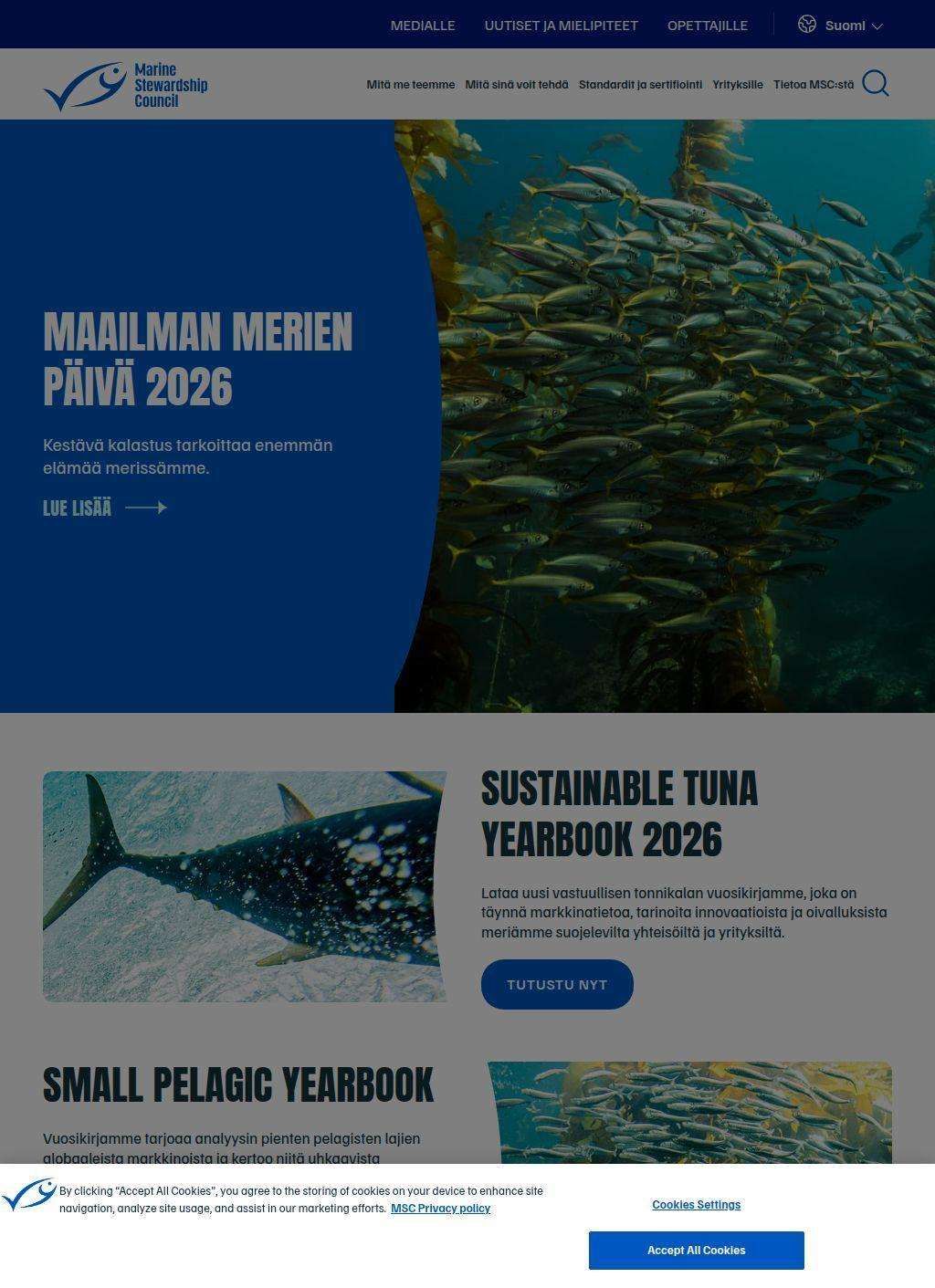
What does that small blue fish logo on a frozen cod fillet or a can of tuna actually promise? It tells a shopper that the seafood came from a wild fishery assessed against an environmental standard, and that the chain handling it after the catch was checked too. The Marine Stewardship Council sets that standard and runs the program behind the label. Based in London and structured as an international non-profit, it works on one narrow but enormous problem: how to keep wild fish populations and the habitats around them intact while the fishing keeps happening. The site is the public window onto that machinery, and it reads like the home of an organisation that has been at this long enough to have built real scaffolding underneath the marketing-free claims.
The headline number gives a sense of scale. The program currently covers 738 certified fisheries, which the organisation puts at 20.6 percent of global marine wild catch. That is a fifth of the world's wild-caught fish moving through a single voluntary standard, and the figure cuts both ways: a substantial slice of the catch is inside the system, and most of it still sits outside.
How certification and traceability work
Two certifications do most of the work. The first is fisheries certification, where an independent third party, not the Marine Stewardship Council itself, assesses a fishing operation against the environmental sustainability standards. That separation is structural, and the site states it plainly. The body that grants the certificate is an accredited assessor, and the Marine Stewardship Council writes the rules those assessors apply. The second is chain of custody certification, which follows the fish forward through processors, distributors, and retailers so a product wearing the label can be traced back to a certified source. Without that traceability piece the eco-label would mean very little once a fish left the boat, and the program treats the two as a pair.
Fisheries improvement programs
Beyond the core pair, the offering widens in sensible directions. There is a joint MSC-ASC seaweed standard, developed with the Aquaculture Stewardship Council, that extends certification into seaweed harvesting and farming. For fisheries that cannot yet meet the full bar, the Fisheries Improvement Program lays out a staged route toward eventual certification, which is a more useful answer than a flat pass-or-fail gate. A fishery short of the mark gets a path instead of a closed door.
Documentation for assessors
The technical depth shows in the material aimed at the certification bodies themselves: program documents, the standards text, and the procedural detail an accredited assessor needs to run a consistent assessment. This is the part of the Marine Stewardship Council that the average seafood buyer never sees, and its presence is the strongest evidence that the label rests on something more than goodwill. A standard is only as good as the documentation that keeps every assessor judging the same way.
Resources for traders and shoppers
The site splits cleanly between people who sell seafood and people who eat it. On the trade side there is a supplier directory for sourcing certified product, a funding opportunities directory, and the technical library mentioned above. A retailer trying to stock labelled seafood, or a processor weighing chain of custody certification, can find the practical entry points without hunting. The Marine Stewardship Council clearly understands that a standard only spreads if the commercial side finds it workable, and the site is built around that reality.
Consumer guides and recipes
The consumer-facing material is lighter in tone and aims to make the label legible at the shelf. Fish guides explain what the blue mark covers, recipes give people a reason to cook the certified species, and the "Simply Seafood" newsletter keeps interested shoppers in the loop. None of this is novel, but it answers the obvious question a curious buyer brings: what is this logo, and what should I do with it. Plain, useful, and pitched at the right level.
Funding conservation projects
Funding and research round out the picture. The Ocean Stewardship Fund channels money into conservation projects in and around certified fisheries, which closes a loop that pure certification leaves open: it is one thing to certify a fishery, another to actively finance improvements on the water. The research and policy work covers climate change effects on fish stocks, bycatch reduction, and the periodic revision of the standards themselves. That last item is worth dwelling on, because a standard that never changes calcifies, and the Marine Stewardship Council treats revision as part of the job.
Tracking documented improvements
One figure on the site reframes the whole effort. The certified fisheries have logged 2,625 documented improvements. That is the difference between a label that simply approves and one that prods operations to do better over time. Each documented improvement is a concrete change on a real fishery: a gear modification, a bycatch measure, a stock-management fix. For an organisation that lives or dies on credibility, counting those changes is the right thing to count.
Acknowledging coverage limits
It is fair to keep the scale honest. Roughly a fifth of the global wild catch carries the certification, which means the larger share does not, and a voluntary standard can only certify the fisheries willing to be assessed and pay for it. The Marine Stewardship Council does not pretend to cover the whole ocean; the published 20.6 percent figure is an admission of exactly that boundary. What the Marine Stewardship Council controls it documents carefully, and where it stops, the site says so plainly.
Taken together, the offering is coherent from the boat to the shelf: a standard, independent assessors who apply it, traceability that protects the claim downstream, a fund that pays for improvements, and research that keeps the rules current. The consumer pages translate all of that into something a shopper can act on in ten seconds. The Marine Stewardship Council has built the rare thing in conservation, a system where the technical rigor and the supermarket label are two ends of the same rope.
The blue label tells a shopper a fishery was checked and the fish was traced. The deeper documentation, the improvement counts, and the funding mechanism are all here for anyone who wants to look past the logo. Whether 20.6 percent of the global wild catch is a ceiling or a starting point depends on how many more fisheries enter the program, and the Marine Stewardship Council publishes the figures to let observers judge that trajectory themselves. Given 738 certified fisheries, 2,625 documented improvements, and a fund actively financing work on the water, the published evidence puts the Marine Stewardship Council among the more credible voluntary standards in food supply chains. The scaffolding holds together, and the record stands open to anyone willing to spend an hour in the documentation.
Business address
Marine Stewardship Council
Marine House, 1 Snow Hill,
London,
England
EC1A 2DH
United Kingdom
Contact details
Phone: +44 20 7246 8900