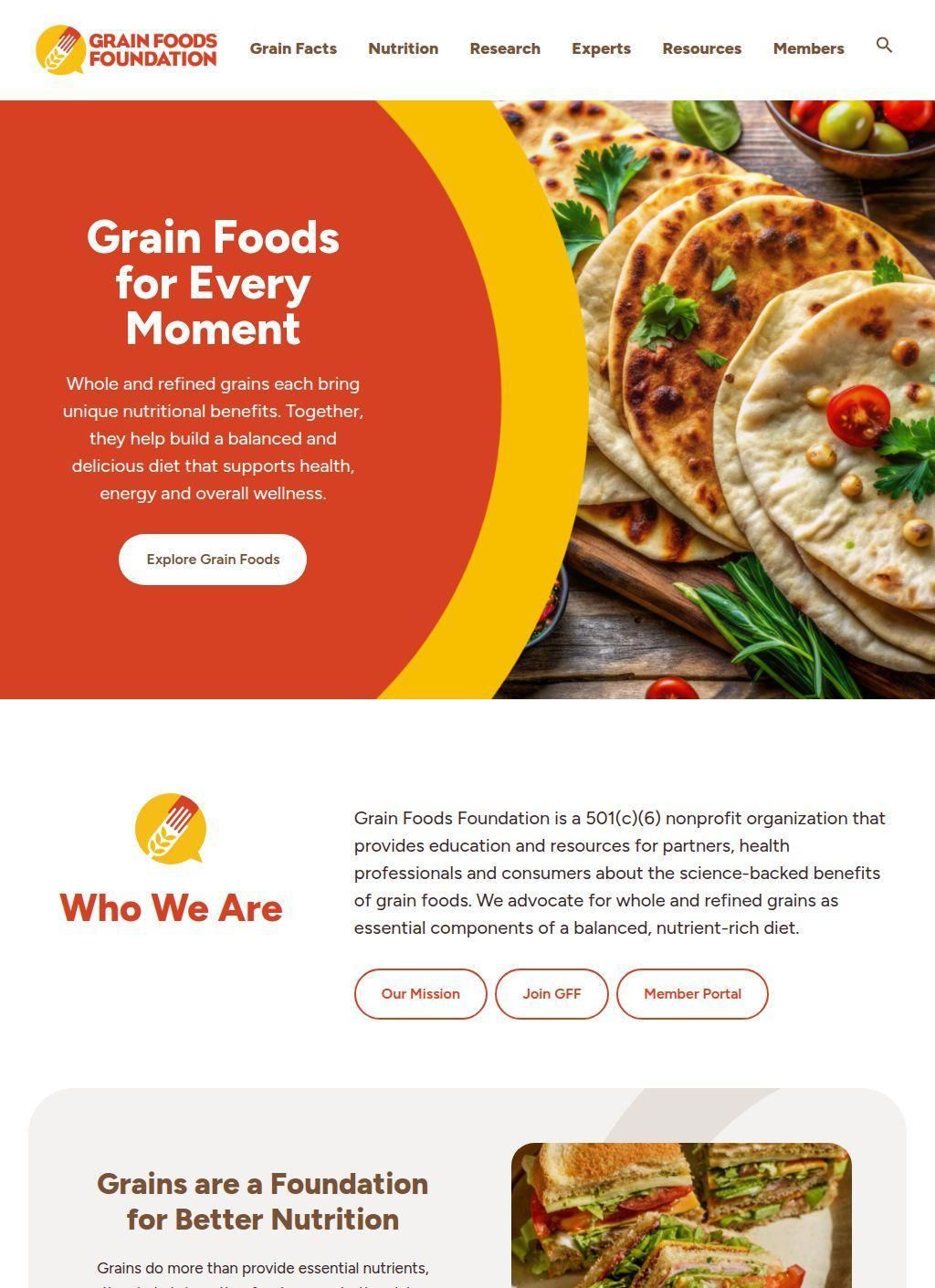
Grain Foods Foundation is a trade association funded by the baking and milling industries, and it spends much of its energy defending refined grains, the very thing most current diet advice tells people to cut back on. That puts it in a genuinely unusual position. Founded in 2004 as a joint venture among industry members, it holds nonprofit status with an EIN of 20-1329442, and its central argument is that both whole and refined grains have a legitimate place on the plate. Whether a reader takes that argument at face value depends a lot on how they feel about who is funding it.
Resources organized by topic
The site is built around resources, and they are organized in a way that makes the mission clear from the start. Grain Facts covers grain types, how milling works, what enrichment adds back, and a set of FAQs aimed at people who want more than a headline. The Nutrition area handles serving guidance and general health tips. There is a Recipes section sorted into meal categories, which is the one part that reads as straightforwardly consumer-facing. Most of the rest leans toward an audience that already works in food, policy, or nutrition, and would not feel out of place listed in a professional or trade-facing business directory.
Grain Facts covers milling and enrichment
The Research section is where Grain Foods Foundation stakes its credibility. It collects scientific studies and white papers, and the group points to a Scientific Advisory Board of nationally recognized nutrition and healthcare experts as the people standing behind its positions. For a body that exists partly to push back on mainstream dietary guidance, leaning on named scientific advisers is a sensible move, and it is more substance than many industry-funded outfits bother to put on display.
Research section with scientific advisers
That said, the framing is worth examining. Grain Foods Foundation engages directly in public advocacy, including formal responses to the Dietary Guidelines Advisory Committee proceedings. It also publishes consumer insight reports aimed at a broad readership. A study cited by a group whose members sell the product being examined carries a built-in tension, and the site does not pretend otherwise: the industry tie is stated plainly on the About page. Readers who want neutral nutrition science will still want to weigh the source carefully, no matter how credentialed the advisory board is.
Separate portals for professionals and members
The materials split clearly by audience. A Health Professionals section offers practitioner-targeted content, presumably for dietitians and clinicians who field grain questions from patients. Industry Insights gathers market trends and research aimed at partners in the trade. A separate Member Portal gates exclusive content for paying industry members, so a chunk of what Grain Foods Foundation produces is never visible to the general public. The layered access structure is typical for trade associations, but worth knowing before you decide how much of the published material represents the full picture.
Limited public presence and third-party verification
The public footprint is modest for an organization that has been operating for two decades. Grain Foods Foundation maintains a LinkedIn page with 1,102 followers, plus accounts on Instagram and YouTube. Those numbers reflect a primarily professional and trade-side audience rather than any large consumer following. Outside coverage backs that up: trade outlets such as Baking Business and World Grain reference Grain Foods Foundation as an industry association voice, and GuideStar confirms the nonprofit registration with financials on file.
Social media following skews toward industry
No consumer reviews or ratings turned up on Google, Trustpilot, Yelp, or comparable platforms. That is not surprising for a policy and education body, since there is nothing to rate in the way a service or product gets rated, but it does mean the only third-party voices are inside the same industry Grain Foods Foundation represents. A nutrition educator or policy researcher weighing this listing has trade-press mentions and a GuideStar record to go on, and little else from outside that orbit.
No consumer ratings on major platforms
Contact is accessible. A Contact link sits in the navigation, though the homepage shows no phone number or email address by default, so anyone wanting to reach the foundation directly has to click through to the contact page. For an advocacy organization whose primary interlocutors are industry members and journalists, this is minor friction. The foundation's Washington, DC base is noted on the About page, which at least anchors the organization geographically for anyone researching its policy work.
Contact information requires navigation click
The unresolved question is the one Grain Foods Foundation cannot fully answer for itself. It presents real science, a credentialed advisory board, and a clear set of resources, and it is upfront about being industry-funded. Yet every favorable claim about refined grains originates with a group that has a direct financial stake in the outcome. The research may be sound, but no neutral party is positioned here to confirm it, and that gap is precisely what Grain Foods Foundation is least equipped to close on its own. A reader who wants the science without the industry angle will need to trace the cited studies back to their original journals and weigh them independently.
Business address
Grain Foods Foundation
25 Massachusetts Avenue NW, #500B,
Washington,
District of Columbia
20001-1430
United States
Contact details
Phone: (202) 491-6930