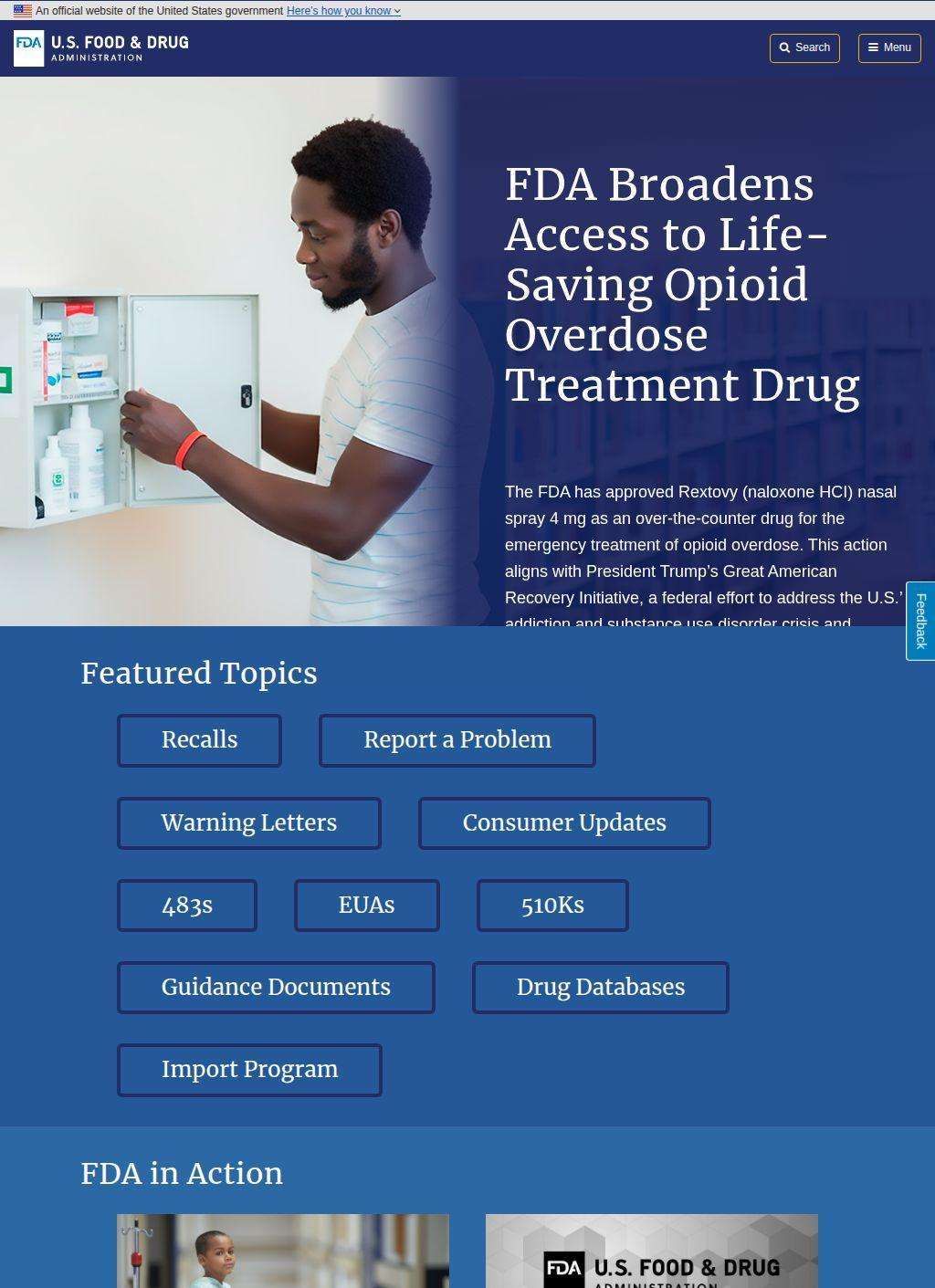
It is not obvious what a federal regulator has to do with a category labeled Baked Goods. More than the heading suggests. The U.S. Food and Drug Administration writes and enforces the rules that decide what a loaf of bread, a packaged muffin, or a box of crackers may say on its label, what it must disclose about allergens, and how the facility that made it has to handle safety. So while this listing sits under bakery products, the site behind it is the rulebook the whole sector answers to, not a shop selling anything.
The U.S. Food and Drug Administration is part of the Department of Health and Human Services, and its remit runs far wider than food. It oversees human and veterinary drugs, vaccines and blood products, medical devices, cosmetics, dietary supplements, products that emit radiation, and tobacco. Food is one pillar among several, and the site is organized to reflect that breadth. For someone arriving from a bakery angle, the relevant material clusters in the Food section, which is where the practical guidance lives.
Food standards and labeling rules
That Food section is denser than a casual visitor might expect. It covers standards of identity for grain-based foods, the framework around GRAS (generally recognized as safe) determinations, food facility registration, and the Preventive Controls for Human Food rules that came out of the Food Safety Modernization Act. Allergen labeling gets detailed treatment, which matters directly to anyone making baked goods, since wheat, tree nuts, and gluten declarations are governed here. Nutrition labeling rules, including the handling of trans fat and the format of the panel itself, are documented at length. A small producer trying to work out what legally has to appear on a package will find the source material, even if reading it is a slog.
For its intended audiences, yes, with the honest caveat that this is reference territory, not a friendly walkthrough. The U.S. Food and Drug Administration publishes guidance documents, Federal Register notices, warning letters, recall announcements, and import alerts, and these are the genuine articles regulators, lawyers, and compliance staff cite. The warning letters in particular are worth knowing about: they show, in plain language, where specific companies fell short of the rules, which is a useful way to understand how the standards actually get applied.
Databases for drugs, devices, food
The searchable databases are the part I keep coming back to as the strongest reason to visit. Drugs@FDA covers approved drug products, the Orange Book handles therapeutic equivalence, and drug shortage listings track supply gaps. On the device side there is the 510(k) clearance database, the premarket approval (PMA) records, and the Establishment Registration and Device Listing system. For food specifically, the CFSAN Adverse Event Reporting System (CAERS) collects reports tied to foods, supplements, and cosmetics. These are primary records, updated by the agency itself, and that is precisely what makes them more trustworthy than a secondhand summary somewhere else.
Reporting adverse events
The reporting tools deserve a mention too. MedWatch is the channel for flagging adverse events tied to drugs and devices, and the CAERS pathway does the parallel job for foods and supplements. A bakery dealing with a contamination scare or an allergen mislabeling incident would end up interacting with this machinery, so knowing it exists, and where it sits, has real value beyond idle browsing.
Navigation challenges for mixed audiences
The breadth that makes the U.S. Food and Drug Administration authoritative is also what makes it hard to navigate. The site serves consumers, patients, clinicians, manufacturers, importers, distributors, researchers, and policy makers all at once, and the writing rarely bends toward the casual reader. A page aimed at a drug manufacturer reads nothing like one aimed at a worried parent, yet both live under the same roof, and the U.S. Food and Drug Administration does not always make it obvious which audience a given page assumes. Someone who just wants to know whether a cookie they bought is part of a recall can get there, but they may pass through several layers of regulatory phrasing to do it. The material is accurate; it is not always quick.
When to use primary sources
That trade-off is the honest center of any verdict here. Plenty of food blogs and trade sites repackage these rules into something easier to read, and for a quick answer they are often faster. But they are interpretations. When the wording of an allergen declaration or the legal definition of a standard of identity actually matters, the U.S. Food and Drug Administration is the place where the binding text lives, and the secondhand versions are only as good as whoever wrote them.
Bakery producers and facility requirements
The Food portal's bakery relevance is genuine on inspection. Grain-based food standards, the rules separating, say, what may legally be called bread versus a related product, sit here. So do the labeling requirements that govern nutrition panels and ingredient lists on packaged baked items. A producer scaling up from a home kitchen to a registered facility will run straight into the food facility registration requirements and the FSMA preventive-controls obligations, both of which the U.S. Food and Drug Administration documents on the site with the supporting guidance attached. The food additive petition process is here as well, for anyone introducing an ingredient that has not already cleared the safety bar.
It is worth being clear about what this is not. The U.S. Food and Drug Administration site does not sell, recommend, or rank bakery products, and it carries no commercial content of the sort the category label might imply. Anyone landing here expecting a vendor or a recipe collection will be in the wrong place. Its job is regulation and public health, and the food coverage exists to enforce safety and honest labeling, not to promote anyone's goods.
Across its other sections, the same pattern holds. The Biologics area handles vaccines, allergenics, and blood. The Tobacco section runs premarket review and marketing orders, a reminder that the U.S. Food and Drug Administration regulates products well outside anything edible. The Drugs and Medical Devices sections pair their approval databases with recall information, so a reader can check both whether something was cleared and whether it was later pulled. None of this is bakery-specific, but it shows the consistency of the approach: a public-facing portal sitting on top of large, official datasets, with the regulatory paperwork published rather than hidden.
So where does that leave the listing? Filed under Baked Goods, the U.S. Food and Drug Administration is an odd fit on the surface and a sensible one underneath. It will not help anyone buy a croissant, and the category framing oversells the bakery angle. What it does offer is the authoritative source for food safety law, allergen and nutrition labeling rules, facility registration, and recall information, the things a serious baker or food manufacturer genuinely needs and cannot get, with equal reliability, anywhere else. The U.S. Food and Drug Administration is dry, occasionally maze-like, and written for professionals before consumers. Judged as a reference, that is a fair price for material this authoritative. If the rules matter and only the primary source will do, this is where they live.
Business address
U.S. Food and Drug Administration
10903 New Hampshire Avenue,
Silver Spring,
Maryland
20993
United States
Contact details
Phone: 1-888-463-6332