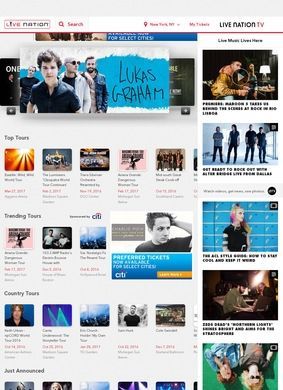
Type a city into the "Shows Near You" box and the front page of Live Nation reshapes itself around whatever is playing within driving distance: an arena tour stop, a club gig, a multi-day festival, a comedy night. That localization is the whole engine of the site. It is built to answer one question fast: what is happening near me and can I get in. It answers that question better than almost anything else aimed at the general concertgoer.
Finding shows by artist, genre or location
The catalogue is enormous because the company sits at the center of the live business itself. It promotes and produces concerts, runs festivals, and operates hundreds of venues around the world, so the events you browse here are frequently events the same firm is staging. You can search by artist name, dig through by genre, or filter to a location and scroll what is on sale.
Discovery is genuinely the strong part. Someone who only half-remembers a band name or who just wants to know what is touring through their region this season will find the browsing fast and well-stocked. Because Live Nation is the party booking many of these shows in the first place, the calendar tends to be current and the on-sale information accurate, which is not always true on aggregator sites that scrape dates from elsewhere and let them go stale.
Checking out through Ticketmaster
Ticketing is where the structure gets more interesting, and more complicated. Live Nation owns Ticketmaster, so when you move from a listing to an actual purchase you are usually handed off into that system. The two are stitched together tightly enough that most visitors will not notice the seam.
VIP upgrades and event insurance
For premium buyers there is VIP Nation, which bundles better seats with extras like early entry or merchandise, and for the cautious there is event protection insurance offered through a tie-up with Allianz, so a ticket can be covered if plans fall apart. Gift cards and merchandise round out the commerce side, and they are positioned so that a casual shopper who came in just to browse can leave having bought a present without ever touching a seating chart. The path from a listing to a paid order is short, which is the point of owning both ends of it.
It mostly helps, with a caveat worth naming. Someone who wants concert tickets, a VIP package, a festival pass, a gift card, and a streamed show can do all of it without leaving the ecosystem, and the localized recommendations mean the homepage rarely feels generic. Citi cardholders get presale windows and discounts through a standing partnership, which is a concrete perk for a large slice of the audience and the kind of arrangement that changes when and at what price you can buy.
Where the ecosystem gets confusing
The caveat is that the breadth can blur the lines. Veeps, the streaming arm, lives under the same roof and lets you watch live performances online, which is a real offering and not an afterthought, yet a casual visitor might not immediately grasp that a streamed Veeps show and an in-person Live Nation concert are different products with different rules. House of Blues, the venue brand the company owns and operates, surfaces in listings as a place rather than as a separate destination, which is fine but means the consumer rarely sees the corporate map underneath. None of this breaks anything. It just rewards a few minutes of orientation before you start clicking buy.
Tools for artists and industry partners
For artists and industry partners the site points toward a different set of doors. Live Nation Productions handles concert production, and the promotion machinery that fills those venues is the business the company is best known for inside the trade. A musician landing here is looking at a potential promoter and production partner, not a ticket to buy, and the site keeps those two audiences reasonably well separated so a fan is not constantly tripping over B2B language. Given how much of the touring world Live Nation touches, that production wing is no small thing, though the consumer side of the site is where most visitors will spend their time and where the design clearly puts its energy.
Country specific versions worldwide
Practical usability holds up across borders. Live Nation runs geo-localized versions for many countries, so a user in one market sees prices, dates, and venues that make sense for them instead of a default US view that would be useless abroad. That sounds obvious but plenty of large entertainment sites still get it wrong, dumping foreign visitors onto an American storefront. Here the regional split is handled cleanly enough that the "Shows Near You" promise delivers wherever you are. For a company the size of Live Nation, getting that basic courtesy right is worth noting, because the audience genuinely spans dozens of markets and currencies.
Festival lineups for trip planning
Festival coverage is one of the better parts. The listings go beyond a single date and a buy button, giving lineup and event information for multi-act gatherings, which is exactly the context a buyer needs when weighing a weekend pass and travel costs. Combined with the VIP packages, this is the part of the platform that serves the planner, the person mapping out a trip around music months ahead, and it does that job with more depth than the typical single-show page.
Is bigger always better for concertgoers?
The thing to keep clear in your head while using Live Nation is the scale of what you are dealing with. This is the dominant player in live entertainment, vertically integrated from the act on stage to the venue to the ticket in your hand, and the site reflects that. The upside is reach and a one-stop flow. The trade-off is that the same firm wears several hats at once, and a buyer who likes to compare options should remember that the recommendations and the inventory are coming from a party with a direct stake in the sale. That is not a knock so much as a thing to be aware of.
The combination of localized discovery and end-to-end purchase is where the site pulls ahead. You can go from idle curiosity about what is on this month to a confirmed seat, with insurance and a VIP upgrade if you want them, inside a single session. Few competitors can match that span because few of them own the venues and the ticketing infrastructure the way Live Nation does. The streaming and merchandise pieces feel like sensible extensions of the core, not bolted-on distractions.
Set against Songkick, which many fans use purely for tour tracking and artist alerts, Live Nation is the heavier, more transactional tool. Songkick will quietly tell you when a favorite act announces a date and then send you off elsewhere to buy; it is light, focused, and neutral about where the ticket comes from. Live Nation does the discovery too, but it closes the loop itself, which is more convenient and also less independent. Someone who only wants alerts and a tidy concert calendar might prefer the lighter option. The tradeoff is clear enough that you can make the call without needing to go further than the homepage of each.