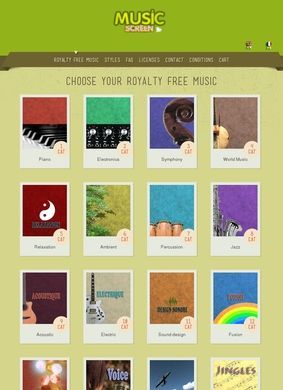
Where do you go for instrumental tracks you can drop into a video or a shop playlist without a royalty bill chasing you afterward? Music Screen is one answer worth knowing about. It is a royalty-free music library run by Hicham Chahidi, an independent composer working out of Belgium, and the whole catalogue is built around pre-cleared instrumental recordings you can download as MP3 files. The pitch is straightforward: pick a track, use it, and skip the ongoing payments that performing rights organisations like BMI, ASCAP and SESAC would otherwise expect.
Sixteen genres in one library
The Music Screen catalogue spreads across sixteen or more genres, and the spread is broad enough to be genuinely useful. Piano, electronica, symphony, world music, relaxation, ambient, jazz, acoustic, and action all sit alongside each other. That mix tells you something about who Chahidi expects to walk through the door: a podcaster scoring an intro, a yoga studio looping ambient pieces, a small film with no budget for an orchestra, a game developer needing something with momentum. One person composing across that many styles is unusual, and it gives the library a consistent hand behind it. You are not stitching together tracks from a dozen contributors with clashing production values.
How licensing works for students and commercial projects
I find the licensing structure to be the part that rewards a close read, because Music Screen is more layered than most one-page music sites bother with. There are two broad routes. Students, nonprofits and private individuals can get free authorisation for online and web projects, a real concession and not a trial gimmick. Then there is the commercial side, where paid licenses cover the situations where money is changing hands: YouTube monetisation, podcasts, film, television, advertising, in-store and background music, radio, games, apps, and exhibitions. The licenses are sorted by project scope, so internet use, advertising, music on hold, television, cinema, radio, application, exhibitions and in-store play each have their own terms. Anyone who has tangled with sync rights will appreciate that the categories are spelled out rather than left vague.
Custom composition and arrangement services
Beyond the off-the-shelf catalogue, Music Screen takes on bespoke jobs, and this is where the operation looks less like a stock library and more like a working composer's studio. There is music customisation, where an existing track can be reshaped by tempo, length or instrumentation to fit a specific cut. There is original composition on commission for anyone who needs something that does not exist yet. And Music Screen offers custom arrangements of public-domain works, which is a smart niche: a familiar classical melody, freshly arranged and cleared, sidesteps both the licensing headache and the cost of an entirely new piece.
Audition tracks before you buy
The try-before-purchase model deserves a mention because it changes how you use the site. You are not buying blind. You can audition a track against your footage or your space, confirm it sits right, and only then pay. For background and in-store music in particular, where a piece has to wear well over hours of repetition, that ability to test first removes most of the guesswork that a marketing line about quality never could. A SoundCloud profile under the handle music-screen carries additional content too, so there is a second place to sample the sound.
Documentation and license clarity
The supporting pages back the Music Screen offering up. A FAQ answers the questions that tend to come up around usage rights, there are dedicated license information pages, and a terms of use document lays out the ground rules. For a music library, that documentation is the difference between a site you trust with a commercial project and one you click away from. Licensing is the whole point of a service like this, and Music Screen does not leave it murky. The free authorisation for students, nonprofits and private web projects sits right alongside the paid commercial tiers on the same license pages, which makes it quick to see which side of the line your own project falls on.
Contact through inquiry forms only
On the question of how to reach Music Screen, there is a contact page that runs on a form for inquiries and quotes. A form is a perfectly normal route for a service that prices work by project, since a quote for a commissioned composition needs the details of the job anyway. The catch is that nothing else is laid out up front: no phone number and no street address surface on the homepage. You have to navigate to the form before you find any way in. For a buyer weighing a commission, a little more visible reassurance about who is behind the desk would not go amiss, though the named composer and the body of work on display do a fair amount of that reassurance on their own.
No independent reviews or ratings
On outside opinion, the picture at Music Screen is quiet. A search turns up the site's own pages and its SoundCloud presence, and not much else: no Trustpilot entries, no clutch of Google ratings, no Yelp listing to point to. That absence is worth naming honestly. It does not mean the music is poor, and for a one-person specialist library it is not surprising, but it does mean a prospective customer is judging on the tracks and the documentation rather than on a wall of testimonials. The Music Screen SoundCloud account is the closest thing to a public footprint, and it functions more as a sample reel than as a feedback channel.
Beware the UK live music site with similar branding
One point of caution that has nothing to do with quality: there is a separate entity at musicscreen.co.uk that runs live music-to-cinema events in the UK, entirely unrelated to this Belgian library. The names are close enough to confuse, so anyone arriving at Music Screen should make sure they have landed on the .org site if royalty-free downloads are what they came for. It is an easy mix-up to make and worth flagging before someone wastes a search.
Weighing Music Screen as a whole, it reads as a focused, single-composer library that knows exactly what it is for. The genre range is wider than the one-man-band setup might lead you to expect, the licensing is unusually well-segmented for the scale of the operation, and the custom-composition and arrangement services lift Music Screen above a plain download shop. The free tier for students and nonprofits is a genuine gesture, and the try-before-buy model removes most of the risk from picking the wrong track. What tempers an outright recommendation is that Music Screen carries no independent reviews to lean on, and contact details take a click or two to surface.
The creative record is solid; the public credibility footprint is almost nonexistent. A podcaster, a small studio, a retailer building an in-store playlist, or anyone who needs music on hold without a recurring license fee will find the practical fit strong. The gap comes down to how comfortable you are buying from a specialist whose reputation lives almost entirely on the tracks themselves.
Business address
Music Screen
10 av des prisonniers de guerre,
Court-St-Etienne,
Brabant Wallon
1490
Belgium
Contact details
Phone: +32 10 73 10 96
Fax: +32 10 73 04 54