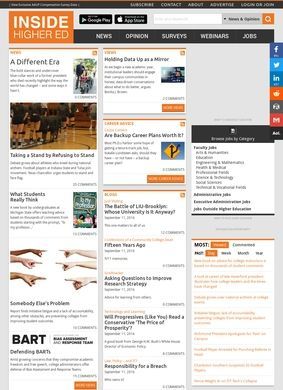
A dean is trying to figure out whether a sudden enrollment dip is local or part of a national pattern, a postdoc is hunting for the next job before a contract runs out, a provost wants to know how peer institutions handled a governance fight that just landed on their own desk. These are the moments when someone reaches for Inside Higher Ed, and the site has spent more than two decades shaping itself around exactly those questions. It reads as a daily working tool for people whose jobs live inside colleges and universities, built for the sector, a trade publication in the proper sense of that term.
News organized by sector divisions
The reporting is organized the way higher education itself is divided. There are sections for Faculty, Students, Diversity, Admissions, Tech and Innovation, Business, Institutions, Governance, Government, Workplace, and Global affairs, which covers most of the seams where the sector actually strains. Someone in a provost's office and someone teaching three sections of composition are looking for very different things, and the layout acknowledges that instead of flattening everyone into a single "campus news" feed. A reader can follow the funding fights and federal policy moves under Government, then cross over to the day-to-day questions of tenure, hiring, and workplace conditions without leaving the same publication.
Mix of reporting formats
What keeps Inside Higher Ed from feeling like a wire service is the mix of formats. Daily news sits next to longer investigative pieces, and alongside both there are opinion columns and career advice written for the people doing the work, including faculty and staff alongside administrators. The career material in particular tends to be practical: how to negotiate, how to read a job market that has been brutal for years, how to move between roles. That combination of breaking news and frank professional guidance is unusual, since most outlets pick one lane and stay in it.
Podcasts for different audiences
Audio is a genuine part of the offering. Inside Higher Ed runs several podcasts, including The Key, Campus, Academic Minute, and The Pulse, each pointed at a slightly different slice of the audience. Academic Minute leans toward research and ideas, while the others stay closer to policy, leadership, and the texture of campus life. For people who commute or who absorb analysis better by ear, that range matters, and it signals that the publication is thinking about how its readers actually live their days.
Job board and institutional services
There is also a layer aimed squarely at institutions. Inside Higher Ed publishes reports and data, runs events and webinars, and operates a job board built for hiring and recruiting across the sector. That job board is worth singling out because for many academics it is the first reason they ever visited the site, and it ties the editorial coverage to the practical reality of finding work in a field where openings can be scarce. The site appears in more than one business directory of higher-education media and professional resources, which reflects its standing rather than any self-promotion. The reports and data give administrators something to cite in planning documents, and the events extend the same conversations the articles start.
Revenue model for institutions
The commercial side is stated plainly: institutional subscriptions, advertising and marketing services, and consulting. There is also a peer-to-peer platform called Campus aimed at institutional clients, which points to an ambition beyond publishing, toward connecting institutions with each other and with services they need. Whether a given college needs all of that depends on its size and budget, but the offering is coherent. The journalism builds the audience, the data and events deepen the relationship, and the institutional products turn that standing into something a university can buy into.
American focus with global coverage
It is worth being clear-eyed about Inside Higher Ed's scope. It is a sector publication, which means its lens is American higher education first, with global coverage added rather than central. A reader outside the United States will find plenty of relevant analysis but should expect the center of gravity to sit on US policy, US institutions, and US labor conditions. The opinion and advice columns also carry the usual caveat of any commentary: useful perspective, best read as one informed voice among many. None of that undercuts the value, but it shapes how the material should be used.
Value for higher education professionals
For the people it is built for, the case is straightforward. Inside Higher Ed treats higher education as a field with its own economics, politics, and labor market, and it reports on all three with the seriousness the subject deserves. Faculty get coverage of the conditions they work under, administrators get analysis and data they can act on, and students get a window into the institutions deciding their futures. The breadth could feel scattered in less disciplined hands, yet the section structure holds it together. After spending time across the news, the columns, and the audio, the impression Inside Higher Ed leaves is of a publication that knows precisely who it is talking to and why. If your professional life runs through higher education in any sustained way, Inside Higher Ed belongs in your regular reading.