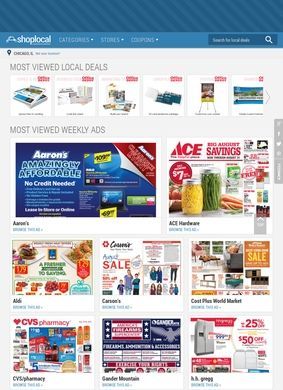
ShopLocal is a B2B digital advertising platform based in the United States that builds and hosts the online weekly ads and product catalogs attached to major retail chains. The main shoplocal.com address is not a store you buy from. It is the engine behind the scenes. The retailer-branded circular pages that consumers browse live on subdomains in the clientname.shoplocal.com pattern, and the parent domain sits there as plumbing with almost nothing visible on the surface.
How ShopLocal powers retailer circulars
That distinction shapes everything about how the site reads. Anyone who types the address expecting a deals marketplace lands on a near-empty page: a cookie consent wall and the tagline "Your Local Deals," and almost nothing else to click. The real product is downstream, in the weekly ad pages that retailers run through the ShopLocal service, where shoppers pick a store location and scroll current promotions, price drops, and product listings for that branch. Understanding this is the key to understanding everything else about the domain.
Major retail clients using the platform
The client roster is the most telling detail, because it is specific and independently verifiable. ShopLocal powers digital circulars for Target, Lowe's, CVS Pharmacy, Walgreens, Staples, Publix, Kohl's, Marc's, and True Value. National pharmacy, grocery, hardware, and general-merchandise chains have handed their weekly-ad infrastructure to one vendor, and those circulars reach a large slice of American shoppers every week whether or not those shoppers ever learn the platform's name. That is a different kind of credential than a testimonials page.
Core services for retailers and shoppers
The core work breaks into a few concrete services: turning a retailer's weekly deals into a browsable online format, keeping product listings live and tied to store locations, and pushing those promotions across devices. For the retailer it is outsourced ad operations. For the shopper it is the difference between a flat PDF flyer and an interactive page that knows which store is nearest. ShopLocal does not need consumers to think of it by name for the product to function.
Corporate ownership and operational history
The corporate history is worth tracing because it bears on platform stability. ShopLocal started in 1999 as ShopLocal LLC. In December 2016 it was acquired by Liquidus Marketing, and it has since operated under Fusion92, an advertising and marketing-solutions company. The brand has outlived its first owner and now functions as a product line inside a larger agency. Long-running infrastructure that major chains keep paying for tends to be infrastructure that works, and a quarter-century of operation in ad tech, where vendors churn fast, is a reasonable track record.
Limited public contact information
Because ShopLocal is a B2B vendor, the usual consumer-trust markers are mostly absent from its own domain. There is no contact information on shoplocal.com: no phone number, no address, no parent-company link. A retailer evaluating the service would presumably reach Fusion92 through other channels, but someone who arrives at the bare domain has no obvious route to anyone. For what ShopLocal is, that is largely defensible. A platform selling to enterprise retail buyers does not need a public storefront on its root page, and the real product lives on retailer subdomains where the retailer's own support takes over.
Visibility challenges for curious visitors
Still, the emptiness is striking. A visitor who does not already know the corporate story would struggle to work out what ShopLocal even does from the page in front of them. There is a real cost to running purely as infrastructure: it makes the company invisible in exactly the places where a curious person might go looking.
Security ratings and employee reviews
On external signals, what exists points toward legitimacy without saying much about quality. Scamadviser rates the domain as legitimate and safe; Scam Detector rates it authentic and secure. Those are security and authenticity checks, not measures of how well the circulars actually perform. No consumer-facing ratings turned up on Google, Trustpilot, Yelp, or the BBB for shoplocal.com specifically, which is about what you would expect for a company most shoppers never knowingly interact with.
Glassdoor employer assessment
The one window into how the operation is regarded from inside comes from Glassdoor, where ShopLocal holds 16 employee reviews and a 3.3 out of 5 overall, with 58 percent saying they would recommend it as an employer. Sixteen voices cannot stand in for a verdict on the product, and the score lands closer to lukewarm than enthusiastic. It is the only human-sourced read available, and it is worth noting it for what it is: a small, middling employer rating with no obvious consumer equivalent to set beside it.
What the available evidence shows
The picture that emerges is genuinely split. What ShopLocal does is real, durable, and trusted by retailers whose names are recognizable to most Americans, and the technical legitimacy of the domain is not in doubt. Yet almost everything a person could independently verify about service quality sits out of reach. The circulars are scattered across client subdomains. The parent company is invisible on the brand's own site. The only direct human feedback is that Glassdoor slice, 16 reviews, which is a narrow base.
For the shopper who reaches a Target or CVS weekly ad and never sees the ShopLocal name, none of this is relevant. For anyone trying to evaluate ShopLocal on its own terms, the published evidence is the client list, a clean legitimacy check, and a middling employer score. That is enough to rule out a scam and not enough to say much beyond it.