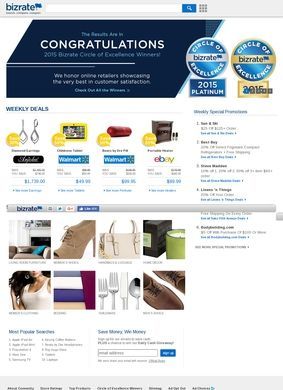
You want a new pair of running shoes, or a laptop, or a set of patio furniture, and you do not want to open fifteen retailer tabs to find out who has the lowest price this week. That is the job Bizrate sets out to do. The site, run by Connexity, pulls products and deals together from a long list of online stores and lets you compare them in one place, sorted into more than twenty categories that cover appliances, automotive parts, baby gear, books, clothing, computers, electronics, furniture, health and beauty, jewelry, pet supplies, sports equipment, toys, and video games. If you have ever bought something online, your category is probably here.
Price comparison across twenty categories
What I found most useful on a first pass is the weekly deals feed, which names the retailer rather than hiding it behind a vague banner. You see offers tied to Best Buy, Saks Fifth Avenue, Steve Madden, Sun and Ski, Linens 'n Things, Bodybuilding.com and others, with discount codes and special promotions attached. Naming the retailer up front tells you whose store you land on once you click through, which saves the unpleasant surprise of landing somewhere unexpected. Alongside the deals sit a "Top Products" section and a body of store ratings and product reviews submitted by shoppers, which give the price comparison some human context instead of pure numbers.
Weekly deals from named retailers
The shopper review layer is the part that distinguishes a comparison portal from a plain price scraper. Bizrate collects feedback and ratings from people who have bought, and it surfaces store ratings so you can weigh a low price against a seller's track record. There is also a related operation, Bizrate Surveys, that gathers verified post-purchase reviews and distributes them to retailers, plus a separate Bizrate Rewards program that hands out points for completing those surveys. So the same name covers a consumer-facing comparison site, a B2B feedback engine, and a points scheme, which can blur together if you are not paying attention.
Store ratings and shopper reviews
Reach extends past the United States as well. The brand operates international sister sites: Bizrate UK, Prixmoinscher in France, SparDeinGeld in Germany, and Shopzilla IT in Italy. If you shop across borders or want a sense of regional pricing, those exist, though the main draw here is the domestic comparison experience.
International sites and regional pricing
There is a clear business side too. Merchants can log in and sign up, get their stores listed, collect customer feedback and ratings, buy advertising, and join a Publisher Program for sites that want to carry Bizrate's product data. These tools are routed through their own login and signup pages, kept separate from the consumer browsing flow, which is sensible. A retailer evaluating the platform has a defined entry point and is not made to wade through deal listings to find it.
Merchant tools and publisher programs
For ordinary shoppers, the contact options are sparse. The homepage shows no phone number, no email, and no street address. The footer carries a "click here" link for reporting price discrepancies, which is a narrow channel for one specific problem, and business inquiries get pointed to those merchant login pages. If you hit a snag with a deal or want to ask a question that is not a price-data error, there is no obvious route. Worth knowing before you treat the site as a place that will help you after a click rather than just before one.
How do you contact customer support?
The public review record is not flattering. Bizrate carries 43 reviews on Trustpilot with user complaints noted in the snippet, 129 reviews on SmartCustomer averaging 1.4 out of 5, 22 on PissedConsumer at 1.5, and a pair of reviews on ResellerRatings sitting at 1.0. Low scores across several independent platforms, and they pull the consumer side down. The one bright spot is the B2B product, Bizrate Insights, which draws generally positive marks from enterprise users on G2. Businesses paying for the feedback tooling seem satisfied; individual shoppers leaving public reviews are often not.
Low ratings on independent review platforms
Some of that gap is the nature of comparison sites. People rarely return to praise a portal that simply pointed them to a good price, and they do return to vent when a deal was stale or a click sent them somewhere unexpected. Even allowing for that bias, ratings clustered between 1 and 1.5 across multiple sources are not noise. The frequency of complaints points to a real pattern: prices or codes that do not hold up at checkout, or clicks that land somewhere shoppers did not expect. Verify any price and any code on the retailer's own site; do not take the listing at face value.
For a deal hunter who treats Bizrate as a starting point and confirms everything at the source, there is still practical value: the category spread is wide, the named-retailer deals save time, and the shopper ratings add a useful second opinion. For a merchant or publisher, the better lead is the business side, since the Insights feedback tooling is the property earning real praise; visit the merchant signup pages and ask specifically how the verified post-purchase surveys feed into your store ratings. Go in clear-eyed about the consumer reviews, and check the final price yourself.