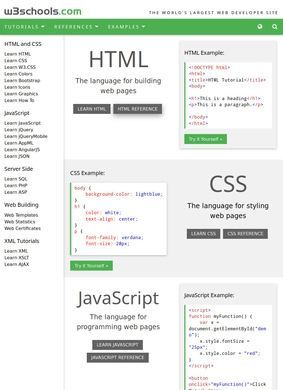
Sitting beside almost every code example on W3schools is the "Try it Yourself" editor, and that single design choice probably explains why the site has lasted since 1999. You read a line about how a CSS flexbox works, click into a live panel, change a value, and watch the result redraw on the spot. No setup, no install, no account required. That immediacy is the whole pitch, and it holds across the catalog: HTML, CSS, JavaScript, Python, SQL, Java, PHP, plus framework material for React and Node.js, with more than fifty technologies covered in total.
Try it Yourself editor
The tutorials follow a predictable rhythm. A topic gets a short explanation, a runnable snippet, and then a reference table you can return to later. The reference documentation is arguably the part people come back to most. When someone needs to remember the exact syntax of a SQL JOIN or which arguments a JavaScript array method takes, the W3schools reference pages are quick to scan and stripped of ceremony. That separation works well: the tutorial teaches the idea once, and the reference lets you look it up forever after without re-reading a lesson.
Tutorials, references, exercises
Beyond reading, W3schools pushes you to test what stuck. There are exercises tied to each language, quizzes that track progress, and code challenges that ask for a working answer instead of multiple choice. The progress tracking gives a self-taught learner a sense of how far through a subject they have come. The exercises lean toward the foundational end; they confirm you understood the lesson without trying to substitute for building a real project.
Paid certifications and subscriptions
Plenty of the platform costs nothing, but W3schools clearly runs a business on top of the free material, and it is worth knowing where the lines fall. The certifications are paid. You study a track, sit an exam, and come away with a credential you can list. How much weight a hiring manager puts on a W3schools certificate will vary; treating it as a job guarantee is reading too much into it. As a marker that you have worked through a body of material and confirmed a baseline, it is reasonable enough.
The subscription side is called W3schools PLUS, which strips the ads, bundles hosting, and adds priority support. For someone using the site daily, removing the advertising alone changes the experience, since the free version carries a fair amount of it. Then there are the Bootcamps, which add live instruction rather than the solo, read-and-try model the rest of the site is built on. That is a genuinely different product: scheduled teaching with a human attached, aimed at people who want structure and accountability over pure self-pacing.
Two other pieces round out the paid catalog. W3schools Spaces is a built-in web hosting and website builder, so the same place where you learn to write a page can also publish one. The Academy program is pitched at schools and educational institutions that want to bring the tutorials and exercises into a classroom setting with management tools around them. These extensions make sense once a site has the audience W3schools has accumulated over two and a half decades. Users who find W3schools through a business directory listing or a simple web search tend to discover this breadth only after spending time with the free material.
The smaller utilities are easy to overlook and genuinely handy. A color picker for grabbing and converting hex values. Typing speed tests. Code challenges that double as practice and as a light competitive nudge. None of these are reasons to visit on their own, but they are the kind of bookmark-it-and-forget-it tools that keep a developer returning to the same domain for years.
Community and learning gaps
There is also a Discord community for peer interaction, which fills a gap the static lessons cannot. Learning to code alone is where a lot of people stall, and having a place to ask why your code throws an error at two in the morning is worth more than another tutorial page. W3schools clearly understands that learning happens partly in conversation, not purely on the page.
A fair criticism of W3schools, and one that has followed it for years in developer circles, is that the simplification sometimes comes at the cost of completeness. The site optimizes for getting a beginner moving quickly, which can mean a topic is presented in its most digestible form instead of its most rigorous one. For a first pass, that trade is exactly right. For deep or edge-case work, a learner will eventually need the official specifications or the documentation maintained by the language and browser communities. W3schools is the on-ramp, and it works best when used that way.
Who benefits most from W3schools
Who is it for, then? A complete beginner gets the most obvious value: clear first lessons, instant feedback, and a path from zero to a basic working page. An intermediate developer uses it differently, mostly as a fast reference and an occasional refresher when picking up an unfamiliar language. Even data science gets coverage through the Python and SQL material, which broadens the audience beyond pure web work. You can learn front-end, back-end, and database basics without leaving one domain, and that consistency of style across so many languages is rare.
One thing W3schools deserves credit for is staying current while keeping its identity. The interactive editors now run backend code alongside front-end snippets, which closes a long-standing gap. The framework coverage means W3schools did not freeze in the era of plain HTML and CSS, and the addition of bootcamps and certifications shows it has tracked how people pursue careers in this field. A resource that started in 1999 and still serves beginners well today has clearly kept revising rather than coasting on its name.
W3schools is one of the most practical free learning resources on the web for anyone starting out in code, with a paid layer that is fairly optional and reasonably priced for what it adds. The interactive approach is its real strength, the reference pages are its quiet workhorse, and the simplification that draws criticism is the same quality that makes it approachable. It will not turn anyone into a senior engineer by itself, and W3schools does not claim to. The published evidence across twenty-five years of iteration makes that case without needing any embellishment.