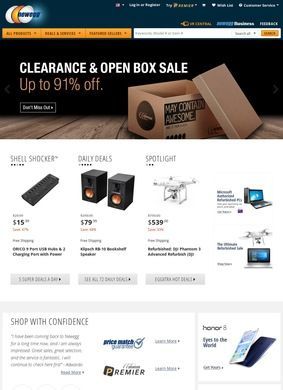
Where should someone go when they want to build a PC from scratch and would rather pick every part themselves than trust a prebuilt box? NewEgg is one of the obvious answers, and it has been since 2001. The site grew up as a destination for computer components, and that DNA still shows. You can buy a single CPU, a GPU, a stick of RAM, an SSD, a motherboard, or a cooling kit, and the catalogue runs deep enough that hunting for a specific chipset or memory speed rarely ends in a dead screen.
Building PCs with detailed component selection
The component focus is the part most people know, but the store has widened a lot over the years. Alongside the parts bins there are finished desktops and gaming PCs, laptops, workstations, and servers for buyers who want the machine assembled and shipped. Monitors, keyboards, mice, and headsets fill out the peripheral side. Networking gear, smart home and security devices, televisions, audio equipment, and cameras all have their own sections. Past that, the listings stretch into software and digital game keys, appliances, automotive accessories, home and outdoor gear, even toys and drones. It is a broad spread, and the breadth is real rather than padding, though the heart of the operation clearly remains the tech aisles.
Expanded product categories beyond computer parts
What separates this retailer from a generic electronics shop is the set of configuration tools aimed at people who actually assemble their own hardware. The PC Builder lets you assemble a parts list and check that the pieces play nicely together. There is a Combo Builder for bundling components, a Laptop Finder and a Gaming PC Finder for buyers who want guidance, and a Power Supply Calculator that answers the one question every first-time builder gets wrong. For storage and infrastructure projects there is a NAS Builder, a Server System Configurator, and a Memory Finder that maps compatible modules to a given machine.
Configuration tools for hardware assembly
These are not decorative widgets. The Power Supply Calculator alone has probably saved a lot of people from underpowering a new graphics card, and the compatibility checking inside the PC Builder is the sort of thing that turns a nervous first build into a manageable afternoon. I tend to judge a parts retailer by whether it helps you avoid mistakes before you spend, and NewEgg leans hard in that direction.
Community focus and technical depth
The store claims a community of more than four million tech enthusiasts worldwide, and the tooling reflects that audience. This is a site built for someone who knows the difference between DDR4 and DDR5 and wants the search filters to respect that knowledge.
Business procurement and financing options
Beyond individual shoppers and gamers, NewEgg also runs a dedicated business arm. Newegg Business handles B2B procurement, which is useful for IT departments and resellers who need volume orders, account terms, and a catalogue tuned to commercial buyers instead of one-off consumer purchases. That split keeps the consumer experience uncluttered while still serving organizations.
The pricing and promotion side has a few recognizable programs. Shell Shocker flash sales are a long-running fixture, rotating limited-quantity deals that reward shoppers who check in often. Price Protection Deals give some cushion against the usual fear of buying right before a drop. There is a Trade-In program for offloading older hardware, and a Student Store with discounts for buyers who can verify enrollment. On the financing front, the catalogue supports the NewEgg store credit card and Progressive Leasing, which broadens access for people who would rather pay over time than all at once. An Affiliate program rounds out the list for content creators and reviewers who send buyers its way.
Marketplace sellers and third-party listings
One detail worth weighing is the third-party marketplace. The platform hosts additional sellers alongside its own stock, which expands the catalogue considerably. The upside is selection and price competition. The thing to keep in mind is that buying from a marketplace seller is a slightly different transaction than buying from the house, so it pays to read which is which before checkout, particularly on higher-ticket items.
Put the pieces together and the picture is coherent. A buyer can research a build with the configurators, source the parts, finance the purchase if needed, trade in the old rig, and catch a flash sale on the way out. That end-to-end loop is the genuine strength here, more so than any single product line. The toys, appliances, and automotive odds and ends feel like sensible extensions of a logistics operation that already ships everything else, not the reason anyone arrives.
If there is a caution, it is the one that comes with any catalogue this large: the sheer number of options and the mix of first-party and marketplace listings can overwhelm a casual shopper who just wants a TV and does not care about chipsets. The configuration tools assume a certain appetite for detail. Someone who finds that tedious might prefer a simpler storefront, while the enthusiast NewEgg was built for will feel right at home.
Comparing the full shopping experience
For the self-builder, the gamer pricing out a new rig, or the small IT buyer who needs parts in volume, NewEgg is a natural first stop. Start with the PC Builder, lock in a parts list, run the Power Supply Calculator against your graphics card, and check whether a Shell Shocker deal lines up with what you already planned to buy. That sequence is where NewEgg has built its long reputation, and it is the practical reason to open it before you finalize your next build.