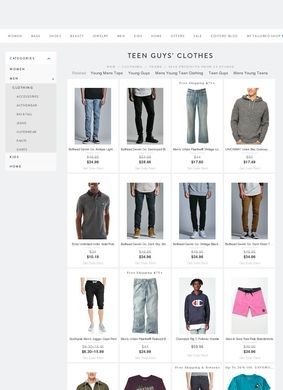
Type a price ceiling of forty dollars into the filter on this page and the feed reshuffles to hoodies, graphic tees and joggers from dozens of separate stores, all sitting side by side. That is the core of what Shop Style: Teen Guys Store does: it pulls apparel aimed at teenage boys out of hundreds of retailers and brands and stacks it into one scrollable list. Tops, T-shirts, jeans, pants, shorts, outerwear, activewear, swimwear and a run of accessories all appear together, and a shopper can narrow the view by brand, retailer, price band, size, colour and style without leaving the page.
How the aggregation works
Nothing here is sold by the platform itself. Click a product and the trail leads off to the original retailer's own checkout. Shop Style: Teen Guys Store is a comparison and aggregation layer, a place to scan a wide spread of options and then hand off to whoever stocks the item. For a teenager who knows roughly what they want but not where it is cheapest, or a parent trying to compare a dozen brands of jeans in one sitting, that pooling of inventory has obvious appeal. You see the breadth in one screen instead of opening fifteen tabs.
Filtering options
Filtering is where the model proves its worth or falls flat, and the controls here are reasonably granular. Brand and retailer filters matter on a feed this large, because without them an aggregated list of teen menswear from thousands of sources would be unusable. Pairing those with size and price means someone can box the results down to, say, a particular label's hoodies under a set budget. The catalogue itself reaches well beyond this one corner, covering men's, women's and kids' lines across a global pool of brands, so the teen guys view is one slice of a much larger machine.
ShopStyle affiliate model
There is a second business running alongside the shopping feed, and it is worth naming because it shapes how the site behaves. Shop Style: Teen Guys Store sits within ShopStyle, which operates an affiliate program called ShopStyle Collective for publishers, bloggers and influencers who earn commissions by linking to products. That means the outbound links are commercial, and the platform makes money when a click converts at the retailer. None of this is hidden or unusual for an aggregator, but it does explain the incentive structure: the site is built to move shoppers efficiently toward a purchase elsewhere.
Company background and safety
The parent ownership says something about the operation. Shop Style: Teen Guys Store runs under ShopStyle, which belongs to Dotdash Meredith and IAC, a sizeable media and shopping group. A separate UK edition operates at its own address for British shoppers, so the brand has scale and a real corporate backing behind it, not a one-person side project. Scamadviser, for what such automated checks are worth, flags the domain as legitimate and safe, which is a low bar but a reassuring one for anyone hesitant about clicking through to unfamiliar retail partners.
Customer reviews and ratings
Outside reputation is harder to read than the size of the company might imply. On Trustpilot's US profile the platform shows only five reviews with no aggregate score surfacing in search results. SmartCustomer lists fifteen reviews averaging three out of five, a middling figure that leans neither glowing nor damning. One third-party review blog cites a much larger pool, something like 2,500 Trustpilot reviews at 4.3 out of five, but that number could not be confirmed against the official Trustpilot data that came back, so it should be treated with caution. The honest read is that public feedback is limited and mixed, and a shopper would be wise not to lean on star counts as the deciding factor here.
Some of that scarcity is structural. When a site never takes a payment itself and never ships a box, customers form their strongest opinions of the retailer they were sent to, not the aggregator that routed them. People remember the store that shipped late. So the modest review count is partly a symptom of the business model, though it does leave anyone evaluating the platform with less to go on than they might like.
Contact visibility is the other soft spot. On the browsing and category pages there is no phone number, no postal address and no direct email in plain sight. A Help Center and a contact form are reachable through footer links, so a determined visitor can get a message through, but nothing is surfaced on the landing view itself. For a price-comparison tool this is less alarming than it would be for a merchant taking your money, since the actual transaction and any dispute land with the retail partner. Still, a clearer support route up top would close a small credibility gap, and its absence is the kind of thing a careful shopper notices.
Weighing it up, Shop Style: Teen Guys Store does the job it sets out to do. The aggregation is broad, the filters are practical, and the breadth of brands in the teen menswear feed is genuinely useful for comparison shopping. What a visitor should keep in mind is the handoff: every purchase, return and customer-service question belongs to the retailer on the far end of the link, and the affiliate model means the platform has a stake in that click.
Shop Style: Teen Guys Store gathers a large, filterable spread of clothing in one place and routes you outward to buy. The reviews are few and the rating is average, the support details sit a click below the surface, and the catalogue itself is wide and well sorted. Treating Shop Style: Teen Guys Store as a starting point for a search, a way to see the field before settling on a retailer, is the right mental model. Shop Style: Teen Guys Store delivers on breadth, which is the thing it is designed to do, and that part is genuinely useful.