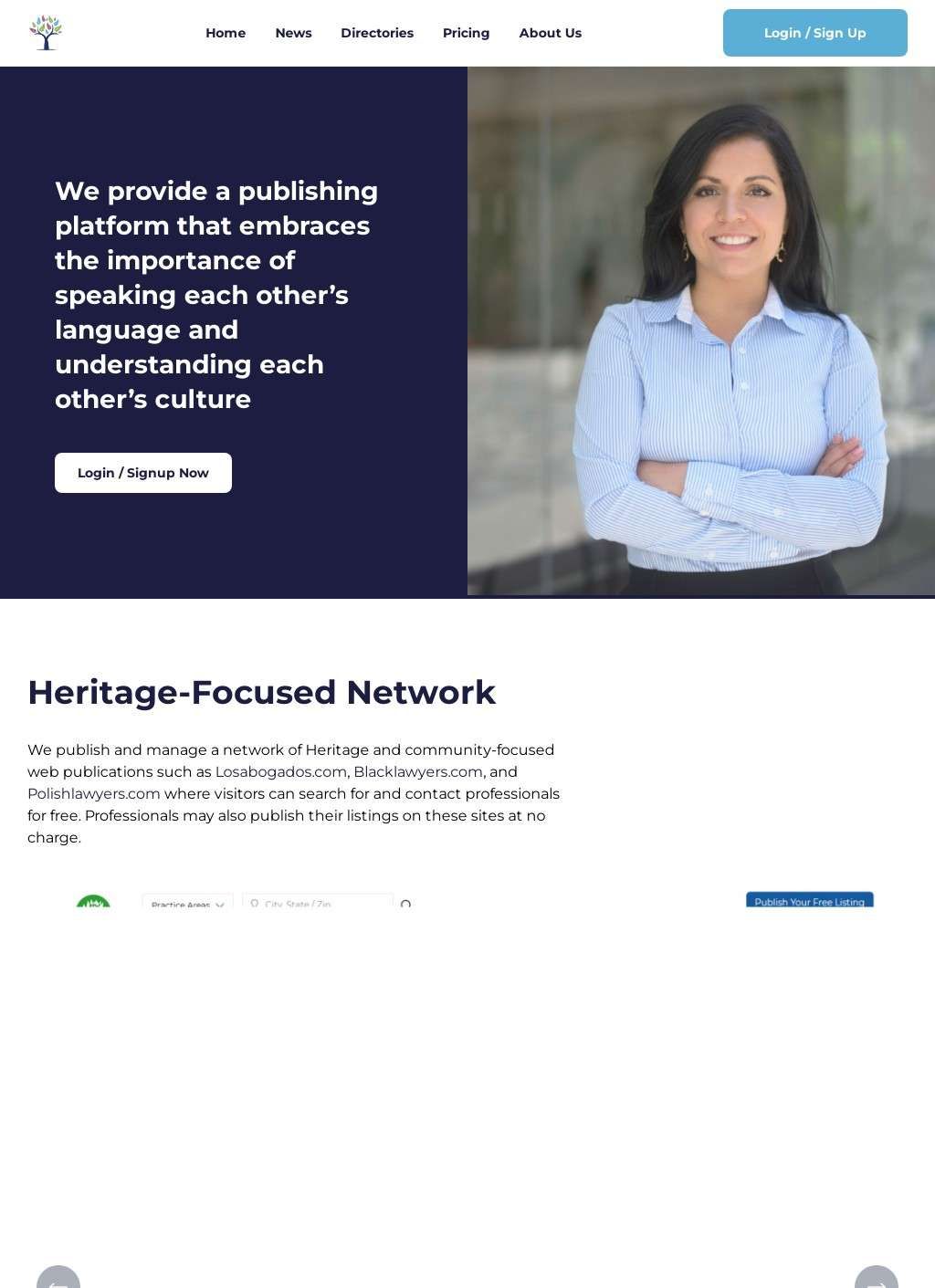
Finding a lawyer or therapist who understands where you come from can be a quiet ordeal. You want competence first, but you also want someone who will not need the back-story explained: the holiday you observe, the language your parents still speak at home, the assumptions you would prefer not to spell out in a first appointment. Heritage Web is built around that exact friction. It is a U.S. platform that pairs people with service providers who share their cultural background or language, and it organizes the whole experience around community instead of treating heritage as an afterthought tucked into a filter. That premise is simple to state and surprisingly rare to find executed with any seriousness, which is what made me look closer at how it delivers on it.
Directory of professionals across key service categories
The practical shape of Heritage Web is a directory of professionals across categories that matter when trust is on the line: lawyers, therapists, doctors, and residential real estate agents, with listings extending into job postings, events, and nonprofit organizations as well. The cultural framing is the spine of the site. You browse by community, and the list runs wide, covering Arab, Black, Chinese, Christian, Filipino, Indian, Iranian, Italian, Jewish, Latino, LGBTQ, Muslim, Native American, and Women, among others. Layered on top of that is geography, with coverage spread across more than fifteen major U.S. cities.
Browsing by community and geographic location
The two axes together let someone in, say, Houston narrow to a therapist who speaks their first language without wading through hundreds of irrelevant profiles. By keeping itself to law, mental health, medicine, and home buying, plus the surrounding context of jobs, events, and nonprofits, the site stays in the territory where shared background genuinely changes the quality of the relationship, and it avoids stretching into every trade where that would matter less.
Annual license verification against state agencies
What gives Heritage Web more weight than a typical listing site is the verification step. The platform says it runs annual license checks on every listed professional against the relevant state issuing agencies. That is a meaningful piece of housekeeping for the categories it covers, because law, medicine, and mental health are precisely the fields where an expired or revoked credential does real harm. A directory that simply collects names and never looks back at them ages badly.
A yearly check against the issuing body is the kind of unglamorous discipline that keeps a roster honest, and a platform that commits to re-checking people it already approved deserves more credit than one that does not bother. That habit is the strongest commitment the platform makes about how it sees its own role: not a passive bulletin board, but something with an ongoing duty of care toward the users it points at those professionals. Most general listing sites never adopt that posture.
Free profiles with optional paid upgrades
The business model is straightforward. Service providers can set up a profile for free, which lowers the barrier for smaller practices and solo practitioners who might not otherwise appear in a polished listing. For those who want more, paid lead-generation options are available, so the upgrade path exists without locking basic visibility behind a paywall. Around the main site sit a few supporting subdomains: a provider dashboard for managing a profile, a help center, and an affiliate program for anyone who wants to refer business.
Provider dashboard and affiliate program structure
A dashboard and an affiliate channel are the sort of plumbing you only build when you expect people to keep returning, and they hint that Heritage Web treats its provider relationships as ongoing accounts. Treating it as a business directory in the traditional sense would undersell it; the community-matching layer is what the platform is actually for.
Small team operating since 2011 from Dallas
Heritage Web has been around since 2011 and operates out of Dallas, Texas, with a small team in the range of two to ten people according to its LinkedIn profile. That headcount is worth keeping in mind: a staff that size can run a focused, well-curated platform, but it also explains why the catalog spans a defined set of cities and categories rather than blanketing the country. The scope feels deliberate, sized to what a lean operation can verify and keep current. A sprawling list nobody could realistically vouch for would be worse than a narrower one that gets checked.
Heritage Web has also stuck with a focused mission for well over a decade, which counts for something when so many community-oriented sites launch with enthusiasm and quietly fade within a couple of years. Longevity in a niche like this takes consistent attention, and the evidence here is that it has managed it.
Limited contact information on the homepage
On the matter of reaching the company directly, the homepage is sparse. No phone number, email, or mailing address appears when it loads. A help center exists on its own subdomain, so support is not entirely absent, though it sits a click away instead of being presented up front. The provider's own contact details are the ones that matter most to users in practice, so the absence of company-level contact info up front is a minor mark against transparency more than a dealbreaker. A visible contact route would buy a bit more confidence from first-time visitors.
Absence of third-party reviews or ratings
Outside reputation is the part of the picture that stays frustratingly blank. There is no third-party review profile for heritageweb.com itself: no Google, Trustpilot, or BBB presence turns up for the current entity. The Facebook page for Heritage Web LLC shows 246 likes but carries no visible star rating, and the broader social footprint (X, LinkedIn with around 110 followers, Instagram) is modest, which fits the size of the team.
There is a trap worth naming. A Yelp listing for "Heritage Web Design" out of Provo, Utah turns up in searches, complete with a couple of reviews and an old poor BBB grade, but that is a separate now-closed company with no connection to this platform. Anyone vetting Heritage Web should be careful not to let an unrelated namesake's history color their judgment. The absence of reviews on the platform itself is not a red flag, but it does mean there is no outside confirmation of how well the matching works in practice.
Strengths and limitations for users
Weighing it all up: the proposition is clear and genuinely useful, the verification routine is a real differentiator, and the free-profile model keeps the provider pool from skewing toward those who can pay. The weak spot is everything that would let an outsider independently confirm how well Heritage Web performs: no aggregated reviews, no ratings, no published track record beyond the platform's own claims. That gap does not make Heritage Web suspect, since plenty of small legitimate platforms have not accumulated a public review trail, but a first-time visitor is taking the verification promise largely on faith.
Verify credentials independently before choosing a provider
If you belong to one of the communities it serves and are in one of its covered cities, the cultural-and-language matching is something most directories cannot offer, and the annual license checks address the one fear that should worry you most in these categories. Use Heritage Web for discovery, confirm any individual provider's credentials independently, and treat it as a starting point rather than a final stamp of approval. On that basis, Heritage Web does enough right to deserve attention, even without a public reputation to back the claim yet.