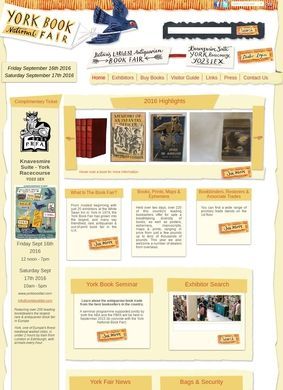
Admission to the York National Book Fair is two pounds at the door, and anyone under sixteen walks in free. For an event the organizing body bills as the largest antiquarian and rare book fair in the UK and Europe, that is a strikingly small gate fee, and it sets the register of the whole thing: a working marketplace for people who buy and sell old books, not a ticketed spectacle. The price alone tells you the money changes hands over the tables, not at the entrance.
The York National Book Fair fills the Knavesmire Suite at York Racecourse. A racecourse function room is an odd-sounding home for antiquarian books, but the practical logic holds. It is large, level, and easy to reach, with room for long rows of dealer tables and the foot traffic they pull. A venue built to move crowds on race days handles a busy book fair without much strain.
Two fairs a year at the racecourse
The York National Book Fair runs twice a year. The headline is a two-day September fair, open across a Friday and Saturday, and there is a separate, quieter one-day fair in January with its own catalogue of stock. Same organizers, same venue, different scale. The two-event rhythm gives collectors a second chance at the same dealers without waiting a full year between visits.
The website supports both with the material a visitor or a dealer wants ahead of time: highlights of books for sale, a visitors' guide with floorplans, exhibitor and dealer information, and a press section. Floorplans matter at a fair this size, where finding one specific dealer among the aisles is half the job, and publishing them in advance lets a serious buyer plan a route before setting foot in the hall.
The September fair and its January companion
September is the main draw and spreads over two days, with an afternoon start on the Friday and a full day on the Saturday. The January fair is a single day and a smaller affair, useful for anyone who cannot make the autumn trip or simply wants a second pass at the same dealers. Both rest on the same premise: physical second-hand and antiquarian books, sold by the people who actually know them.
For a collector, the difference is one of scale, not character, and the January catalogue means the smaller event is worth checking rather than dismissing.
The York Antiquarian Book Seminar for the trade
Wrapped around the September event is the York Antiquarian Book Seminar, a run of educational sessions aimed at booksellers, librarians, and collectors. This is the piece that separates the York National Book Fair from an ordinary sale.
A seminar for the trade points to an organization invested in the craft of bookselling itself, teaching it and sustaining it, well beyond the weekend business of moving stock across tables. It also signals that the people behind the fair see themselves as custodians of a trade, which is reassuring for anyone spending real money on rare stock.
What a day at the fair involves
The York National Book Fair site is unusually specific about the visitor experience, which counts for something when the decision is whether a trip across the country is worth it. Practical detail like this is what turns a listing into a plan.
Most fair websites stop at an address and an opening time, leaving the rest to guesswork on the day. This one answers the questions that actually come up on the drive over: how to get from the station to the door, what happens to a coat in a room full of dealer tables, and what a hungry visitor does at midday without losing their place in the hall.
Shuttle buses, cafe, and cloakroom
Free shuttle buses run from the Memorial Gardens coach stand every half hour, which quietly solves the racecourse parking problem for anyone arriving by train. Inside there is a ground-floor cafe with vegetarian, vegan, and standard options, a free cloakroom for bags and coats, and stated security procedures for books once you have paid for them.
None of this is glamorous. All of it is the sort of logistics that decide whether a long day among the stalls stays comfortable or turns into a slog, and the security note in particular is a thoughtful touch for buyers carrying fragile, valuable stock around a crowded hall.
Dealers, the trade area, and who turns up
The audience is broad: book dealers, antiquarian booksellers, collectors, librarians, and ordinary shoppers who just like old paper. Alongside the booksellers, a dedicated trade area welcomes exhibitors from the surrounding crafts, bookbinders and other book-related trades and software among them.
That trade presence is a telling detail, because it points at an event serving the whole ecosystem around books, the making and mending of them as much as their sale. A fair that makes room for binders and suppliers is one that treats books as objects to be kept and repaired, part of a living trade and not disposable stock.
Reputation and getting in touch
Outside verification is scarce, and it is worth being plain about what exists. The testimonials on the York National Book Fair's own site, including a quote credited to Rare Book Review and one from an exhibitor, are self-reported and promotional, so they mean about as much as any business's chosen praise does, which is not much on its own. The PBFA, the Provincial Booksellers Fairs Association that organizes the event, describes it as having grown over the decades into the largest and, in their words, friendliest such fair in the UK and Europe.
That comes from the organizer, not an independent judge, so it belongs in the marketing column. The Facebook page shows 1,347 likes and 139 people marked as having been there, which are engagement counts, not a rating. No Google, Trustpilot, Yelp, or Tripadvisor scores turned up in search at all.
Contact is workable if not lavish. An email address is published and a contact page sits in the navigation, so a dealer or visitor with a question has a clear route in. There is no phone number or street address on the pages reviewed, which for a twice-yearly event run by an association is a reasonable, if slightly bare, arrangement. Anyone needing a quick answer before travelling has one channel to rely on.
So the case for the York National Book Fair is a physical one: two pounds at the door, thousands of old books, real dealers to bargain with face to face, and a seminar for people who take the trade seriously. Weigh that against an evening scrolling AbeBooks from the sofa, where many of the same titles sit behind a search box with no shuttle bus and no cafe, and the decision narrows to one thing: whether handling the books in person is worth the journey to York.