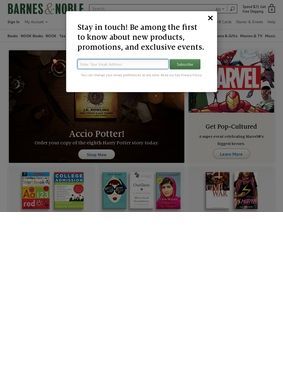
What can a shopper expect to find on the Barnes & Noble website beyond the obvious pile of novels? Quite a lot, as it turns out. The catalogue covers new books across every genre a general reader might want: fiction, nonfiction, children's titles, and textbooks all sit under the same roof. On top of the printed stock, the site sells NOOK e-readers and the e-books that feed them, so someone who prefers reading on a screen is served by the same account they use to buy hardcovers. That dual nature, a paper store and a digital one running in parallel, is the first thing worth understanding about how this retailer operates online.
Books organized for every reader type
The book side is organised the way a large seller has to organise it once the inventory runs into the hundreds of thousands. Bestsellers and New Releases give the casual browser a starting point. Signed Editions and Barnes & Noble Exclusive editions and collectibles pull in the readers who care about a specific printing, a particular cover, or an author's autograph, and those are the sort of items that hold value for people who collect rather than simply read. There is a Book Club area, including the B&N Book Club, for anyone who likes reading on a schedule with other people and picking up the monthly selection. It is a sensible way to keep regular visitors coming back without inventing a gimmick to do it.
Kids and students get dedicated sections
Parents and students get their own clearly marked corners. The Kids' section groups children's books so a parent is not sifting through adult fiction to find a picture book, and the Textbooks area addresses the practical, often expensive problem of course reading. Both of those categories reflect a real chunk of who walks into a Barnes & Noble looking for something specific, and putting them front and centre online mirrors how the physical stores already lay themselves out. Barnes & Noble knows these two groups shop under the pressure of a deadline or a birthday. A parent buying an educational title and a college student hunting for a required text are different shoppers with different urgency, and the site treats them as such.
Beyond books in the product mix
Not everything Barnes & Noble sells is a book, and the range beyond print is broader than some people remember. Magazines, DVDs and Blu-ray discs, toys and games, gifts, stationery, and journals all appear in the mix. In the physical locations there is also the Barnes & Noble Cafe, with its own menu of drinks and food, which turns a shopping trip into somewhere you might sit for an hour. The online store cannot pour you a coffee, but it does carry the merchandise side of that experience, so a visitor shopping for a birthday present or a nice notebook is not out of place here. This is closer to a general retailer with books at its centre than a pure bookshop.
Buying options across online and stores
The buying mechanics are where the size of Barnes & Noble actually pays off for a customer. Orders ship to your door, which is the baseline expectation, but the site also runs Buy Online, Pick Up In Store, letting a shopper reserve something and collect it from a nearby branch without waiting for a courier. A store locator ties the website to the national chain of physical shops, so the online catalogue and the bricks-and-mortar network function as one system instead of two separate businesses that happen to share a name. For anyone who wants a book today and lives near a location, that link between the two is the practical advantage over an online-only seller.
Membership discounts and shipping benefits
There is a paid layer sitting over all of this. The Barnes & Noble Membership charges a fee in exchange for discounts, free shipping, and offers reserved for members. Whether it earns its keep depends entirely on how often a given person buys, and the site is upfront that it is a subscription rather than a loyalty punch card you fill up for free. A heavy reader who orders several times a year will do the arithmetic quickly and probably come out ahead; an occasional gift-buyer may find the free-shipping threshold on ordinary orders does the job without paying anything. The program is a straightforward trade, and Barnes & Noble does not dress it up as more than that.
Taken as a whole, the Barnes & Noble offering is coherent in a way that many large retail sites are not. The genres feed the bestseller lists, the bestseller lists feed the book clubs, the exclusive editions reward the collectors, and the store locator drags the whole thing back into the physical world where the chain still has hundreds of shops. Students, parents, gift shoppers, and people who just want the new release everyone is talking about each have a clear path through the same catalogue. It is the sort of structure that only makes sense when a company has been selling books at national scale long enough to know exactly how its customers differ from one another.
Designed for the American market
The consumer base is squarely general and US-based, and Barnes & Noble makes no pretence otherwise. It is built for the American reader ordering to an American address, with shipping, in-store pickup, and a membership program all calibrated to that market. Someone outside the country can still browse the enormous catalogue and read about what Barnes & Noble stocks, but the pickup option and the store network are only useful if there is a branch within driving distance. That is not a flaw so much as a definition of who the website is for.
How breadth serves multiple shopping needs
What the catalogue does well is give a reader more than one reason to stay. A person might arrive for a single textbook and leave having also glanced at the signed editions, the toys for a nephew, and a journal by the register-equivalent. The breadth is genuine, and the digital and physical sides genuinely reinforce each other. For most people looking to buy a book in the United States, whether new fiction, a children's title, or a required course text, Barnes & Noble covers the request without much friction and offers a real store to walk into if the online version falls short.
Trade-offs of selling many product types
The open question is what all of that breadth costs the core. A site that sells NOOK devices, e-books, print, DVDs, toys, gifts, cafe fare, exclusive collectibles, and a membership plan is asking a single storefront to be many things at once, and the risk is that the reader who came for one carefully chosen novel gets routed through gift merchandise and subscription prompts on the way. Barnes & Noble has the inventory and the store network to back every one of those departments. Whether the whole holds together as a place to think about books, or whether the sheer number of things for sale eventually crowds out the quiet browsing that a bookshop is supposed to invite, is the part a visitor has to judge for themselves.