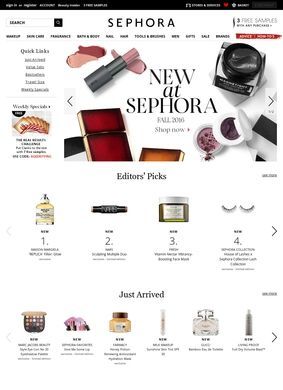
Type a product into the search bar on Sephora.com and within a few keystrokes you can be comparing a NARS foundation against a Charlotte Tilbury one, reading the shade range, scanning customer star ratings, and checking whether either ships free. That density of information on a single page defines Sephora Cosmetics. It is the official U.S. storefront and brand portal for Sephora, the prestige beauty retailer, and it puts the full catalogue in one place: cosmetics, skincare, haircare, fragrance, and the tools that go with all four. The point of the site is that you do not have to leave it to make a decision, because the comparison, the social proof, and the checkout all live in one place.
Comparing products across hundreds of brands
The brand list alone is the strongest argument for spending time here. Fenty Beauty, Urban Decay, Tatcha, Drunk Elephant, and hundreds of other prestige labels sit alongside Sephora Collection, the retailer's own private line, which tends to undercut the name brands on price while covering the same basics.
Someone hunting for a specific serum or a particular mascara is rarely stuck with one option. The product taxonomy goes deep: foundation, lip color, and eyeshadow on the makeup side, then moisturizers, cleansers, sunscreen, and serums under skincare, plus shampoos, hair treatments, perfumes, and bath products. It is organized by what you are trying to fix or buy, not by some internal warehouse logic. Sephora Cosmetics has had years to refine that structure, and it shows in how quickly you can move from a vague intent like "I need a tinted sunscreen" to a shortlist of five products with prices and reviews attached.
How the loyalty program works
The Beauty Insider loyalty program runs three tiers, Insider at the entry level, then VIB, then Rouge at the top, and each step up changes what you get: points that convert to rewards, earlier access to launches, and member-only perks. Free shipping kicks in for members and on orders above a set threshold, which counts when you are buying a single tube of something small. The loyalty structure is genuinely woven into how the site works, not bolted on as an afterthought.
Virtual try-on and consultation tools
Then there are the tools that try to solve the oldest problem in buying makeup online, which is that you cannot see it on your own face. The Sephora Virtual Artist uses augmented reality to let you try on shades through your camera, and the Beauty Advisor offers a virtual consultation when you want a human-style recommendation instead of guessing. Customer ratings and written reviews sit on the product pages, so the AR try-on and the crowd feedback work together. AR try-on tools can feel gimmicky, but for lip and eye color the preview is close enough to be useful before someone spends money on a shade they have never worn.
Connecting online shopping to physical stores
The site also keeps a "Happening at Sephora" section for events and masterclasses, which is where the online catalogue connects to the physical side of the business. Sephora Cosmetics runs over 500 stores across the U.S. and Canada, and those locations offer makeovers and skincare consultations in person. So the website is not a closed loop. It points you toward in-store services when a screen and a camera are not enough, and it lets you book or browse what is scheduled near you. That bridge between the website and the physical counters is one of the genuine strengths here, since most online beauty retail leaves you entirely on your own once the product arrives.
Curated gift sets and clearly marked sale sections round out the practical shopping experience on Sephora Cosmetics. The gift sets save the work of assembling a present from scratch, and the sale areas are easy to find without digging, which is not always true on large retail sites where discounts get buried. Sephora Cosmetics treats the sale section as a destination, not a hidden corner.
The catalogue also handles its audience range with some care. There is a dedicated section for men's grooming and a range of gender-neutral products, so the site is not built on the assumption that beauty shopping has a single audience. That breadth shows up in the brand mix as much as in the navigation. A shopper looking for a straightforward moisturizer and one chasing a niche fragrance both have somewhere to land. Sephora Cosmetics puts men's grooming on equal footing with everything else instead of treating it as a token category, and that decision reads as deliberate.
If there is a fair criticism of a catalogue this size, it is that the sheer volume can be overwhelming on a first visit. Thousands of products across hundreds of brands means the filters and the search do a lot of heavy lifting, and you need to use them. The site clearly knows this, which is why the recommendation tools and the tiered curation exist. Used well, the filtering turns the scale from a problem into the main advantage. Used carelessly, you can lose an hour scrolling.
Skincare and fragrance selections
The skincare range deserves a separate mention because it has grown well past being an add-on to the makeup business. Cleansers, serums, moisturizers, and sunscreen from clinical-leaning brands like Drunk Elephant and Tatcha fill out the section, and the customer reviews on those pages tend to be detailed, since skincare buyers care about ingredients and results over a span of weeks. For anyone building or revising a routine, that combination of brand range and honest written feedback is the reason to start here rather than going brand-direct. The single-brand sites can tell you only their own story, while Sephora Cosmetics sets a Drunk Elephant serum next to three competitors and lets the ratings do the arguing. That comparison view is hard to replicate anywhere a single label controls the page.
Fragrance is handled with similar seriousness. The perfume catalogue spans designer houses and niche makers, and the gift-set framing makes it one of the easier categories to shop for someone else. Sephora Cosmetics has clearly invested in making each vertical, makeup, skin, hair, and scent, stand on its own, with no one vertical treated as filler for the others.
What customer reviews reveal
Third-party reviews of Sephora Cosmetics are easy to find. Trustpilot and Google carry large volumes, and Sephora Cosmetics scores are mixed in the way you expect for a retailer at this scale: shipping delays and return friction come up alongside strong praise for the product range and the loyalty program. The complaints are standard retail complaints, nothing specific to the catalogue or the tools.
My overall read is that Sephora Cosmetics has built a portal where scale is a feature once you learn the filters, and a mild burden until you do. The loyalty program rewards people who return, the AR and consultation tools cut the guesswork that plagues online beauty buying, and the store network gives the digital experience a physical backstop. Few beauty sites combine that range with that level of supporting tooling. The learning curve is short, and the payoff for regular shoppers is concrete: points accrue on purchases you were going to make anyway, and the comparison tools save time that would otherwise go into bouncing between brand sites.