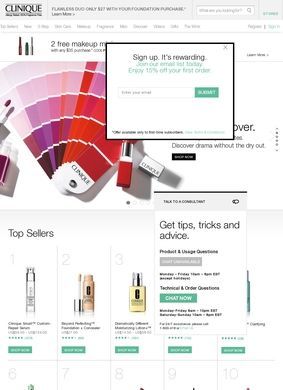
Clinique sells almost its entire range under one banner: allergy tested, 100 percent fragrance free, and dermatologist developed. That line, repeated across every section of the site, is the brand's oldest argument for itself, and it is the reason a shopper with reactive or easily irritated skin usually lands here before trying anything else.
The company belongs to the Estee Lauder group, which places Clinique among the bigger names in department-store cosmetics. The site itself reads as a plain storefront, split into skincare, face makeup, fragrances, and gifts, with on-site consultants offering tips and first-party product reviews attached to the category pages. The tagline the brand uses, "for every face, every day," sets the tone: broad, practical, built around daily routines instead of occasion or luxury.
Skincare built on the 3-Step system
Skincare is where Clinique began and where the site puts most of its weight. The pitch is dermatology-based: products organized by skin concern instead of loose categories, with the fragrance-free rule applied to every formula. A shopper picks by problem first, then by skin type, and the copy stays clinical the whole way through.
The audience is specific. This is a range built for people who read ingredient labels because they have to, and the everyday framing keeps it clear of luxury-ritual territory. On-site consultants sit next to the products to hand out expert tips, which nudges an unsure shopper toward a full routine instead of leaving them to piece one together alone. It is a sensible way to sell skincare to people who find the category intimidating, and it fits the plain, functional tone the brand keeps across the site.
The marquee example the site puts forward is a comforting cream moisturizer aimed at redness and barrier repair. It is a fair snapshot of how Clinique frames a product: a named concern, a matching formula, and the same tested-for-allergens promise stamped on the label.
The 3-Step Skin Care System explained
The centerpiece is the Clinique 3-Step Skin Care System, a routine split into cleanse, exfoliate, and moisturize. It is the signature framework, the thing most people recognize, and the site treats it as the front door to the rest of skincare. For a first-time buyer that structure does real work. Instead of guessing among a dozen serums, the three steps give a defined starting sequence, and the wider catalog hangs off it.
Whether three steps is enough for skin that needs targeted treatment is a separate question, and the framework can read more like a merchandising device than a diagnosis. As a starting point, though, it holds together, which is more than a lot of skincare sites manage.
A moisturizer for redness and barrier repair
The comforting cream moisturizer is positioned for people dealing with visible redness and a compromised skin barrier, which lines up cleanly with the sensitive-skin audience Clinique courts. Consistency is the real selling point. Someone who reacts to added fragrance can move across the entire skincare range without re-reading every ingredient list, because the fragrance-free standard holds from the cleanser through to the treatment creams.
That reliability is the practical value. A person shopping for reactive skin gets one rule to trust across the whole Clinique line, which is worth more than any single hero product. Redness and a compromised barrier are exactly the complaints that make people nervous about trying something unfamiliar, so a range that repeats the same fragrance-free promise from cleanser to night cream lowers the stakes of experimenting. That is the quiet logic holding the skincare catalog together, and it is a real reason the brand keeps the loyalty it does.
Makeup and fragrance under one roof
Past skincare, the site carries a full face makeup section, a fragrance line, and a gifts area, so Clinique works as a complete cosmetics store and not a single-category shop.
Face makeup covers foundation, lips, and eyes. The fragrance line sits a little awkwardly beside a brand whose skincare identity is built on being fragrance free, though the two live in clearly separate parts of the catalog. Gifts and promotional kits, including free gift-with-purchase offers, appear on the homepage, which is how the brand tends to pull shoppers toward a first order.
Face makeup powered by skincare
The makeup is described as oil-free and "powered by skincare," Clinique tying its color range back to the dermatological positioning that carries the rest of the site. Foundation, lip, and eye products form the core, with a limited-edition eyeshadow palette among the current releases. The claim that the makeup is itself a form of skincare is the brand's own, and a buyer should read it as marketing language until a specific formula backs it up.
The oil-free framing is the more checkable half of that pitch. For oily or acne-prone skin an oil-free foundation is a genuine advantage, and it follows the same sensitive-skin logic running through everything else Clinique puts on the page.
Fragrances, gifts, and limited editions
The fragrance and gifts sections round out the range. Limited-edition items and gift sets drive the homepage promotions, and the gift-with-purchase kits are a long-running fixture of how Clinique sells. None of this is unusual for a department-store cosmetics label, and the brand handles it the way regular shoppers will expect. The gift-with-purchase kit in particular is one of the oldest hooks in this corner of retail, and it still does the job of turning a browser into a first order.
Breadth is the takeaway from this half of the site. Skincare, color, and scent sit in one place, under one name, with the Clinique consultants and on-page reviews meant to steer the choice.
Where the claims come from
Much of what makes Clinique distinctive is self-described. "The original dermatologist-developed brand," "allergy tested," "100 percent fragrance free," "powered by skincare": each is the brand's own statement, printed on its own pages. That is normal for a manufacturer's storefront, and it does not make the claims false. It does mean the site is the seller talking, and the product reviews sitting on those category pages are hosted by that same seller. A business directory entry can point to the storefront and to what outside retailers carry, but it cannot referee claims that only Clinique itself has made.
The products sell well beyond this storefront, which helps a cautious buyer. Amazon carries the line, Bluemercury stocks it, and Ulta Beauty lists 214 Clinique products, so the range is easy to find and compare away from the brand's own pages. For an outside read on a specific item, that external availability does more work than anything on the homepage.
A shopper unsure about the moisturizer or a foundation shade can read what buyers elsewhere thought, then come back to the brand's own site to order, and the size of the Ulta catalog alone shows the range is widely stocked rather than a niche line.
The unresolved part is the distance between the promise and the proof. The fragrance-free and allergy-tested claims are exactly what pull the sensitive-skin shopper in, and they are also the claims a person cannot confirm from the page. "Allergy tested" carries no single fixed meaning across the industry, and Clinique does not spell out on these pages what its testing actually involves. The central pitch, the thing meant to separate the brand from an ordinary shelf of cosmetics, is the one part a visitor has to take on trust.