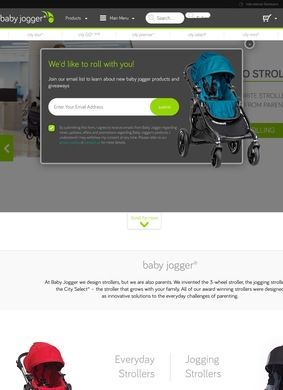
Baby Jogger offers a 100-day trial on strollers, which is an unusual commitment for a juvenile products brand and suggests real confidence in how the gear holds up under daily use. The brand sits under the Graco umbrella, itself part of Newell Brands, so it is a subsidiary of a publicly traded consumer goods conglomerate rather than an independent niche maker. That corporate backing shows in the breadth of the product range and the depth of the support infrastructure around it.
Stroller models for different parenting situations
The stroller lineup covers genuinely different use cases. The city mini GT3 addresses all-terrain needs, the summit X3 is built for running, the city tour 2 targets parents who travel with a compact fold, and the city select 2 handles two children. The city prix adds a bike trailer configuration. Beyond those flagship names, Baby Jogger also produces adaptive strollers for children with different mobility needs, and travel systems that pair a stroller frame with a compatible car seat so parents avoid the guesswork of mixing brands. The category coverage is thorough enough that most parents searching for a stroller will find a relevant model here.
Car seats that pair with stroller frames
Baby Jogger has moved beyond strollers into car seats, which matters if a family wants to keep one brand across both products. The city go 2 is an infant seat; the city turn is a convertible seat that takes a child from infancy through toddlerhood. The brand publishes compatibility charts and a matching tool on the site, which is genuinely useful because car seat and stroller adapter compatibility is one of the more confusing parts of shopping for juvenile gear. A parent can check whether a specific car seat clicks onto a specific stroller frame without having to read through forum threads or guess from photos.
Accessories that extend stroller life
Accessories round out the ecosystem: glider boards for older siblings, parent consoles, and the adapters needed to mix Baby Jogger strollers with third-party infant seats. This is not decoration. It extends the useful life of a stroller frame and reduces the pressure to buy an entirely new system when a second child arrives or when a toddler outgrows the seat insert.
Direct sales and financing options
The site sells direct and also points buyers toward local and specialty retail partners. Afterpay financing is available for direct purchases, which brings higher-priced models within reach for buyers who prefer to spread the cost. Product registration and warranty support are handled through the main site, and a help center at a separate subdomain covers order support and customer service. That separation keeps the purchase flow clean while giving support its own indexed space.
Comparing jogging heritage with urban design
The brand's identity as a jogging-stroller brand, established long before the current product range existed, gives the name a specific meaning for active parents even if the lineup has grown well beyond that original positioning. The summit X3 keeps that heritage with a three-wheel jogging frame, wrist strap, and hand brake, while the rest of the range serves parents whose needs are more urban or travel-oriented. Not every model shares the same philosophy. The city tour 2, for instance, is a lightweight single-piece fold aimed at air travel and tight storage, which is a different set of priorities from the GT3 or the select 2.
Testing strollers through the 100-day trial
The 100-day trial deserves more attention than it usually gets in product descriptions. For a stroller that costs several hundred dollars, a trial window that long means a parent can test it through different seasons or terrains before the return window closes. Baby Jogger applies this to strollers purchased directly through the site, and it puts the brand on the side of the buyer in a category where most purchases are made before a parent has held or pushed the product.
Modular double stroller for growing families
The double stroller category is where the brand has historically had a strong foothold. The city select 2 is a modular system that can be configured as a single or double and accepts different seat combinations, including an infant car seat in the second position. For families expecting a second child within a few years of the first, this modularity means the stroller can grow with the family. Baby Jogger built the original city select around this idea, and the second generation keeps the core concept while updating the fold mechanism and canopy coverage.
Baby Jogger publishes product specifications in enough detail that a careful buyer can compare wheel size, weight, folded dimensions, and canopy coverage across models before committing. The site does not bury this information behind a request form or a dealer locator. Weight and fold dimensions matter a lot in practice, and the spec pages allow side-by-side comparison without requiring a store visit.
The brand's position in the market is well-established. Baby Jogger is stocked by major retailers as well as specialty baby stores, which means a buyer who researches online can usually find a floor model to inspect in person. The compatibility tool and detailed spec pages make the research phase faster, and the direct-to-consumer channel with Afterpay and the 100-day trial gives buyers a reason to purchase without going through a third-party retailer. Both paths are covered without leaning entirely on one distribution model.
Across Amazon, Target, and Buy Buy Baby, Baby Jogger products carry thousands of verified reviews, which gives prospective buyers a large body of real-world feedback before deciding. The volume is useful in itself, and the ratings for the core models tend to cluster toward the higher end of the scale.
The range spans enough of the market that a parent does not need to go elsewhere when their needs change. A running-capable three-wheel frame, a narrow double for city use, a featherweight fold for flights: Baby Jogger has a specific product built for each situation, and the site makes it reasonably straightforward to find the right one.
Business address
United States