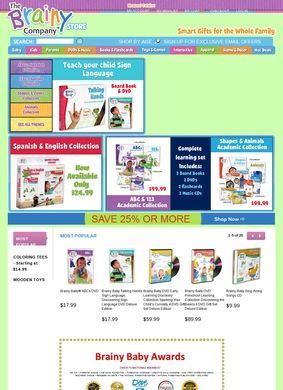
A parent of a two-year-old wants something to put in front of the kid that teaches letters and numbers without feeling like passive babysitting, and ideally something a four-year-old sibling can grow into. That is the exact gap The Brainy Store Company sets out to fill. It is the retail storefront for Brainy Baby, a US early-childhood brand whose catalogue runs from six months up through the five-plus range, sorted by both age and subject so a shopper can land on the right shelf instead of guessing.
Physical media and streaming options
The merchandise splits cleanly between things you hold and things you stream. On the physical side there are DVDs, board books, flashcards, puzzles, memory games, and music CDs. On the digital side The Brainy Store Company sells streaming video through Brainy Digital and Brainy TV, plus downloadable printable activity sheets that a parent can run off at home. That mix is worth noting because households differ: some still want a disc and a book on the shelf, others want a login and a tablet. Covering both is a sensible call, and the store does not force a choice.
Subject areas and specialized product lines
Subject coverage is broad in the way preschool material tends to be: the alphabet, numbers, colors, shapes, animals, art, music, and language. The Brainy Store Company also fans out into several sub-lines, including BrainyBooks, Baby's First Impressions, Bilingual Baby, and Small Fry Beginnings, pointing to a deeper back catalogue than the front page lets on. The bilingual line in particular is the sort of thing a specific family goes looking for and rarely finds bundled with everything else.
Preschool learning sets for homeschooling families
For homeschooling households there are bundled Preschool Learning Sets built around a Teach-Repeat-Review method. Whether that branded label means much will depend on the buyer, but the underlying idea (introduce, drill, revisit) is how small children actually retain material, so the structure is more than marketing dressing. A parent assembling a year of early lessons gets a ready-made spine instead of stitching loose products together one at a time.
Academic study and award history
The Brainy Store Company leans hard on heritage, calling itself a pioneer of the preschool educational DVD market. There is a real claim underneath the slogan: Brainy Baby products were studied at a university and the results published in the Journal of Children and Media, and the brand counts 77 product awards. A citation in a peer-reviewed journal is a stronger credential than the usual self-awarded badges, and it is the kind of thing a cautious parent can go and check rather than take on faith.
Building a verifiable record
I'd treat the 77-award figure as the softer of the two numbers, since product awards in this space come from a wide range of bodies with varying weight, but the combination of an academic study and a long award list does paint a brand with a genuine record, not a storefront that appeared last quarter. The DVD-pioneer framing also reads as a little dated now that the catalogue has clearly moved into streaming, though The Brainy Store Company has at least kept pace by building out Brainy Digital and Brainy TV alongside the discs.
Specific product details over vague claims
What The Brainy Store Company does well is keep the educational promise specific. It names subjects, names age bands, and ties products to a method. A shopper is not asked to trust a vague pledge about smarter babies; they are shown which product covers shapes for an eighteen-month-old and which set strings a preschool year together. That specificity separates The Brainy Store Company from the vague "developmental" labels plastered across half the toy aisle.
Customer reviews and contact methods
Reputation outside the brand's own walls is where the picture gets sparse. A search for thebrainystore.com turns up little: no body of independent customer reviews tied to the store itself, with results mostly pointing at other unrelated "Brainy" outfits. One coupon aggregator lists the store but shows no rating or review count, and a scholarship-deal site records zero customer reviews. That absence is not the same as bad word of mouth, and the Brainy Baby brand itself plainly has history behind it, but a buyer hoping to read a stack of recent verified purchase notes before checkout will not find them easily for this particular storefront.
Contact options sit in a similar middle zone. The Brainy Store Company runs a contact form, and the social presence is full: Facebook, YouTube, Instagram, Pinterest, and Twitter are all linked. What is missing from the homepage is a phone number or a physical address, so a customer who wants to call about an order is funneled into the form and a wait for a reply. For online toy and media orders that is workable, and the active social accounts give a second route for a quick question, but a visible phone line would reassure anyone nervous about handing over a card to an unfamiliar shop.
Reading subscription terms at checkout
One small practical note for the streaming side: subscription and digital-access products live or die on how clear the terms are at checkout, and that is worth reading carefully before buying, since the site does not surface pricing or renewal detail prominently. Nothing here flags a problem; it is simply the part of any digital storefront a parent should not skim.
Set against a giant like BabyFirst, the streaming-first educational service with a broadcast pedigree and a deep app, The Brainy Store Company looks narrower and a touch older in presentation, and it cannot match that kind of polished, all-you-can-watch platform. What it offers instead is ownership: physical discs, books, and printables a family keeps, a published study behind the method, and several niche lines (bilingual material especially) that the big streamers tend to skip. For a parent who wants a tangible, subject-organised preschool library and is comfortable using a contact form rather than a phone line, The Brainy Store Company is a credible place to shop, with the caveat that the wider review trail is sparse.