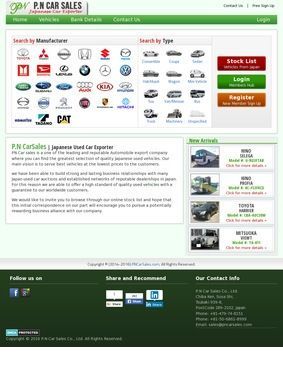
The whole operation runs out of a single address in Sosa-Shi, a quiet stretch of Chiba prefecture, and from there it ships cars to buyers who may never set foot in Japan. That is the first thing worth knowing about Used Japanese Cars, the export arm of P.N Car Sales Co., Ltd. It is not a showroom you walk into. Used Japanese Cars is a mail-order pipeline for Toyota, Honda, Nissan, Mercedes-Benz and a long tail of other makes, aimed at people abroad who want a Japanese vehicle without flying to a domestic auction to bid on one themselves.
What that means in practice is that the site lives or dies on two things: how easy it is to find a car, and how much you can trust a company you will only ever meet through a screen. On the first count the setup is straightforward. On the second, the picture is more mixed, and I will come back to why.
The inventory is the core of it. The site keeps a browsable stock list instead of a static gallery of a few hero models, and the list can be filtered two obvious ways: by manufacturer, so you can go straight to the Nissan or the Mercedes-Benz pages, or by body type, which is where it gets a little more interesting than the usual sedan-and-SUV split. Alongside passenger cars you get trucks, buses and machinery. That last category tells you who this is really for.
Plenty of overseas buyers are not shopping for a family runabout at all. They are sourcing a used tipper, a minibus for a transport business, or a piece of equipment that is cheaper to import second-hand from Japan than to buy new locally. A stock list that puts commercial vehicles and machinery on the same footing as saloons is quietly telling you it expects trade buyers as much as private ones. On that point Used Japanese Cars reads more like a wholesale channel than a consumer storefront.
How the buying process is set up
Importing a car sight-unseen is an act of faith, so the mechanics of how a site handles accounts, enquiries and payment matter more here than they would for a local dealer. Used Japanese Cars leans on a fairly conventional exporter template, and it is worth walking through the pieces because each one carries a bit of the trust load.
Member registration and login
There is an account system. You register, you log in, and from there you presumably track enquiries, saved vehicles or orders. For a one-off buyer this can feel like friction; browsing the full stock without signing up first would be the preferred route. But the login model makes sense once you remember the audience. A dealer in another country placing repeat orders wants a persistent account, a record of past purchases and a faster path to reserving a unit before someone else does.
Used Japanese Cars is clearly building for that returning buyer as much as for the person importing a single car for themselves.
The trade-off is that gating features behind an account can hide how deep the real inventory goes until you have committed some details. A first-time visitor has to take the breadth on trust to begin with.
Search by manufacturer and vehicle type
The two filters do the heavy lifting, and they are the right two. Manufacturer search is the natural entry point for anyone with a specific badge in mind, and the marque list is broad enough to cover the mainstream Japanese makers plus European names like Mercedes-Benz that turn up regularly in Japan's second-hand market.
Type search is the smarter one. Being able to jump straight to trucks or buses or machinery, without wading past hundreds of cars, is genuinely useful for the commercial buyer, and it is the feature that separates a real exporter's catalogue from a thin brochure of a dozen photos. It is also where Used Japanese Cars earns most of its practical value.
What a listing like this always hinges on, and what the site cannot fully convey from the outside, is stock freshness and the honesty of each vehicle's condition report. Grades, mileage, auction sheets and inspection notes are where these transactions succeed or fall apart. The filtering gets you to the right shelf. The individual listings are where a buyer has to do the real due diligence.
Banking details and payment
Payment for an imported vehicle almost always means an international bank transfer, and Used Japanese Cars puts its banking details out in the open for exactly that. On the plus side, published account information is what a serious cross-border seller needs; you cannot wire six months of savings to a company that hides how to pay it. On the other side, an open invitation to send money abroad is precisely the arrangement that demands the most care from a buyer, because a wire, once sent, is gone.
None of that is a mark against the company by itself. It is simply the shape of the business. What it does mean is that a cautious buyer should treat the payment step as the moment to slow down, confirm the account is genuinely the company's, and get every term of the sale, shipping and inspection in writing first.
Which brings the whole thing back to trust, and here there is not much to go on. I went looking for what other people say about Used Japanese Cars and came up largely empty: searches surface the company's own pages and a crowd of unrelated Japanese used-car exporters, but no clear body of independent reviews, ratings or customer accounts tied specifically to this seller.
That is not proof of anything bad. Japan's used-export trade is enormous, fragmented, and full of small firms that do steady business without ever setting up a Trustpilot page. Still, when you are wiring money overseas, an untraceable track record is a real gap, and an honest reader should weigh it rather than wave it away.
Contact information, at least, is a genuine strength and does something to offset that. The site does not hide. There is a full street address in Chiba, two separate phone numbers including an international line, an email, a proper contact form, and a Facebook presence on top. A company that publishes a fixed physical location and more than one way to reach a human is easier to take seriously than one operating from behind a single web form.
For a buyer thinking about a large transfer, being able to phone Japan directly and speak to someone ahead of any payment is worth as much as anything on the stock pages.
So where does that leave Used Japanese Cars overall. The offering is coherent and built for its job. The catalogue is filterable in the ways that matter, the commercial and machinery stock signals a real exporter rather than a hobby site, the account system suits repeat trade buyers, and the contact and banking transparency are what you want to see from a firm asking for money across borders. The one weak spot is the missing independent reputation, and that weak spot happens to sit in the most sensitive part of the deal.
An overseas dealer or trade buyer who already knows the Japanese export game, understands auction grades, and is comfortable arranging their own shipping and inspection has enough on the Used Japanese Cars site to make a direct enquiry: call the Chiba number and ask for a current auction sheet and condition grade on a specific unit before anything else. A first-time private importer with no prior experience of buying a car from Japan needs a slower approach.
Testing how responsive and specific the answers are through the contact form or phone, insisting on third-party inspection, and only then weighing whether the price and the reassurance line up is the safer order of operations, given how little outside evidence exists to lean on in the meantime.
Business address
P.N Car Sales Co., Ltd
Tsubaki 939-8,
Sosa Shi,
Chiba Ken
289-2102
Japan
Contact details
Phone: +81-479-74-8151
Fax: +81-50-6861-8999