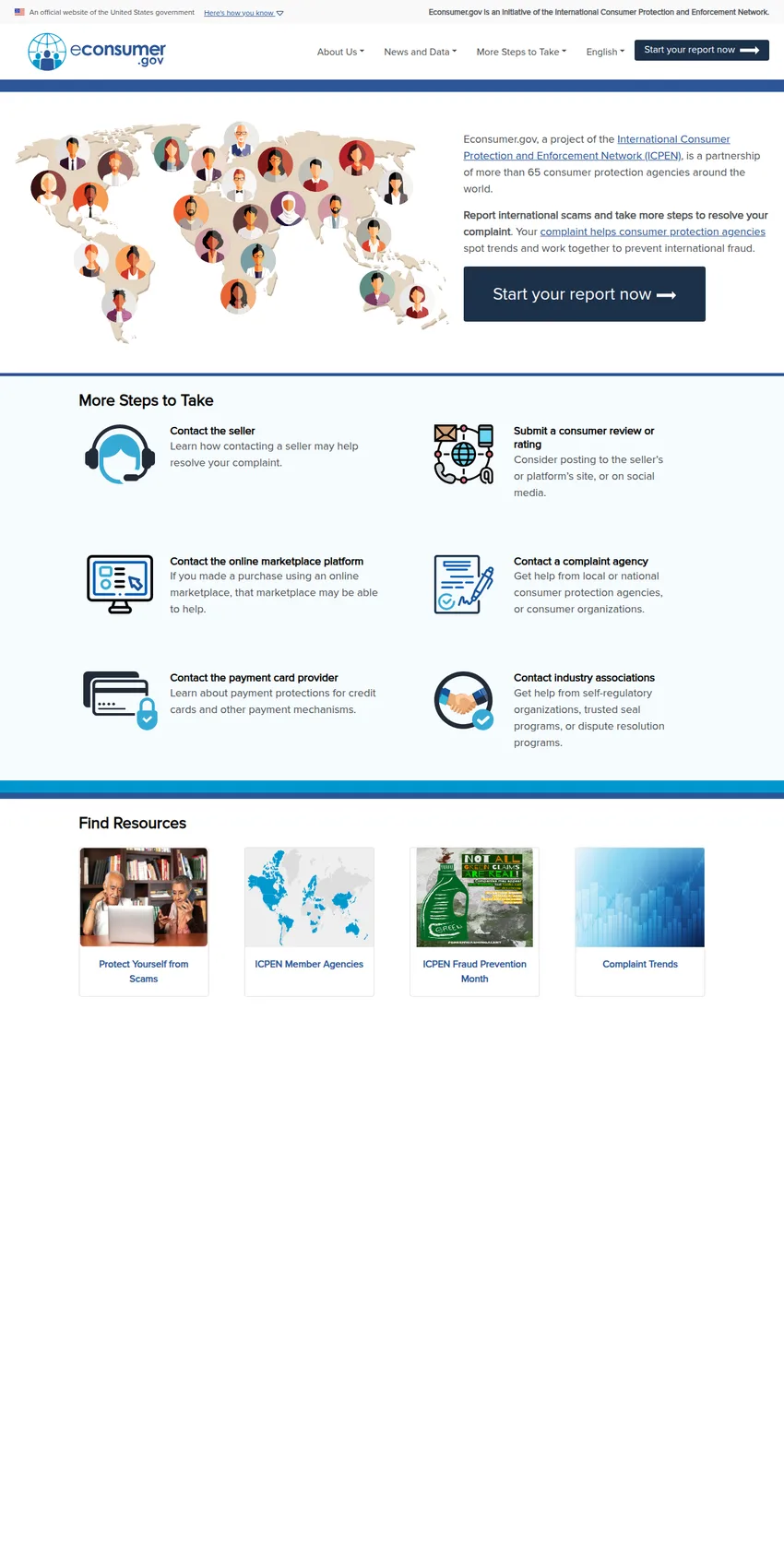
What econsumer.gov is
Econsumer.gov is a public complaint portal for cross-border consumer problems. It is operated by members of the International Consumer Protection and Enforcement Network, usually shortened to ICPEN, and the United States takes part through the Federal Trade Commission. The site was launched in 2001. Its purpose is narrow and practical: it collects reports from people who bought something, or tried to buy something, from a business located in another country, and it routes that information to the agencies that can act on it.
The portal is not a search engine for company reviews, and it does not settle individual disputes or recover money for the person who files. It is a reporting channel. When a shopper in one country is defrauded by a seller or website based in another, the ordinary domestic complaint route often stops at the border. Econsumer.gov exists to carry that report across the border to a partner authority that has jurisdiction over the trader.
Consumer protection agencies from more than thirty other countries take part alongside the FTC. The site is available in eight languages, among them English, French, German, Japanese, Korean, Polish, Spanish, and Turkish, which reflects the international audience it is built for.
How complaints move toward enforcement
A report filed on econsumer.gov does not sit in isolation. Each submission is entered into the Consumer Sentinel Network, a secure database maintained by the Federal Trade Commission, where it becomes available to participating enforcement bodies in member countries.
The Consumer Sentinel connection
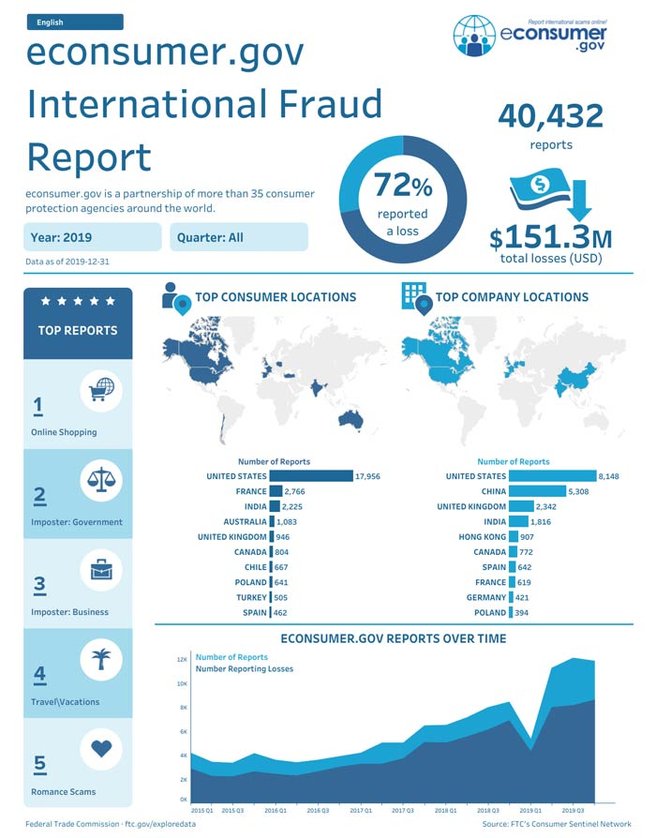
Consumer Sentinel is the mechanism that gives the portal its value to investigators. Single reports rarely trigger action on their own, but patterns do. When dozens or hundreds of consumers describe the same website, the same payment handler, or the same unfulfilled offer, the aggregated data helps agencies identify a scheme, measure how much money is involved, and decide whether to open a case. Regulators use the information to spot emerging fraud, to support cross-border investigations, and to track how complaints shift over time. In 2019 the portal received 40,432 reports, with stated losses above 151 million dollars, which gives a sense of the volume that flows through the system in a single year.
Online shopping and auction reports
Online shopping complaints consistently rank at the top of the reports the portal receives. These cover merchandise that never arrived, products that did not match their description, and refunds that were promised but never paid. Online auction problems fall inside this same group. A consumer who bids through a foreign auction site, pays, and then receives nothing, or receives an item worth far less than expected, is describing exactly the kind of transaction the portal was built to record.
Relevance to bidding-fee and penny auctions
Penny auctions, also called bidding-fee auctions, add a layer of risk that ordinary shopping does not carry. On these sites a bidder pays a non-refundable fee for each bid placed, and the final price shown is only part of what participants actually spend. A person can lay out a large sum in bid fees and still walk away with nothing, because the fees are charged whether or not the bidder wins. When the operator is based abroad, is hard to identify, or disappears after collecting fees, the consumer is left with few domestic options.
This is where a cross-border reporting channel matters. A shopper who loses money on a foreign bidding-fee platform can file the details on econsumer.gov, and the report reaches authorities in the country where the operator is registered. The form asks the person to document:
- the identity and location of the auction operator, so far as the consumer knows it;
- the amount paid in bid fees and any final purchase price;
- the payment method used, which often becomes the thread investigators follow.
What the portal does and does not do
It helps to be clear about scope. Filing on econsumer.gov does not guarantee a refund, and it does not produce a ruling on any single complaint. The site is a data-gathering and referral tool, not a court or an arbitration service. Its strength is collective. Reports accumulate, patterns surface, and agencies with authority over the trader decide what to do with them. For a consumer weighing whether a penny-auction site is trustworthy, the same portal publishes trend information and consumer education material drawn from what earlier reports have revealed.
For the Penny Auctions category, econsumer.gov functions as a reference point rather than a marketplace. It sits alongside the auction listings as the official place to report a cross-border problem, and as a source of the complaint data that helps separate a legitimate bidding-fee operator from one that has drawn repeated reports. The ICPEN network behind it, whose own website is maintained by the United Kingdom Competition and Markets Authority, ties the national agencies together so that a single report can inform action well beyond the country where it was filed.



Business address
Federal Trade Commission (econsumer.gov / ICPEN)
600 Pennsylvania Avenue NW,
Washington,
District of Columbia
20580
United States
Contact details
Phone: +1 202-326-2222