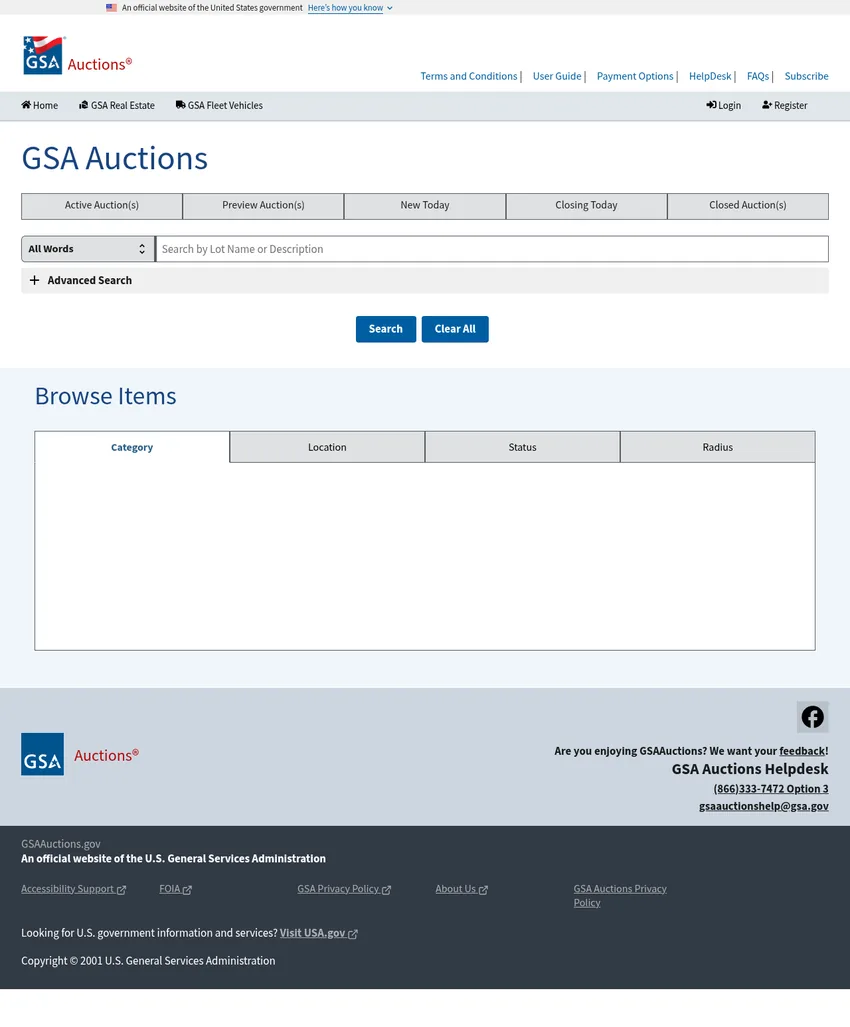
GSA Auctions is the online sales platform of the United States General Services Administration, the agency that handles procurement, buildings, and property management for the federal government. Through the site, members of the public bid electronically on surplus and forfeited federal personal property held at facilities across the country. The Federal Acquisition Service runs the program, and anyone with a computer and a registered account can take part.
How the sales program works
Federal property moves through a fixed sequence before it reaches a public auction. When an agency reports equipment it no longer needs, the property is first offered for transfer to other federal agencies, then for donation to state agencies and eligible public organizations. Only property that clears both stages without a taker is put up for sale to citizens.
GSA is direct about expectations. There are no giveaways, and stories about yachts or exotic cars sold for a hundred dollars are fiction. The agency answers to taxpayers for the return it gets, so competitive bidding is expected to produce a fair market price. Many lots still sell well below retail replacement cost, but the price is set by the bidders, not by a discount schedule.
Each auction runs for a stated period. Registered bidders raise the price against one another until the posted closing time, and when the auction closes the highest bid takes the lot.
Property types and locations
The catalog covers personal property in the legal sense, meaning movable goods rather than land or buildings. Common categories include:
- Office furniture, computers, and communications equipment
- Laboratory instruments and medical apparatus
- Shop tools, generators, tractors, and heavy machinery
- Sedans, trucks, buses, and other fleet vehicles
- Aircraft, vessels, and trailers
Lots are stored at federal installations in every region of the country and in United States territories. A listing names the exact holding location, and the buyer is the one who must travel there, first to inspect and later to haul the purchase away.
Inspection before bidding
Everything sells as is and where is. GSA discloses deficiencies it knows about before the sale, but it does not guarantee condition, completeness, or fitness for any purpose, and it accepts no responsibility for problems identified after the hammer falls. The agency itself encourages inspection during the preview period shown in each listing. For vehicles and machinery in particular, an in-person look is the only dependable way to judge wear, missing parts, or storage damage.
Registration and bidding
Bidding requires a free account. The registration form asks for a name, postal address, email address, and tax identification number, and the system sends a confirmation email once the details check out. No business license, dealer status, or government connection is required, which distinguishes these sales from some other federal disposal channels.
Items are offered singly or grouped into lots, and a registered user may bid on any number of open auctions within the posted time frames. Award notices go out after closing with instructions for payment.
Terms that govern each sale
Sales follow Standard Form 114C, the government's General Sale Terms and Conditions, dated April 2001. Individual offerings can add special terms, and notices posted for a specific sale carry the same weight. GSA advises studying the terms in the invitation for bid before placing a first bid, since the conditions bind the buyer whether or not they were read.
Payment, removal, and default
Accepted payment methods include wire transfers through Fedwire or ACH, checks issued by federal, state, or local governments, and MasterCard, Visa, Discover, and American Express cards processed through the Department of the Treasury's electronic payment service. Credit card purchases are capped at $24,999.99 and limited to one card per transaction. Personal checks, bank drafts, and PIN-based debit cards are not accepted. The government provides no financing of any kind.
Payment comes before removal, never after. Buyers must collect their property within the deadline stated for the sale, supplying their own labor, rigging, and transport. Nothing leaves the holding site until the money has cleared.
Missing the deadline has a defined cost. If a buyer fails to pay for and remove merchandise on time, the government collects damages: the full award amount when the award is under $325, a flat $325 fee for awards between $325 and $100,000, and five percent of the award above $100,000.
Where to get help
Sales Contracting Officers in the GSA regional sales offices walk buyers through payment arrangements, wire transfer logistics, and removal scheduling for specific lots. General questions about the program or the website go to the agency's National Customer Service Center, which operates by phone, chat, and email through the week. Contact details for the sales office responsible for a given item appear in that item's listing, and buyers arranging electronic funds transfers are told to coordinate with that office before sending payment.
GSA publishes short instructional videos on finding and bidding on property, and some sales are also announced through the government's contracting opportunity portal. For a private buyer, though, the auction site itself remains the single place where registration, search, bidding, and award all happen, and checking it on a regular schedule is how repeat buyers catch the short-notice lots.



Business address
U.S. General Services Administration
1800 F Street NW,
Washington,
DC
20405
United States
Contact details
Phone: (800) 488-3111