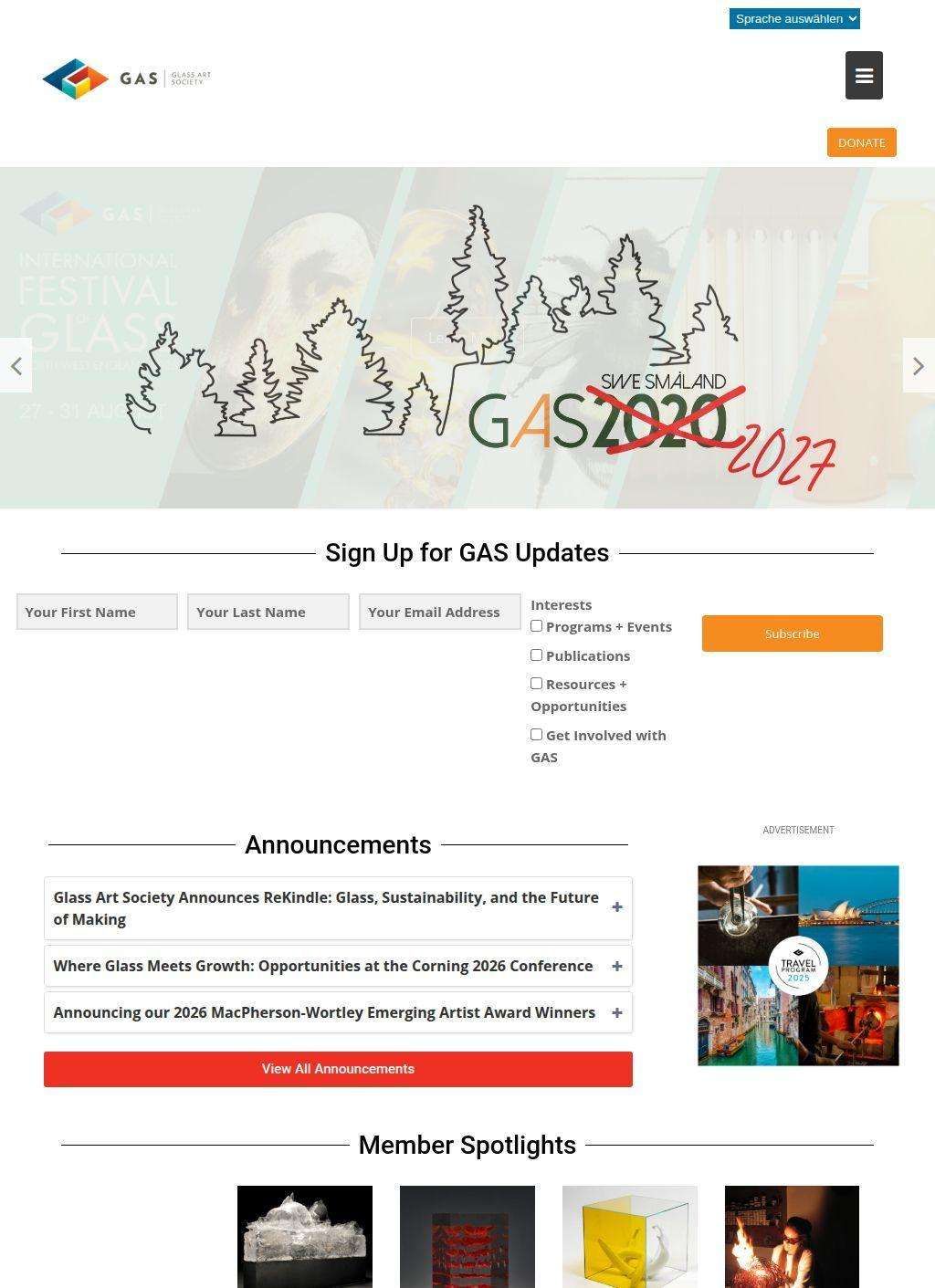
Glass Art Society, usually shortened to GAS, is an international nonprofit membership organization for people who work with glass as an art material. It was founded in 1971 at the Penland School of Crafts by Fritz Dreisbach, Mark Peiser, and William Bernstein, three artists who decided after the first gathering that a formal organization was needed. The group is registered as a 501(c)(3) and is headquartered in Seattle, Washington, a city that became a center of American studio glass.
Membership across roles and countries
The membership is the organization, in a real sense. GAS counts roughly 2,700 members across many countries, and they are not all artists. The rolls include educators, students, collectors, gallery and museum staff, art critics, and manufacturers who supply the tools and raw materials. The stated aim is to connect, inspire, and empower the global glass community, and to encourage excellence and education in the field. Bringing those different roles into one body is part of what the society is for, because a working glass studio depends on all of them.
Annual conference with demonstrations
The annual conference is the most visible thing GAS does. Each year the society holds a multi day meeting in a different host city, with the first truly international conference taking place in Toronto in 1989. The program includes live demonstrations by invited artists, technical lectures, panel discussions, exhibitions, and a trade show where equipment and material suppliers present their products. For many members the conference is the one time each year they can watch leading makers work and compare techniques in person.
Publishing the field's history
Publishing has been part of the society almost from the start. What began as the GAS Newsletter in 1976 grew into a regular journal, and the organization also produces GASnews, which carries stories, opportunities, and developments from across the glass world. The conference proceedings and journals form a record of how the field has changed over decades, and back issues are a useful source for anyone researching the studio glass movement or a particular artist's career.
Member resources and directories
Beyond the conference and publications, GAS maintains resources that members use throughout the year. These include directories of members and programs, listings of educational opportunities, technical information, and notices of grants, residencies, and jobs. The society also administers awards and recognition for contributions to the field. For a student trying to find a school or a residency, or an artist looking for a teaching post, these listings function as a focused business directory for the glass profession, narrower and better vetted than a general search.
Connecting students with mentors
The society's education mandate is broad. It supports the teaching of glass techniques, helps connect students with schools and mentors, and promotes the appreciation of glass art among the wider public. Because the membership crosses so many roles, a student can reach working artists, a collector can reach scholars, and a manufacturer can reach the makers who use their products. That cross connection is harder to find through commercial channels, which tend to separate buyers from sellers rather than join a whole community.
Authority in glass education
Why treat GAS as authoritative. It is a long established nonprofit run for its members rather than for profit, its leadership comes from within the field, and its conferences and publications are referenced across glass education and scholarship. The organization does not sell art or take a commission on sales, so its directories and recognition carry weight precisely because they are not tied to a transaction. When a curated business directory lists glass organizations, GAS belongs in it as a membership body that represents the practicing field rather than any single studio or shop.
The society is reachable in the ordinary ways. Its offices are at 700 NW 42nd Street, Suite 101, Seattle, Washington, 98107, and the main phone line is (206) 382-1305 during weekday business hours on Pacific time. The website at glassart.org carries membership details, the current conference program, the resource directories, and the publication archive. Membership is open to anyone with an interest in glass, not just to professional artists, which keeps the organization accessible to newcomers. A teacher, a hobbyist, or a researcher can join on the same footing as a full time maker.
For someone outside the glass world trying to understand it, GAS offers a clear entry point. The history pages explain how the studio glass movement developed, the member directory shows who is active and where, and the conference archive records what the field has been discussing. For someone already inside it, the same organization is a professional home, a place to publish, present, find work, and meet peers.
The geographic reach is genuinely international despite the Seattle base. Conferences have been held in cities across North America and abroad, members live on several continents, and the publications cover work from many countries. That breadth is deliberate. The founders set out to serve glass art worldwide rather than one national scene, and the organization has kept that orientation as the field has grown and spread.
Business address
Glass Art Society
700 NW 42nd Street, Ste 101,
Seattle,
Washington
98107
United States
Contact details
Phone: (206) 382-1305