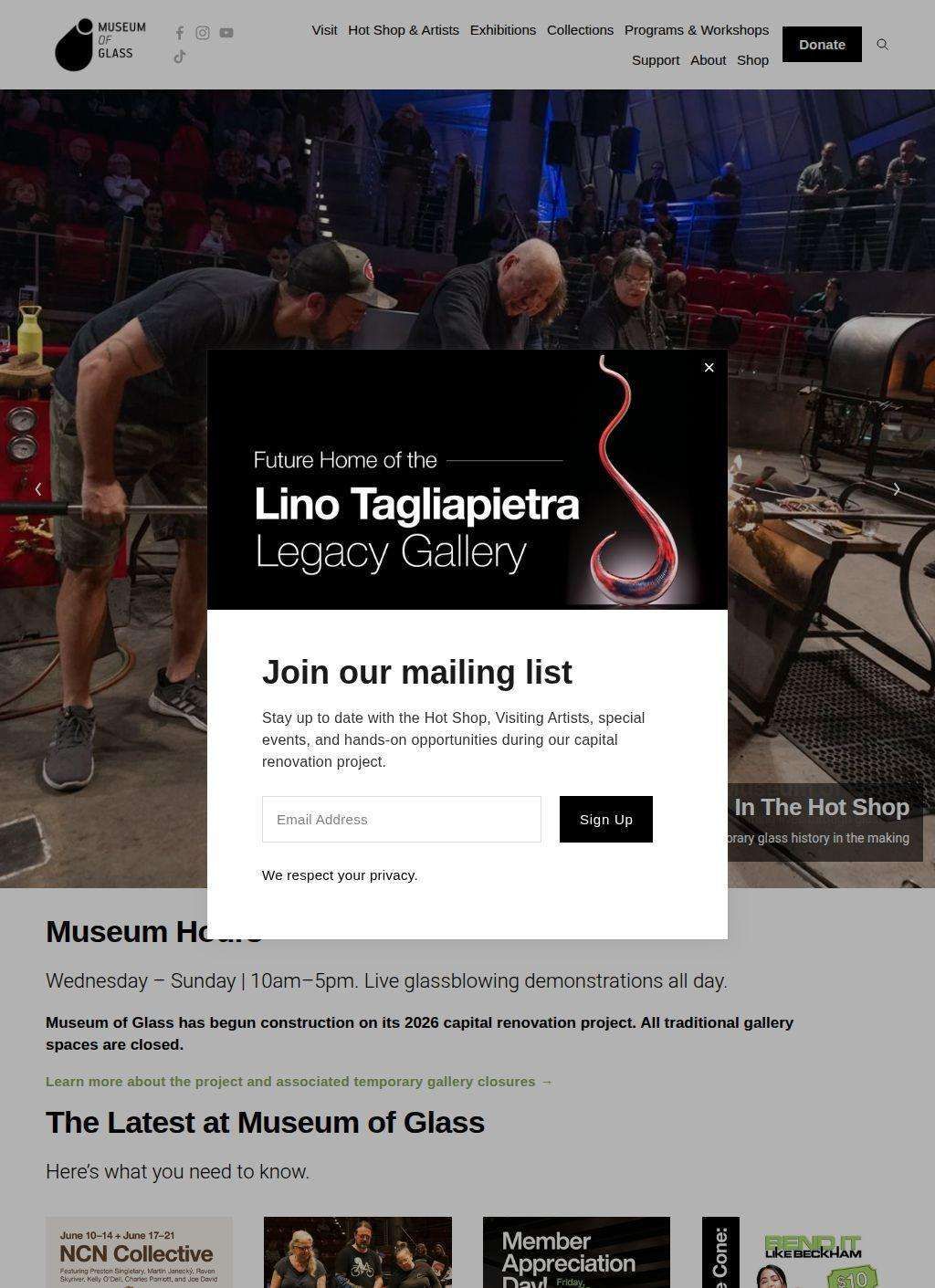
Sitting on the Tacoma waterfront at 1801 Dock Street, the Museum of Glass is a contemporary art museum built around studio glass and the people who make it. Its permanent collection traces the Studio Glass movement, but the thing that sets the place apart from a quiet room of vitrines is the Hot Shop, where visiting artists work molten glass in front of whoever happens to be there during operating hours. That live element is the spine of the visit, and most of what the museum programs flows outward from it.
Hot Shop residencies bring rotating artists
The Hot Shop is more than a viewing platform. Through the Visiting Artist Residency Program, glassmakers come from around the world for stints running anywhere from a single day to a full week, so the work on the bench changes as the calendar turns. Go twice in a season and you are likely to catch different hands and different pieces in progress. That rotating cast is more interesting than a fixed display would be, because the demonstrations are never quite a rerun. The artists are doing real commissions and experiments, not a scripted loop for tourists.
Programming builds engagement beyond the furnace
Around the furnace, the programming is broad and clearly aimed at keeping people engaged beyond a single walk-through. There are hands-on workshops where visitors make glass art themselves, evening events with names like "Forged in Fire" and "Movies in the Cone," and a strong push toward younger audiences through Kids Design Glass and the Junior Curator Academy. Docent-led gallery tours and outdoor walking tours fill in the context, and the Museum of Glass actively runs school and group field trips, which fits a place that treats its craft as something to be taught rather than only admired. The range is wide without feeling padded; each piece of programming serves the same basic mission of getting people closer to how glass is actually made.
Renovation closes traditional galleries until 2026
Anyone planning a trip needs to weigh one significant caveat. The traditional gallery spaces are closed through roughly fall 2026 as part of a capital renovation, so the standing exhibitions are not fully available right now. That is not a small footnote. A museum trading on its permanent collection while large parts of that collection are behind construction is asking visitors to come mostly for the live work and the grounds, and it is worth knowing that before you drive in.
Tagliapietra gallery set to open in 2026
The payoff for the disruption is the Lino Tagliapietra Legacy Gallery, scheduled to open in fall 2026 with 175 works by the Venetian maestro. Tagliapietra is about as serious a name as studio glass has, and a permanent gallery devoted to that many of his pieces is a real reason to plan a return visit once it opens. So the calculus depends on timing: a trip during the closure gets considerably less gallery content, while a trip after the reopening gains a major new draw. The Museum of Glass is fairly upfront about this on its own pages, which I appreciated.
Support services keep the museum running
Beyond the art, the site lays out the practical machinery of a working cultural venue. There is a Museum Store that runs both online and on-site, a cafe operated by Sliced Sandwiches, and private event rental spaces for people who want to host something against the glass-art backdrop. Membership tiers, an annual Red Hot Auction and Gala, and a capital campaign giving track round out the support side. None of this is unusual for a museum of this scale, but it is presented cleanly and tells you the institution is funded and run like a going concern, not a hobby project.
Reviews highlight live demonstrations and scenery
On outside reputation, the Museum of Glass comes out well. It carries a Travelers' Choice award on Tripadvisor, drawing from a few hundred reviews, which puts it in the top tier of properties there. Yelp shows a comparable review count alongside more than a thousand visitor photos, which says something about how photogenic the Museum of Glass is in person. WhichMuseum singles out the waterfront setting and the outdoor installations, including Dale Chihuly's Bridge of Glass, which connects the museum to the wider downtown art walk. Individual reviewers tend to call out the live demonstrations, the gift shop, and the cafe as highlights. A recurring honest note is that the Museum of Glass is fairly compact, and a few visitors clearly expected something larger, though nobody seems to walk away feeling cheated.
Contact details and operating hours
Contact information is easy to find, a phone number, email address, and full street address all sitting in the open, with operating hours listed as Wednesday through Sunday, ten to five. Given that hours and gallery availability are in flux during the renovation, having that contact layer accessible saves a wasted trip.
Weighing the closure against the payoff
Pulling it together: the core attraction at the Museum of Glass, watching skilled artists shape molten glass in real time, is genuinely distinctive and not easily replicated elsewhere. The Museum of Glass runs that experience consistently well. The education and youth programming give the institution depth beyond a single afternoon. The honest hesitation is the renovation itself.
Until the galleries and the Tagliapietra space reopen, visitors are paying for a partial experience, and the compact scale some reviewers mention only sharpens that during the closure. This is a strong stop for people in Tacoma now, especially those with kids or a real interest in craft, and a much stronger one after the new gallery opens. The Museum of Glass deserves credit for being clear about the timeline instead of burying it, and that transparency is probably the most reassuring thing about booking a visit right now.
Business address
Museum of Glass
1801 Dock Street,
Tacoma,
Washington
98402
United States
Contact details
Phone: (253) 284-4750