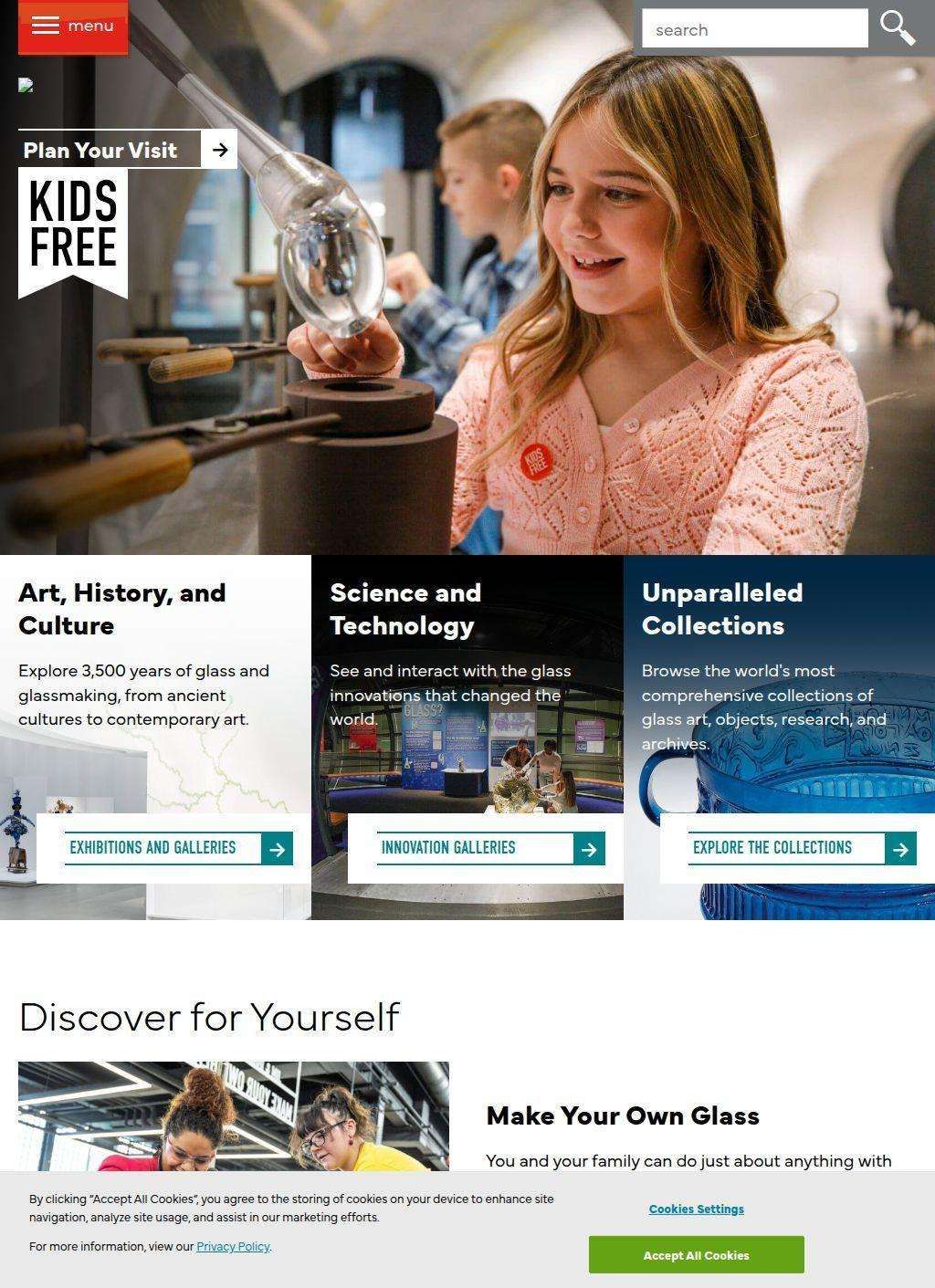
How much glass can one museum reasonably hold, and why would a person plan a whole trip around it? The Corning Museum of Glass answers both questions with a collection that reaches back roughly 3,500 years, from ancient vessels through scientific instruments to contemporary studio pieces. It calls itself the largest glass museum in the world, and the breadth on display backs that up. This is not a single themed gallery padded out with gift-shop trinkets. It is a sprawling institution in Corning, New York that treats glass as art, as science, and as industrial history all at once, and gives each of those threads real room.
From ancient vessels to modern sculpture
The permanent and rotating exhibitions run across art glass, scientific glass, and the industrial story of how glass got made and used over centuries. A visitor moving through the galleries can go from delicate Roman and Islamic objects to optical and laboratory glass to large modern sculptures, an arc that few specialist museums attempt.
How does science shape the collection?
The science material matters here because Corning Incorporated, the company that founded the museum as a nonprofit in 1951, built its name on technical glass. That heritage shows in the displays without overwhelming the artistic side. The result is a place where optical and laboratory work sits comfortably next to sculpture, and where the industrial story is told as carefully as the aesthetic one. Few collections give equal weight to the beaker and the vase, and that even-handedness is a big part of what gives the galleries their range.
Live glassblowing demonstrations
Quite a lot, as it happens. The live glassblowing demonstrations are a regular draw, narrated shows where you watch molten glass pulled and shaped in real time. For people who want to do more than watch, there are hands-on make-your-own sessions covering glassblowing, flameworking, and fusing. That combination of spectacle and participation is what separates The Corning Museum of Glass from a museum you simply file past. The smartest thing a craft institution can do is let visitors feel how hard the material is to control, and the chance to work hot glass does exactly that.
Programs for every age group
These programs are built for a range of ages and skill levels. Children, students, adults, and working artists all have something pitched at them, and school groups are clearly part of the plan. A family with restless kids, a teenager curious about making things, and an adult who has never touched a torch can each find a session that fits. The educational offering at The Corning Museum of Glass extends past one-off experiences into structured programs, which means the place functions as a teaching institution and an exhibition hall in equal measure. A teacher organizing a field trip and an artist looking to sharpen a technique are working with the same museum, just at different ends of its programming.
Inside the Rakow Research Library
The depth on the scholarship side is easy to underrate from the outside. The Rakow Research Library sits inside The Corning Museum of Glass and ranks among the foremost glass research libraries anywhere. Alongside it are archives focused on glass and glassmaking, which together make this a genuine resource for serious study. A historian tracing a technique, a collector verifying provenance, or a graduate student chasing primary sources has somewhere real to go. Plenty of museums hold strong collections; far fewer pair them with a library of this standing.
Digital tools and online collections
Online, the reach continues. The Corning Museum of Glass maintains an extensive collection database that opens much of the holdings to anyone with a connection, useful for research and for planning what to see in person. There is also GlassApp and a set of digital tools meant to help during a visit, guiding people through galleries and demonstrations. These additions are practical rather than decorative, and they make the institution easier to use whether you are standing in Corning or working from a desk far away.
The Glass Market gift shop
The Glass Market, the museum shop, rounds things out for those who want to take something home. It sells glass art and gifts, which fits a place where the objects on the walls might inspire a purchase you can keep. It is a sensible extension of the visit, and for collectors it can be a starting point as much as a souvenir stand. None of this overshadows the core mission, but it adds to what a full day there can include. The Corning Museum of Glass is plainly built for a long visit, with enough threads running at once that a single afternoon barely covers it. Between the galleries, a glassblowing show, a make-your-own session, and the shop, a day fills quickly, and that is before anyone steps into the library.
What holds the whole enterprise together is focus. The Corning Museum of Glass does one subject and does it with unusual completeness, keeping the art, the science, and the history of a single material in the same building and treating each seriously. The span of 3,500 years gives it a long view that a newer or narrower collection cannot match, and the working hot shops give it a pulse that static displays lack. A listing in a business directory can only sketch the outline of a place like this; the reality is denser and more layered than a summary allows.
There is a coherence to how the pieces fit. The galleries feed curiosity, the demonstrations show how the objects came to be, the make-your-own studios let you try it, and the Rakow Research Library waits for anyone who wants to dig deeper afterward. The Corning Museum of Glass is structured so that a casual tourist and a dedicated scholar can both leave satisfied, and the same trip can shift from entertainment to study without leaving the grounds. That layered design is the strongest thing about it, and it is the reason The Corning Museum of Glass outlasts a single visit in ways that narrower institutions rarely manage.
If you collect glass, study material culture, or simply want a day that mixes watching skilled craft with trying it yourself, The Corning Museum of Glass is worth the drive. Researchers should contact the Rakow Research Library before arriving, since serious archival work rewards a little advance coordination. The published record here is substantial, the programming is genuinely broad, and the collection depth takes multiple visits to absorb. On the evidence available, The Corning Museum of Glass is among the more complete cultural institutions of its type in North America.
Business address
The Corning Museum of Glass
One Museum Way,
Corning,
New York
14830
United States
Contact details
Phone: (607) 937-5371