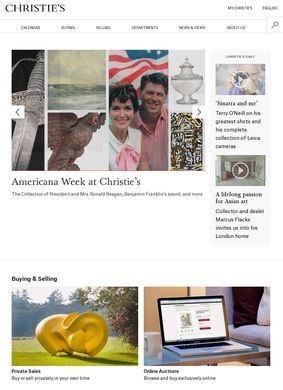
An Old Masters painting, a case of vintage Burgundy, a rare wristwatch and a Hong Kong apartment can all move through the same company, and that breadth is the first thing a visitor notices. Christie's International has run sales across a long roster of categories for over two and a half centuries: Impressionist and Modern Art, Post-War and Contemporary, Asian Art, jewels and watches, furniture and decorative arts, wine and spirits, handbags and memorabilia. The auction calendar lists what is coming up live and online, and registration to bid sits a short step away from the listings. Scanning the upcoming sales takes a few minutes, and even a first-time visitor gets a clear sense of the spread without needing any account or introduction.
Auction categories and sales calendar
The business splits into distinct operations that share a name. There is the auction house itself, founded in London in 1766 by James Christie. There is Christie's Education, which runs courses and programs on the art market. And there is Christie's International Real Estate, a separate affiliated network that connects luxury residential property sales through brokers in different countries. They are related but not interchangeable, and the site does a reasonable job of keeping the auction side and the property side from bleeding into each other. If you land expecting one and find another, a little orientation fixes it quickly.
Three separate operations under one name
For buyers, the draw is obvious: access to objects that rarely surface elsewhere, sold through a process with a long track record. For sellers, the offering is more involved. Christie's International takes consignments from collectors, estates, private sellers, museums and institutional consignors, and it provides specialist valuation and appraisal alongside the actual auctions. Private sale brokerage is also available, sidestepping the saleroom entirely for people who want a quieter transaction. The mix covers the two main reasons someone arrives, to acquire or to part with something, and both get serious treatment.
Buying and selling services
This is where Christie's International pulls ahead of what most people expect from an auction house website. The price databases and past sale results are open to browse, which means a collector trying to value a piece, or just curious about what a comparable lot fetched last season, can do real research without committing to anything. Auction prices are notoriously hard to pin down from the outside, and having decades of recorded sales behind a search box changes what a casual visitor can learn.
Price databases and past sale results
The online bidding setup extends the same logic. You no longer need to be in the room in King Street or on Park Avenue to take part, and the registration flow is built around that reality. For a market that was once defined by physical presence and a certain amount of intimidation, opening the catalogues and the results to anyone with a browser is a real change in how the firm relates to its audience. The information is there whether or not you ever spend a cent.
Online bidding without geographic limits
The valuation and appraisal services are the bridge between browsing and acting. Someone who has inherited a collection, or suspects an object in the attic is worth more than they assumed, can find the route to a specialist opinion. That is where Christie's International distinguishes itself from a marketplace that simply lists things. A business directory entry can point you to the site, but the depth of the archive and the specialist access are what make the visit worth the time.
Valuation services for inherited collections
Christie's International operates salerooms in London, with locations at King Street and South Kensington, and maintains a presence in New York, Paris, Hong Kong, Geneva and other cities. That geographic spread maps onto where the major collecting markets actually are. Asian Art moving through Hong Kong, jewels through Geneva, contemporary work through New York: the network follows the material and the buyers rather than imposing a single center on everything.
Global saleroom locations
Ownership sits with Groupe Artemis, the holding company of the Francois Pinault family, which has held the business privately since 1998. Private ownership under a single group tends to favor the long view over quarterly pressure, and the continuity shows in how the operation is run. Christie's International is one of the two largest auction houses in the world, and the site reflects an organization that has had a very long time to work out what its clients need from it.
None of this makes the site simple to navigate end to end. The sheer number of departments, sales, services and the separate real estate arm means a first-time visitor can feel the weight of it before finding the one thing they came for. The depth is real, but depth and ease are not the same thing. A newcomer should expect to spend some time orienting before the structure clicks into place.
Christie's International has no meaningful competition at the top of the fine art and collectibles market in terms of depth of record and specialist reach, and the site reflects that position honestly. The open price archive and online bidding make it genuinely useful even to people who never intend to buy a lot. Scale is both the strength and the friction here: the firm covers so much ground that finding your corner of it takes more initial effort than a narrower resource would. Once you know where to look, the information is hard to replicate anywhere else.