The first federal art collection
The Smithsonian American Art Museum grew out of the earliest art collection assembled by the United States government. Its origins reach back to 1829, when the Washington curiosity collector John Varden began gathering pictures for display in the capital. Those holdings passed through the National Institute and entered the Smithsonian after its founding in 1846. The government's pictures then hung in the Smithsonian Castle and other federal buildings for a century, and the collection moved several times before settling into its present home in 1968.
The museum has carried several names. From 1906 to 1937 it was itself called the National Gallery of Art, a title Congress later transferred to the new museum built with Andrew Mellon's collection on the Mall. It then operated as the National Collection of Fine Arts, was renamed the National Museum of American Art in 1980, and has used its present name since 2000. Through every renaming the mandate stayed the same: collecting the art of the United States.
Today the collection includes tens of thousands of works by more than 7,000 artists, from colonial portraiture to contemporary media art, and admission is free.
Paintings across the centuries
Landscape painting and the West
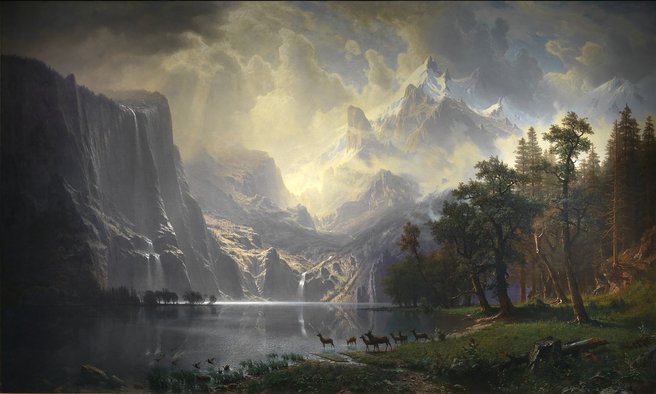
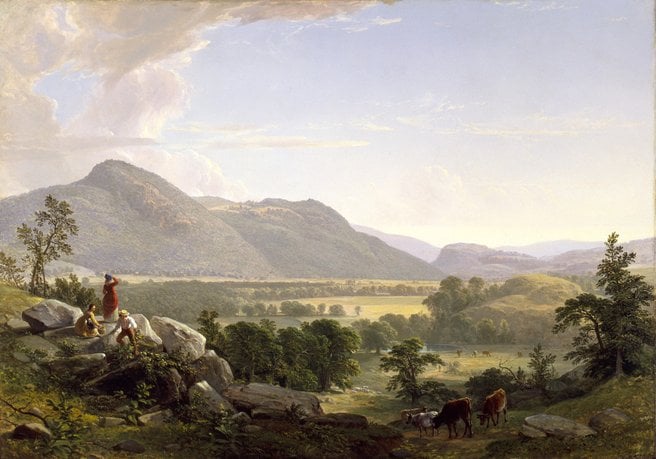
Nineteenth century American landscape painting is a particular strength. Albert Bierstadt's Among the Sierra Nevada, California, a canvas roughly ten feet wide painted in 1868, was made for European audiences curious about the American frontier and toured the continent before crossing the Atlantic. Asher B. Durand's Dover Plains, Dutchess County, New York represents the Hudson River School at its calmest, while monumental canvases by Thomas Moran hang nearby and record the Yellowstone country that his paintings helped persuade Congress to protect. Frederic Edwin Church's Aurora Borealis of 1865, painted from sketches made on an Arctic voyage, belongs to the same rooms.
Impressionism and the Gilded Age
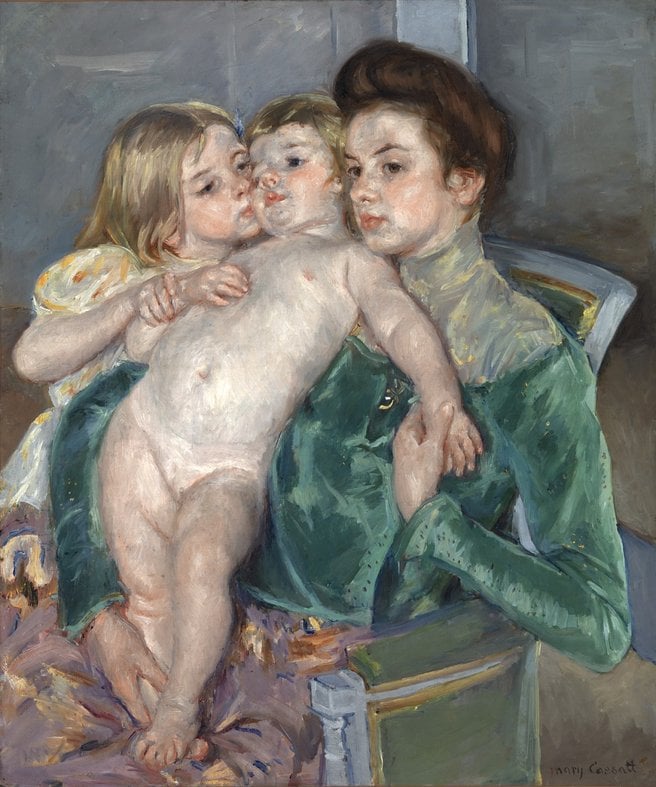
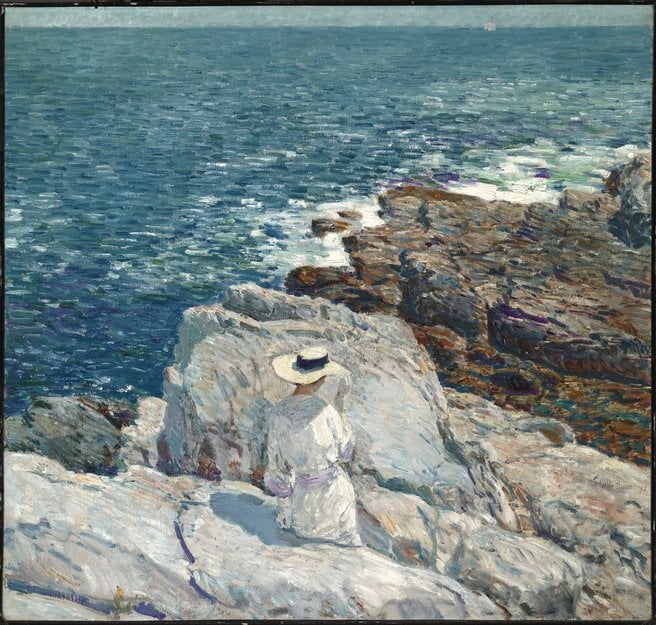
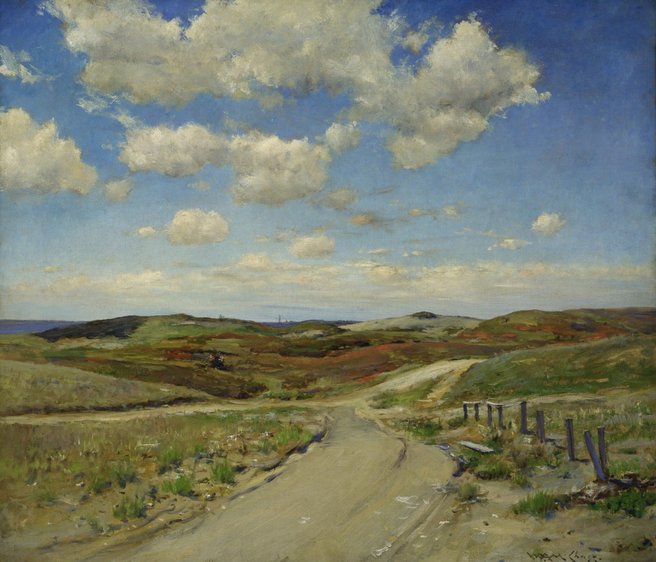
The galleries for the turn of the twentieth century include Childe Hassam's The South Ledges, Appledore, William Merritt Chase's Shinnecock Hills, and Mary Cassatt's The Caress. Portraits by John Singer Sargent and Cecilia Beaux, among them Beaux's Man with the Cat, share space with the idealized figures of Abbott Handerson Thayer and Thomas Wilmer Dewing. Winslow Homer's late marine paintings close out the century.
The twentieth century and self-taught artists
Edward Hopper's Cape Cod Morning and Georgia O'Keeffe's Manhattan carry the collection into the modern period, together with panels by William H. Johnson and Jacob Lawrence and easel paintings produced under the New Deal federal art programs, which the museum inherited in quantity. Folk and self-taught art has been collected here for decades; James Hampton's foil covered Throne of the Third Heaven of the Nations' Millennium General Assembly is the best known example. The museum also holds the archive of the video artist Nam June Paik, whose Electronic Superhighway installation traces the outline of the continental United States in neon tubing and stacked monitors.
Building and public study spaces
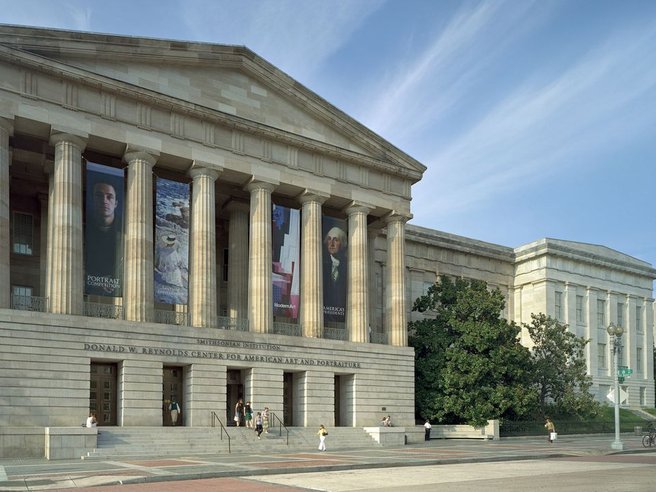
The museum occupies the Old Patent Office Building, a Greek Revival structure begun in 1836 and shared with the National Portrait Gallery. After a six year renovation the building reopened in 2006 as the Donald W. Reynolds Center for American Art and Portraiture, with a glass canopied courtyard added over the central court. The structure itself has a long civic history: it displayed patent models in the nineteenth century, sheltered wounded soldiers during the Civil War, and hosted Abraham Lincoln's second inaugural ball in 1865.
Two facilities matter to anyone who studies pictures closely. The Luce Foundation Center presents more than 3,000 objects in open storage on the upper floors, so paintings that would otherwise sit in vaults stay visible in dense glass cases. The Lunder Conservation Center puts working conservation laboratories behind floor to ceiling glass, and visitors can watch treatments of paintings and frames in progress. A separate branch, the Renwick Gallery near the White House, is devoted to American craft and decorative art.
Images, records, and research use
Under the Smithsonian Open Access program launched in 2020, images of works the museum considers free of copyright are released without restriction, and the full collection database can be searched online with credit lines, exhibition histories, and provenance notes. High resolution files download directly from object pages, and each carries a Creative Commons Zero designation, so publishers, designers, and educators can reuse them without fees or permission letters.
Collectors and buyers of American pictures have a further reason to know this museum. It maintains the Inventories of American Painting and Sculpture, research databases that index hundreds of thousands of works in public and private hands across the country, which makes them a standard first check when tracing an unfamiliar American canvas or confirming where versions of a composition exist. Entries record alternate titles and past attributions, details that matter when the same picture has passed through several sales under different names. A long running fellowship program has also made the museum a center for scholarship in the field, and its library and photograph archives support attribution and provenance work by appointment.
The building sits above the Gallery Place Metro station in the Penn Quarter neighborhood. Galleries are open daily, and no ticket is required.
Business address
Smithsonian American Art Museum
8th and G Streets NW,
Washington,
DC
20004
United States
Contact details
Phone: (202) 633-7970