A national collection built on private gifts
The National Gallery of Art holds the national collection of paintings, sculpture, and graphic arts of the United States. Congress established the museum in March 1937 through a joint resolution that accepted the collection of financier and former Treasury Secretary Andrew W. Mellon, along with his funds for a building. Mellon's founding gift included 126 paintings, among them old masters he had purchased from the Hermitage in Leningrad earlier that decade. The West Building, a domed neoclassical structure designed by John Russell Pope, opened to the public in March 1941.
Federal appropriations pay for operations and the care of the collection. The art itself, however, has entered the museum entirely through private donation or through purchase funds given by private citizens, an arrangement fixed at the founding.
Other benefactors followed Mellon. Samuel H. Kress and his brother Rush gave hundreds of Italian pictures gathered for the Kress Foundation. Joseph Widener contributed the old masters and decorative arts assembled at Lynnewood Hall near Philadelphia. Chester Dale left a body of French painting of the nineteenth and early twentieth centuries, Lessing J. Rosenwald donated prints and drawings, and Paul Mellon and Ailsa Mellon Bruce added French and British works together with large endowments. The campus grew as well: the East Building, designed by I. M. Pei for modern and contemporary art, opened in 1978, and an outdoor sculpture garden followed in 1999.
Painting schools and periods
The painting galleries run from thirteenth century Italian panels to work made in the past few decades. Admission is free, and the museum is open daily except December 25 and January 1.
European painting
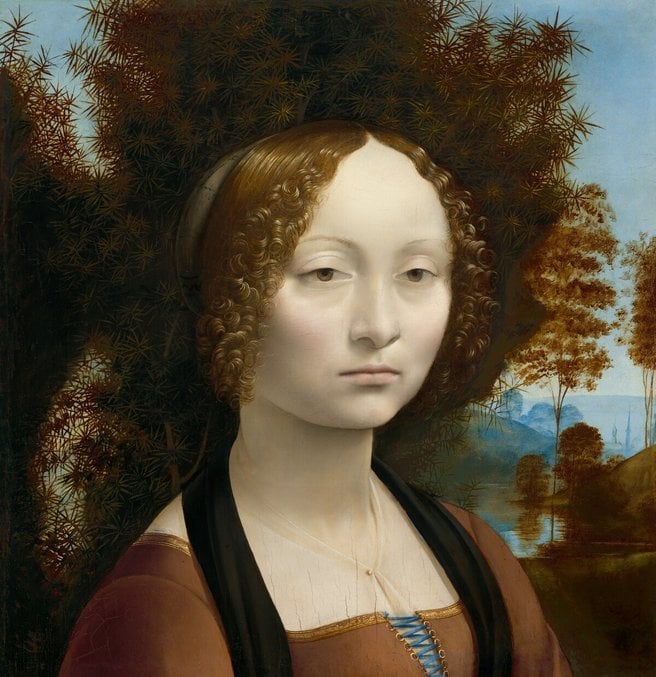
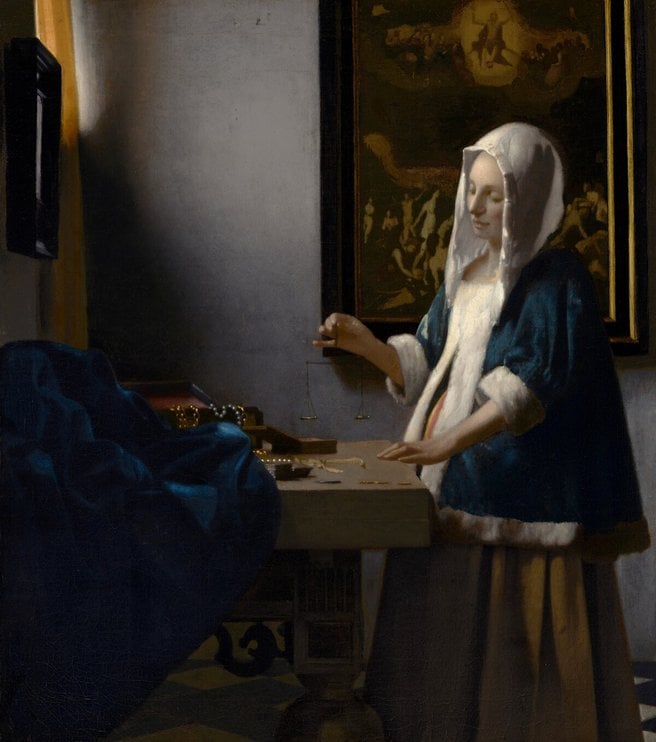
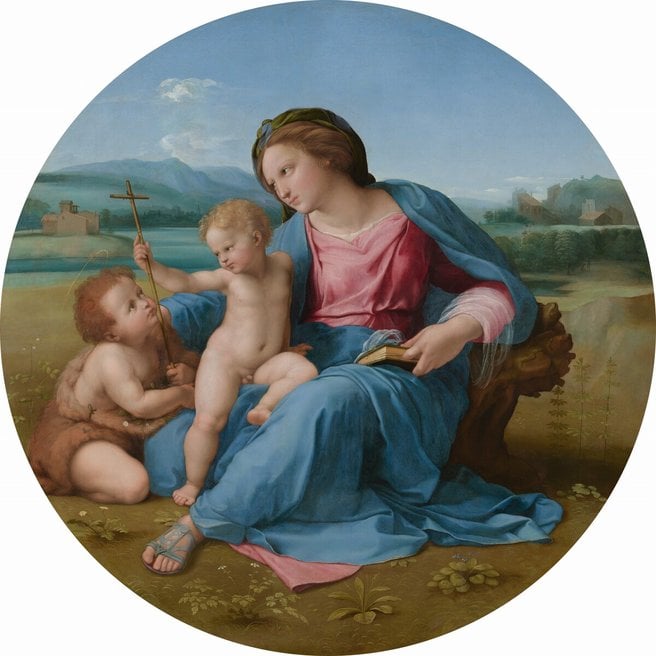
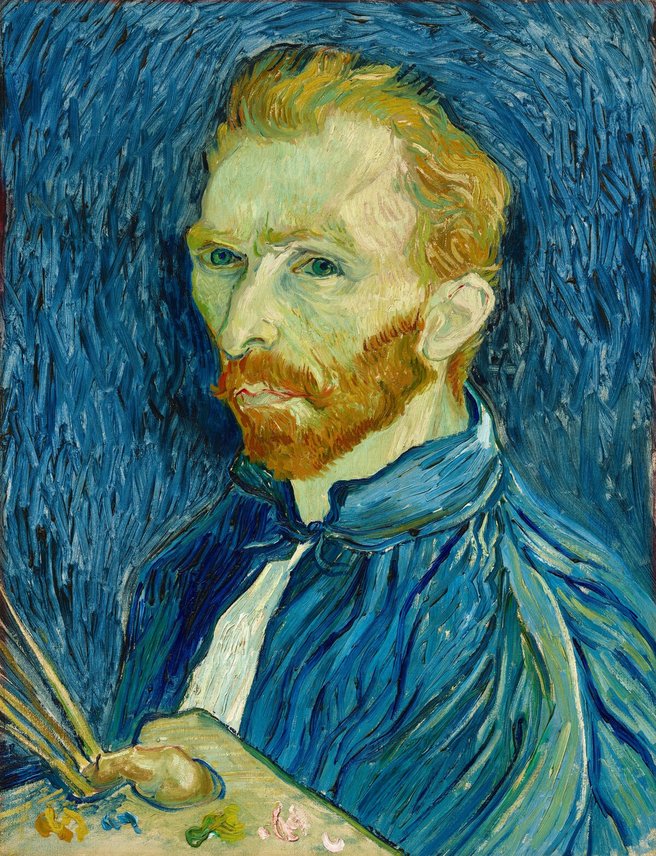
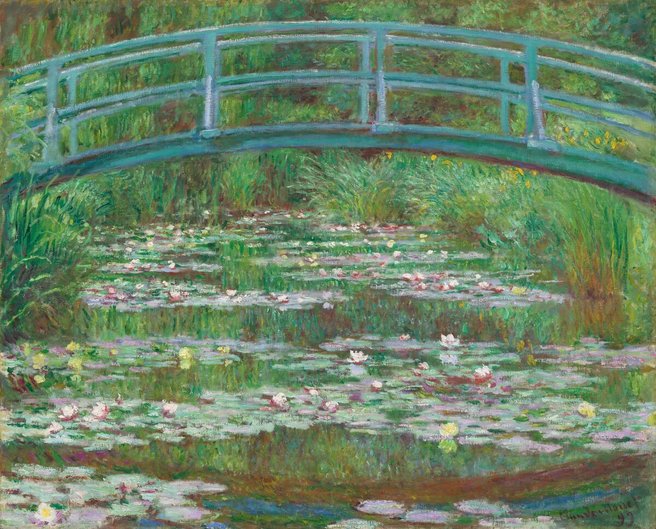
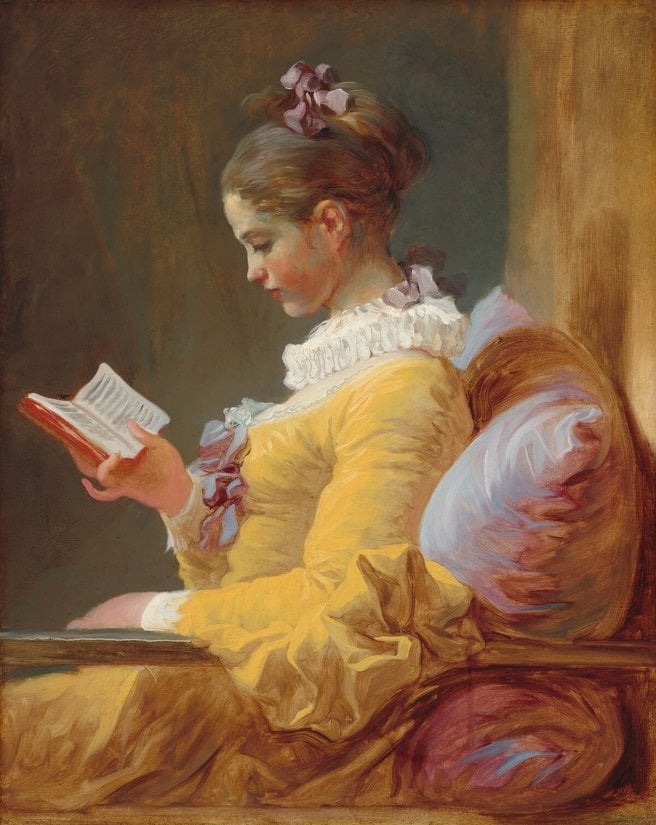
Ginevra de' Benci, bought in 1967 from the princely family of Liechtenstein, is the only painting by Leonardo da Vinci on public view in the Americas. The Italian rooms also hold Raphael's Alba Madonna, The Feast of the Gods by Giovanni Bellini and Titian, and panels by Botticelli, Fra Angelico, and Filippo Lippi. Dutch and Flemish galleries include Rembrandt portraits and self-portraits, works associated with Johannes Vermeer such as Woman Holding a Balance and Girl with the Red Hat, and canvases by Rubens and Van Dyck. Spanish painting is represented by El Greco and Goya. French holdings range from Watteau and Fragonard, whose Young Girl Reading is a familiar image from survey textbooks, to a deep group of Impressionist and Post-Impressionist pictures by Manet, Monet, Renoir, Degas, Cezanne, Gauguin, and van Gogh, including the 1889 van Gogh Self-Portrait.
American painting
Gilbert Stuart's portraits of the first five presidents anchor the early American rooms. John Singleton Copley's Watson and the Shark, marine and rural scenes by Winslow Homer, Whistler's Symphony in White, No. 1, portraits by John Singer Sargent, urban subjects by George Bellows, and paintings by Mary Cassatt and Georgia O'Keeffe carry the story through the nineteenth and twentieth centuries. Hudson River School landscape painting appears in canvases by Thomas Cole and his successors. A related holding, the Index of American Design, preserves about 18,000 watercolor renderings of American folk and decorative objects made by federal project artists between 1935 and 1942, and it remains a reference archive for students of decorative painting and material culture.
Open access images and collection data
The museum releases high resolution photographs of works it believes to be in the public domain under an open access policy. More than 60,000 images can be downloaded from the collection pages at no charge, without permission requests, for any use including commercial publication. The files are large enough for print reproduction, and no account or registration is needed. A machine readable dataset of collection records accompanies the images and lists titles, attributions, dimensions, credit lines, provenance, bibliography, and exhibition histories, which researchers use to study collecting patterns and to reconcile attributions across older publications.
Each object page flags whether its image is open access, so the status of a given picture is never in doubt.
What collectors and buyers can learn
For anyone buying or researching paintings, the collection records are a working model of documentation. Provenance entries trace ownership from the artist forward, name dealers and auction houses, and mark gaps honestly. The museum ran a dedicated research program on works that changed hands in Europe between 1933 and 1945, and it publishes the results. Its systematic catalogues describe physical examination of each picture, including x-radiography and infrared study of underdrawing, which is the kind of technical evidence that separates autograph works from studio replicas and later copies. Scientific staff also publish analyses of pigments and grounds, data that can help place an undocumented picture in a period and workshop.
The attribution vocabulary used on labels, with distinctions among studio of, circle of, follower of, and after, gives private buyers a precise language for judging how auction catalogues describe pictures. Useful starting points include:
- Object pages with provenance, bibliography, and exhibition histories
- Downloadable open access images and full collection datasets
- Systematic catalogues with conservation and technical reports
- A research library and image archive open to the public by appointment
The buildings face the National Mall along Constitution Avenue between Third and Ninth Streets NW, a short walk from the Smithsonian museums. An underground concourse links the West and East Buildings, and the sculpture garden sits across Seventh Street from the West Building.
Business address
National Gallery of Art
6th Street and Constitution Avenue NW,
Washington,
DC
20565
United States
Contact details
Phone: (202) 737-4215