Founded by a painter
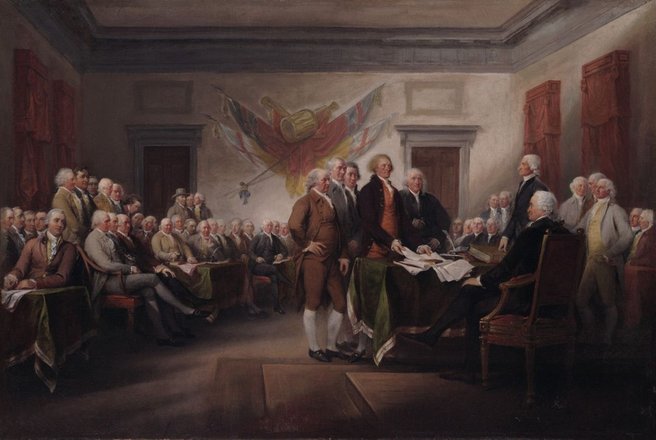
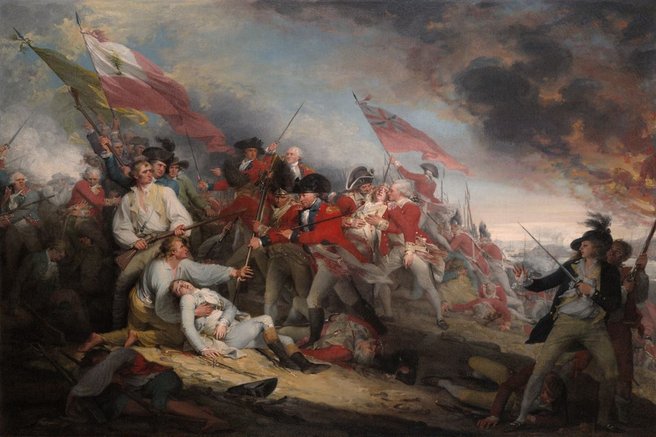
The Yale University Art Gallery began in 1832, when the painter John Trumbull gave more than one hundred of his works to Yale College in exchange for an annuity and designed a building on the Old Campus to house them. That arrangement created the oldest university art museum in the western hemisphere. Trumbull's gift centered on his Revolutionary War subjects, including The Declaration of Independence, July 4, 1776 and The Battle of Bunker's Hill, June 17, 1775, small canvases painted from life studies of the participants decades before his enlarged versions went into the United States Capitol. Trumbull asked to be buried beneath his paintings, and his tomb has moved with the collection ever since.
From that single room of history paintings the collection has grown to roughly 200,000 objects, from ancient Mediterranean art to contemporary work. Beyond paintings, the museum holds large archaeological collections, including finds from Yale's excavations at Dura-Europos in Syria, together with African, Asian, and Indo-Pacific art. Admission has remained free.
Painting collections
American painting
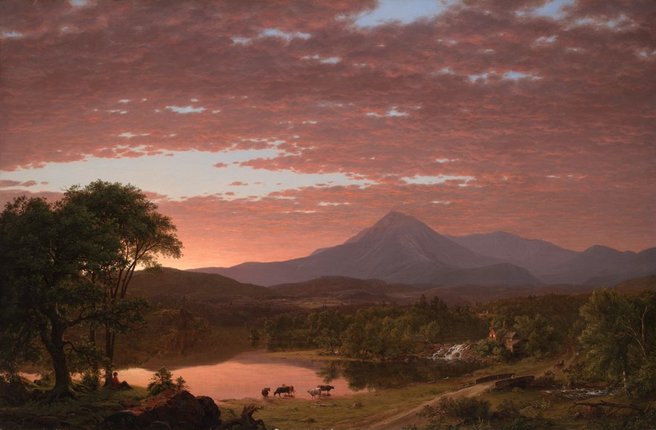
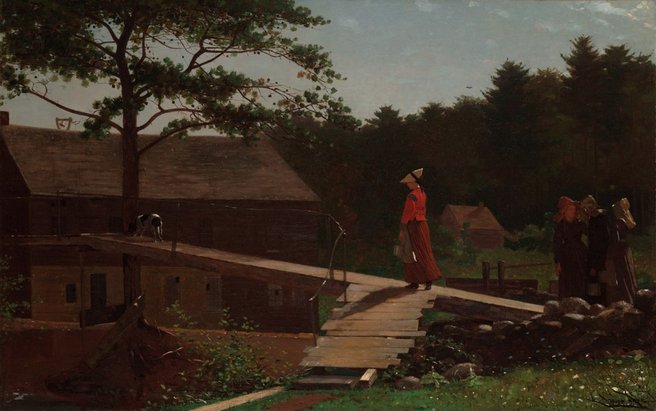
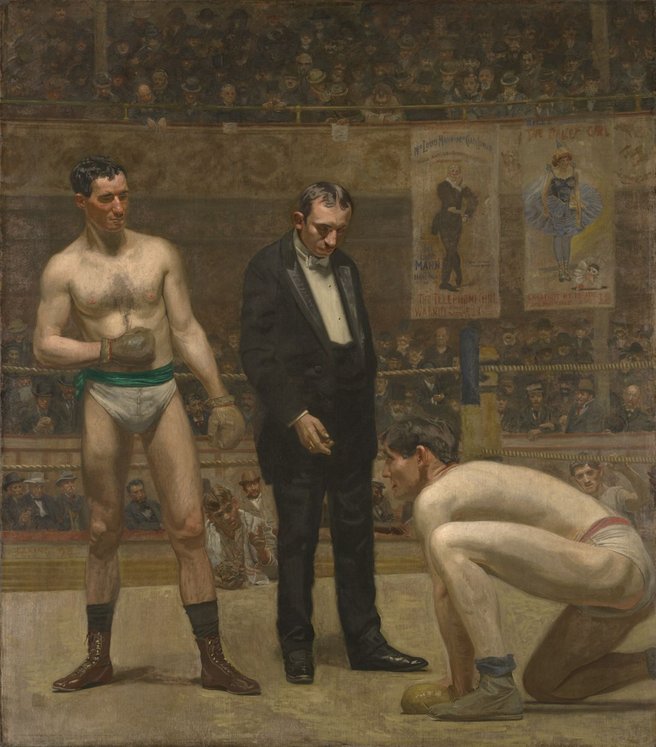
American holdings extend from colonial portraits by John Singleton Copley and Ralph Earl through the nineteenth century and beyond. Earl's full length portrait of Roger Sherman, painted around 1775, remains one of the plainest and most direct images of a Connecticut founder, shown a few blocks from where Sherman lived. Frederic Edwin Church's Mt. Ktaadn of 1853 shows the Maine wilderness his teacher Thomas Cole never painted, and Winslow Homer's Old Mill (The Morning Bell) records New England factory life in the years just after the Civil War. Thomas Eakins's boxing picture Taking the Count of 1898 is among the largest canvases of his late career. The collection also documents American decorative arts alongside the paintings, which helps place pictures within the furnishings and rooms of their period.
European painting and the Jarves collection
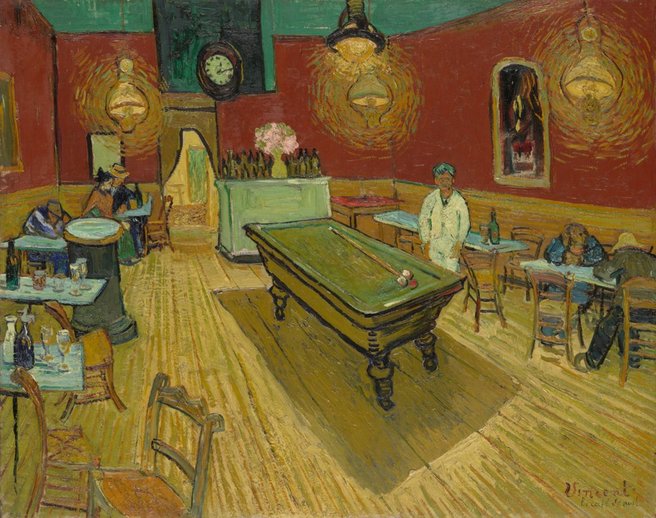
In 1871 Yale acquired the collection of early Italian paintings formed by the critic James Jackson Jarves, at the time one of the largest groups of gold ground panels in the United States. Jarves had assembled the pictures in Florence in the 1850s and 1860s, when early panels were cheap and unfashionable, and Yale took the collection after he could not repay a loan the college had extended against it. It remains a primary resource for studying Italian painting of the fourteenth and fifteenth centuries outside Europe. The European galleries continue through Dutch and Flemish pictures, French painting of the nineteenth century, and one widely reproduced canvas: Vincent van Gogh's Le cafe de nuit (The Night Cafe) of 1888, which came to the museum in 1961 through the bequest of the collector Stephen Carlton Clark.
The Societe Anonyme and modern art
Modern art at Yale rests on the Societe Anonyme collection, assembled after 1920 by Katherine S. Dreier with Marcel Duchamp and Man Ray as a traveling museum of new European and American art. The group gave its holdings to Yale in 1941. Works by Duchamp, Kandinsky, Klee, Mondrian, and Schwitters entered a university collection at a date when few American museums collected such material at all. Dreier intended the group for study as much as display, and the catalogue of the collection prepared at Yale in 1950 is still consulted as a record of European modernism in America.
Buildings from Trumbull to Kahn
The gallery's architecture records its whole history. Street Hall of 1866 and the 1928 gallery building by Egerton Swartwout served earlier generations, and in 1953 the museum opened Louis Kahn's first significant public building, a concrete and glass structure whose tetrahedral ceiling made it a founding work of postwar American museum architecture. A renovation completed in 2012 joined the three buildings into a single complex with about 70,000 square feet of gallery space along Chapel Street. Street Hall returned to gallery use in that project after decades of other university functions, so the museum now runs the length of a city block.
Access, images, and study
The collection database is searchable online, and under the museum's open access policy images of works in the public domain can be downloaded free of charge for any purpose, without permission. Object records carry provenance, bibliography, and exhibition information, and gallery objects also appear in Yale's cross collection discovery platform together with holdings of the university's libraries and other museums. Curatorial departments answer inquiries about works in their fields, and the museum publishes a bulletin that records new acquisitions and research on the collection.
Because it is a teaching museum, study rooms allow close examination of prints, drawings, and photographs by appointment, and object study classes use original paintings rather than reproductions. For collectors, the published records of the Jarves panels, the Trumbull pictures, and the Clark bequest offer clear examples of how attribution, condition, and ownership history are documented over long periods. The building sits at the center of the university's arts campus, across the street from the Yale Center for British Art, and galleries are open to the public six days a week.
Business address
Yale University Art Gallery
1111 Chapel Street,
New Haven,
Connecticut
06510
United States
Contact details
Phone: (203) 432-0600