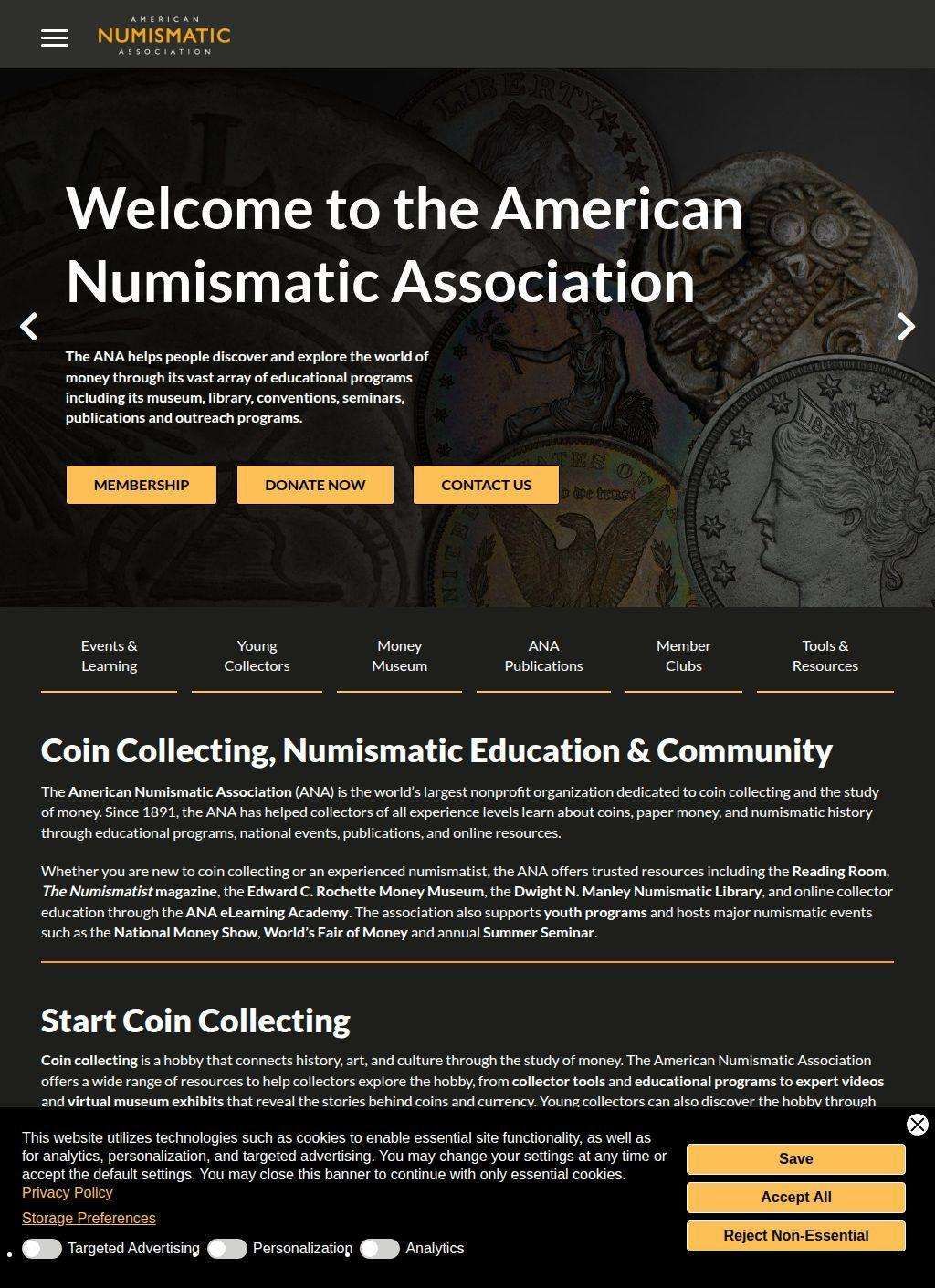
At the center of money.org sits the Dwight N. Manley Numismatic Library: more than 128,000 books, auction catalogs, periodicals, and videos, making it one of the deepest single repositories a coin collector can reach without owning the shelf space themselves. That library is the working core of the American Numismatic Association, a nonprofit founded in 1891 and devoted to the study of money in every form it has taken. The scale matters up front, because much of what the site offers rests on that accumulated material being there and being searchable.
Membership benefits and learning resources
Membership is the spine of the operation. It comes with The Numismatist, a monthly print publication, and The Reading Room, a digital magazine covering the same ground in a format you can carry on a phone. Around those sit teaching resources that go well past a hobbyist newsletter: an eLearning Academy built on video series, a Numismatic Diploma Program for collectors who want a structured path, twice-monthly NumismaTalks Live webinars, and technical seminars for the more specialized side of grading and authentication. A collector who has plateaued and wants to learn how to read surfaces, strike, and wear will find the grading resources and coursework the American Numismatic Association puts out more useful than another forum thread.
Museum exhibits in Colorado Springs
The Edward C. Rochette Money Museum in Colorado Springs runs both in-person and virtual exhibits, so the collection is reachable whether or not a trip to Colorado is on the cards. Once a year the same city hosts the Summer Seminar, an intensive run of classes scheduled for late June into early July in 2026. The teaching calendar is not an afterthought bolted onto a membership pitch; it is one of the main reasons the American Numismatic Association holds its standing in the field.
Serving multiple collector audiences
The honest answer is several audiences at once, and the site does not pretend otherwise. Young collectors are served by a dedicated Young Numismatist program and college scholarships, a genuinely long-term way to run an organization that depends on the next generation caring about coins. Educators get teacher tools and consumer awareness materials from the American Numismatic Association, the latter useful for anyone explaining to a classroom why a coin is worth more than its face value. Dealers and serious buyers get a searchable Dealer Directory, a practical filter when the alternative is guessing whether a seller is reputable.
Research materials and archives
Researchers are the group that gets the most, and it is worth being blunt about that. Between the Manley library, the video archive, and the back catalog of The Numismatist, the depth here rewards someone who arrives with a specific question rather than someone idly browsing. That is not a flaw. It means the American Numismatic Association functions as a reference body as much as a club, and the two roles reinforce each other instead of competing for attention.
Events and community networks
Community sits alongside all of this. The organization maintains a directory of more than 300 member coin clubs, runs National Coin Week, and puts on two flagship gatherings each year. The World's Fair of Money lands in Pittsburgh in late August 2026, and the National Money Show runs separately. These are events where the searchable directories and the educational programs stop being abstract and turn into people in a room comparing notes over a display case.
What money.org does well is keep all of these threads connected. The blog, branded as the ANA Coin Press, and the broader video archive round out the digital offering, so a member who joins for the magazine can drift into the eLearning Academy or the webinar schedule without leaving the same ecosystem. There is a coherence to it that a collection of separate websites would struggle to match, and that coherence is the practical payoff of more than a century of one body steering the whole thing.
Outside reputation is harder to pin down. A search turns up no aggregated review platforms with meaningful counts for the American Numismatic Association as an organization; the name appears in collector forums and numismatic publications rather than on Trustpilot or Google reviews. That gap is not unusual for a nonprofit trade body of this type, and it does not change what the published record shows.
Navigation challenges for new visitors
If there is a limit, it is that the breadth can feel like a lot to navigate on a first visit. Someone who wants only a grading chart has to wade past membership, museum, and event material to get there. That is the trade-off of an organization trying to be the field's library, school, museum, and meeting hall at the same time.
Comparing PCGS grading services
Set the American Numismatic Association next to the Professional Coin Grading Service, which many collectors reach for first, and the difference in purpose becomes clear. PCGS answers one question very precisely: third-party grading and a slab. The American Numismatic Association answers a wider set, teaching a collector how to think about that grade, where to read more, which dealer to trust, and which event to attend. A collector serious about the hobby will likely use PCGS for verdicts and the American Numismatic Association for education, reference, and community. On that side of the hobby, the published evidence points to no deeper or longer-standing place to go.
Business address
American Numismatic Association
818 North Cascade Avenue,
Colorado Springs,
CO
80903
United States
Contact details
Phone: 800-367-9723