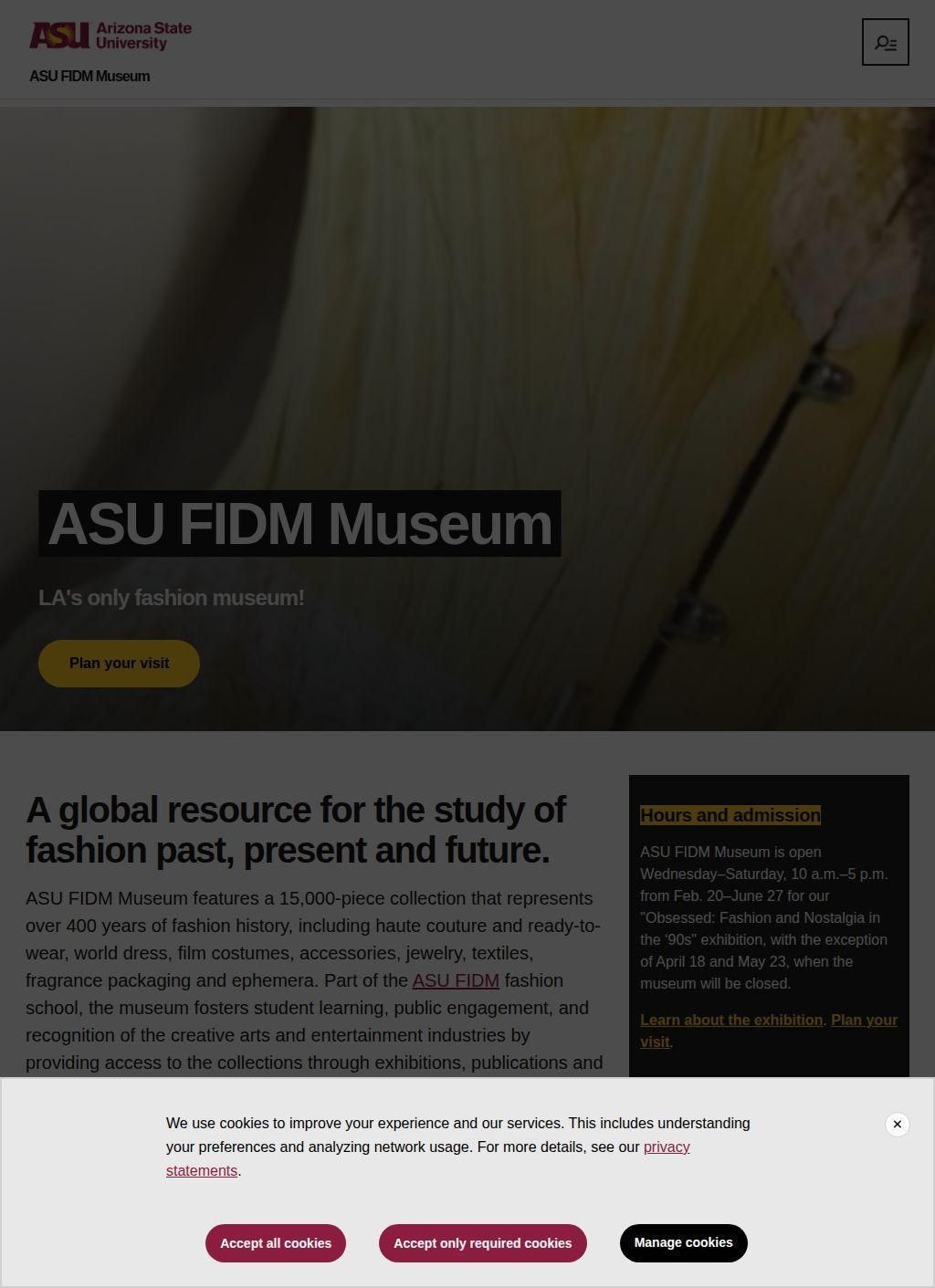
The ASU FIDM Museum is the fashion and costume museum run by Arizona State University's FIDM school, sitting inside the ASU California Center at 919 South Grand Avenue in downtown Los Angeles. That single sentence hides a lot, because what the museum keeps behind those doors is a permanent collection of roughly 15,000 objects that stretch across more than four centuries of how people have dressed. This is not a small teaching cabinet with a handful of gowns. It is a serious holding, and the ASU FIDM Museum has built its website to reflect that scale.
Collection scope across four centuries
Walk through what the collection actually contains and the range starts to make sense. There is haute couture, the kind of hand-finished garment made for one client, alongside ready-to-wear pieces that trace how clothing moved into factories and shops. There is world dress, meaning garments from cultures and traditions well outside the European runway story. There are film and entertainment costumes, a category that counts for a lot in a city whose main industry has been putting people in front of cameras for a century. Add accessories, jewelry, textiles, and even fragrance packaging, and the collection reads less like a costume rail and more like a full record of the objects that surround how we present ourselves. This is the raw material the ASU FIDM Museum draws on for everything else it does.
Haute couture, ready-to-wear, world dress
The site frames the ASU FIDM Museum around four working purposes, and they are worth taking at face value. It is a resource for fashion scholarship, so researchers and writers can study primary material instead of photographs. It supports student learning, which is the natural consequence of a museum attached to a fashion school. It exists for public engagement, meaning ordinary visitors are welcome alongside enrolled students and academics. And it sets out to recognize the creative arts and entertainment industries, which again ties the collection back to the film and television work that shaped Los Angeles. Those aims overlap, but each one explains a different slice of what the place does day to day.
Research, student learning, public access
The featured show listed on the site is "Obsessed: Fashion and Nostalgia in the '90s," running through a stated end date. The title alone tells you the museum is not confining itself to gowns behind glass from distant centuries. A show built around the 1990s pulls in a decade that many current visitors lived through, which is a smart way to make a costume collection feel personal instead of remote. Nostalgia is the hook, and fashion is the lens for it, which is a confident choice for the ASU FIDM Museum to lead with.
Current exhibitions from the permanent holdings
What stands out is that the exhibition is treated as one rotating piece of a larger whole. The permanent collection of 15,000 objects sits underneath the public shows, and only a fraction of it can be on display at any time. That is normal for a museum of this size, but the site makes the depth visible, so a visitor understands the current show is a curated selection drawn from a much bigger reserve. The exhibitions change, the holdings stay, and the two are described as connected parts of one program.
Publications and scholarship opportunities
Beyond the galleries, the ASU FIDM Museum points to publications and to research and scholarship opportunities tied directly to its costume and textile holdings. That is the part that separates a museum from a display. Publications mean the curatorial staff are producing written work that outlasts a single exhibition, and the research access means the objects are available for study rather than locked away purely for viewing. For anyone writing about dress history, film costume, or textile production, that combination is the reason to make contact in the first place.
Gallery hours and closure dates
The practical visiting information is laid out cleanly. The galleries are open to the public Wednesday through Saturday, from 10 a.m. to 5 p.m., with specific closure dates listed so nobody drives across Los Angeles on a day the doors are shut. A four-day public week is a common pattern for a collection of this kind, where the remaining days at the ASU FIDM Museum go to conservation, installation, and research access. Publishing the closures rather than burying them is a small courtesy that a lot of larger institutions still get wrong.
Social media channels for visual content
The digital footprint extends past the main site through Instagram, Facebook, and YouTube, all under the handle @FIDMMuseum. For a fashion collection this is more than decoration, because so much of what the museum holds is visual. A garment photographs well, a textile detail rewards a close-up, and a costume from a known film carries its own audience. The social channels give the ASU FIDM Museum a way to show pieces that are not currently installed, which loops back to the point about a 15,000-object reserve that outstrips any single gallery run.
It is worth being clear about the institutional shape, because the name carries some history. FIDM was the Fashion Institute of Design and Merchandising, a long-running California fashion school, and the ASU FIDM Museum now operates as part of Arizona State University after that connection formed. The Los Angeles location and the collection did not move; the academic parent changed. For a visitor this mostly means the museum now sits within a large public university's structure, which brings the scholarship and student-teaching mission into sharper focus than a standalone school museum might have had.
The collection's Los Angeles setting keeps surfacing as more than an address. A museum that holds film and entertainment costumes and happens to be housed in the city where those costumes were made and worn is drawing on local material in a way an East Coast or European institution simply cannot. The entertainment-industry recognition built into its stated mission is not a marketing angle, it is a reflection of where the objects came from. That geographic logic runs through the whole enterprise, from the world-dress holdings to the couture pieces to the screen costumes.
Reading through the ASU FIDM Museum site, the impression is of an institution that knows exactly what it holds and organizes everything around that inventory. The four-century span is the anchor, the rotating exhibitions are the public face, and the publications and research access are the scholarly spine. A casual visitor gets a themed show like the 1990s nostalgia exhibition; a student gets teaching material; a researcher gets primary sources in textiles, dress, and costume. The same 15,000 objects serve all three without the site pretending they are three different places.
If there is a limit to what the online presence conveys, it is that a permanent collection of this scale can only ever be sampled through a screen or a single visit. The site is honest about that, presenting the current exhibition as a window into holdings that are far deeper than any one show. For fashion history, film costume, textiles, and the study of how dress has changed over 400 years, the ASU FIDM Museum is positioned as a working collection first and a public gallery second, and the two roles reinforce each other. A visitor planning a trip should check the listed closure dates against the Wednesday-to-Saturday schedule.
Business address
ASU FIDM Museum
919 South Grand Avenue,
Los Angeles,
California
90015
United States
Contact details
Phone: (213) 510-6964