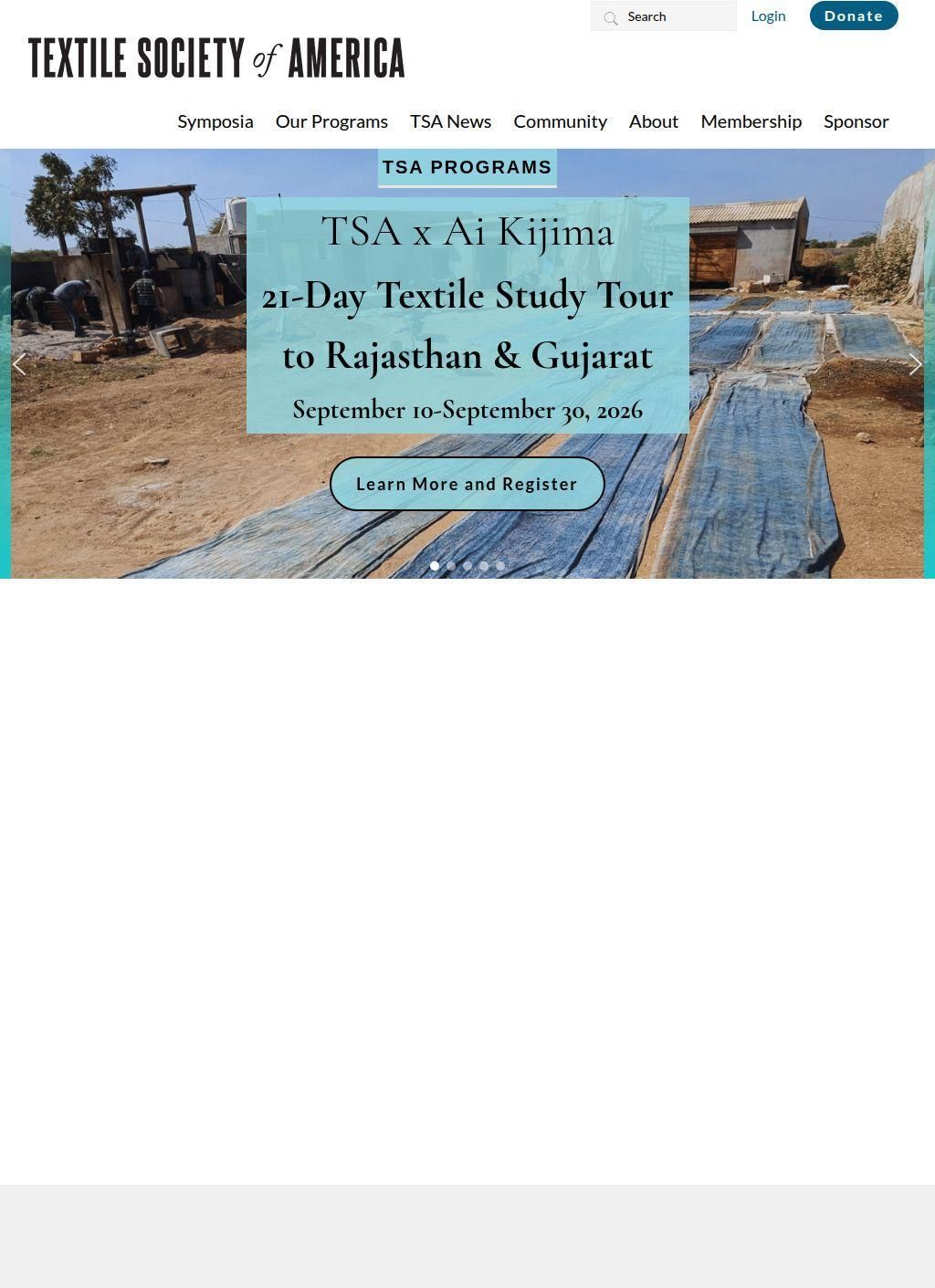
A 21-day study tour through Rajasthan and Gujarat, scheduled for September 2026, gives you a pretty clear read on who the Textile Society of America is for. It runs the trip as fieldwork rather than tourism, a chance to see historic cloth, dyeing, and weaving traditions where they are actually made. That single program says more about the group's character than any mission statement, and it sits alongside a calendar that treats textiles as a serious subject of study.
Annual symposium and recurring programs
At the center of the Textile Society of America's year is an annual symposium. The 2024 edition carried the theme "Shifts and Strands," and a Fall 2026 Colloquium has been announced under the title "(re)Generation: Fibers of Resilience and Renewal." These are framed events with named themes, the sort that produce papers, conversations, and a lasting record. Between the big gatherings, recurring programs keep things moving: Textiles Close Up, a set of virtual roundtables, and Contemporary Voices, which keeps current practitioners in the discussion. For a scholarly group, staying active in the quiet stretches of the year is harder than it looks, and the Textile Society of America manages it.
Inside the membership
The membership it serves is genuinely mixed, and that mix is part of what makes the place interesting. Scholars sit alongside artists, curators alongside cultural practitioners, and there is room for the plain enthusiast who simply cares about cloth and its history. I find that range harder to pull off than it sounds, because organizations that try to hold both the academic and the amateur usually end up tilting hard toward one. The Textile Society of America appears to keep both in view, with programming that a curator and a hobbyist could each get something from.
Publishing output and research support
Publishing is where a society like this either builds a record or quietly fades, and here the output is concrete. There is the TSA Newsletter, which carries a real ISSN (2642-7532), a detail that puts the publication in library catalogues and marks it as something meant to last. Colloquium proceedings are gathered and kept, so the talks do not evaporate once the room empties. Members also gain access to journals, which is often the most practical reason a researcher joins anything: the literature is where the field lives, and clearing that paywall is half the battle for anyone working outside a large university library.
From study tours to travel grants
Beyond publishing and events, the group puts money and recognition behind the work itself. The Textile Society of America administers Awards and Scholarships, and it offers Research Travel Grants, the latter being especially meaningful in a field where the primary sources are physical objects scattered across collections worldwide. You cannot study a particular weave or a regional dyeing method from a screen alone. Someone has to go and look, and travel funding is what makes that possible for scholars who are not independently wealthy. Building this into its operations suggests the Textile Society of America understands how its own discipline actually advances.
The stated purpose of the Textile Society of America ties all of this together: building an international community, diverse and inclusive, for the exchange and spread of knowledge about textiles across the world. What backs up that language is the evidence on the page. An international study tour, a global membership, themed symposia, funded research travel, and an ongoing publication program are the practical shape of an organization that means to connect people who would otherwise work in isolation. Textile study can be a lonely specialty, with practitioners scattered across museums, studios, and departments that may have only one person doing this kind of work. A society that pulls them into a single conversation is doing something concrete.
For anyone whose interest runs to dress history, fiber arts, conservation, or the material culture of cloth, the Textile Society of America covers a wide span of what that work requires. The events give you a place to present and to listen. The publications give you something to cite and to read. The grants and awards give early or under-resourced researchers a way in. Membership benefits, including journal access, networking, discounts, and community, are the ordinary scaffolding that keeps a professional body functioning year to year. The Textile Society of America also keeps an active presence across Facebook, Instagram, LinkedIn, and YouTube, more relevant here than it would be for a purely text-based discipline, given that seeing a textile is most of understanding it.
Independent public reviews of the Textile Society of America are sparse; it operates in a specialized niche where members form their own opinions through years of participation instead of public ratings platforms. That is typical of academic societies at this level of specialization.
None of this is flashy, and that feels right for the subject. Cloth rewards patience and close looking, and so does an organization devoted to it. The Textile Society of America reads as a working body rather than a ceremonial one, with enough range in its programs that a graduate student, a practicing weaver, and a museum curator could each find a reason to belong. The Rajasthan and Gujarat tour, the funded travel grants, the catalogued newsletter, and the themed colloquia are not decorative features. For practitioners scattered across institutions where sometimes only one person works in textiles, the society has built a structure that makes membership mean something.
Business address
Textile Society of America
P.O. Box 177,
Millersville,
Maryland
21108
United States
Contact details
Phone: (510) 363-4541