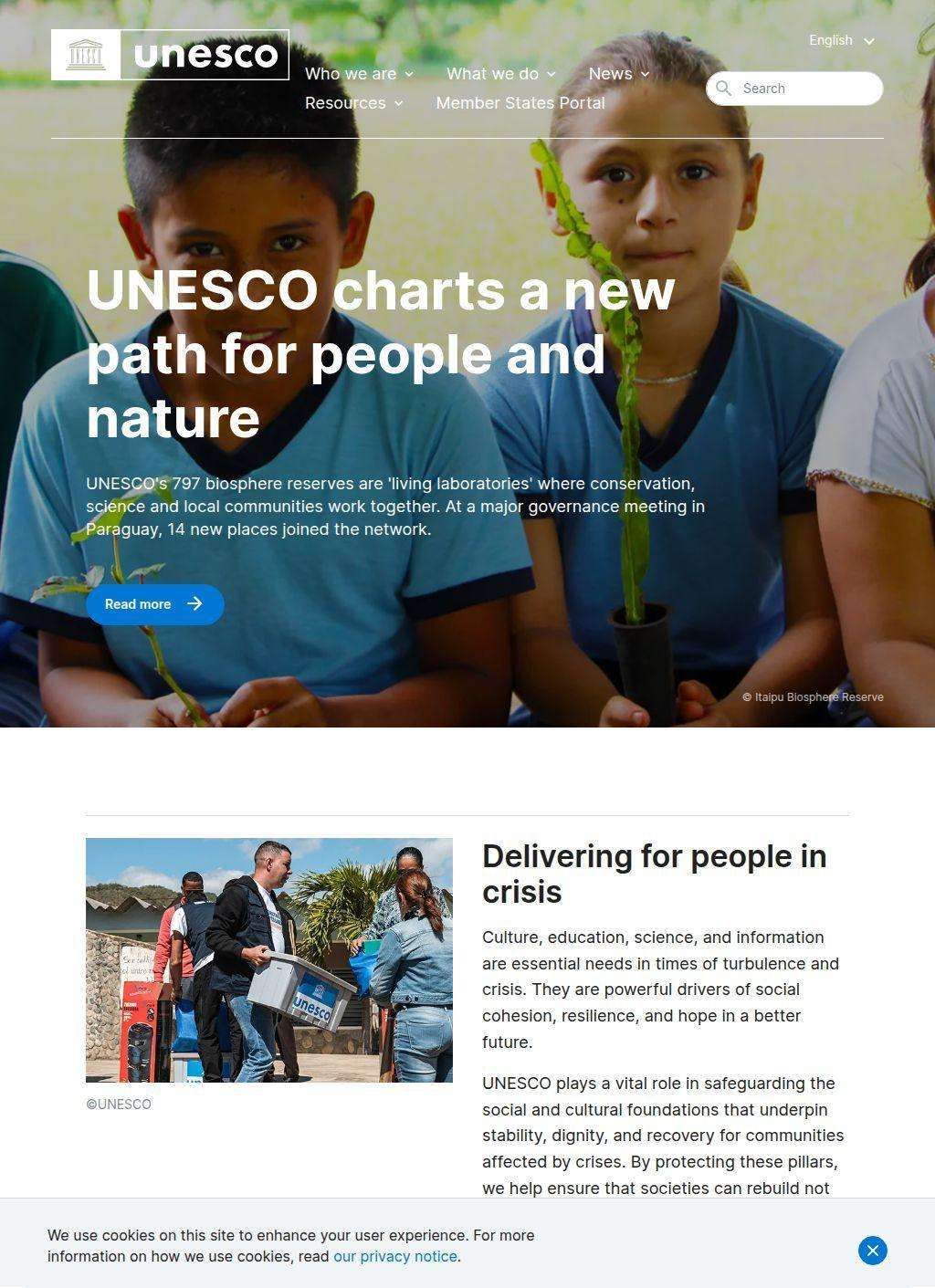
Arriving at this site looking for one thing (say, the legal text of the 1970 Convention on the illicit transfer of cultural property) and finding it immediately, with the full ratification status of member states alongside it, is a good introduction to how UNESCO (United Nations Educational, Scientific and Cultural Organization) works as an online resource.
Primary source for heritage law
The agency does not summarise other people's law on heritage and trafficking; it is the forum where that law is negotiated and adopted, so the texts on these pages are the authoritative versions. When a national ministry or a court reaches for the wording of the 1970 Convention, this is the wording they reach for. That is a different order of value from a commentary site, and it explains why serious work on cultural property tends to start here. UNESCO (United Nations Educational, Scientific and Cultural Organization) is the drafting body, not a relay station.
UNESCO (United Nations Educational, Scientific and Cultural Organization) is a specialized agency of the United Nations with 193 member states and a headquarters in Paris. Its remit runs across education, the natural sciences, the social and human sciences, culture, and communication and information. That spread can make the front door feel crowded. Someone arriving for one narrow topic, say the trafficking of antiquities, has to push past oceanography, freshwater science, and media-development material that has nothing to do with their question. The payoff is that once you reach the culture section, the depth is substantial and the sourcing goes back to the instruments themselves.
Intangible cultural heritage lists
The culture pillar is where the listing's stated category, artifacts, finds its footing. Beyond the 1970 Convention, UNESCO (United Nations Educational, Scientific and Cultural Organization) documents the Intangible Cultural Heritage Lists, which cover living practices rather than monuments, and sets out the conventions, recommendations, and declarations that member states have formally adopted. This is the legal scaffolding that underpins almost every cross-border claim over a looted object or a contested collection.
Post-conflict reconstruction of cultural heritage gets its own programme material here too, drawing on the agency's field presence in damaged regions. Work on indigenous knowledge runs alongside this, and it is directly relevant to restitution debates that now turn on who holds the authority to speak for an object's origin community. The material reads as the output of an organisation that issues binding instruments and then monitors how states apply them. For provenance researchers, dealers checking the legitimacy of a piece, or lawyers building a return case, this is primary-source territory.
One honest limit: UNESCO (United Nations Educational, Scientific and Cultural Organization) documents the rules and the lists, but it is not a searchable register of individual stolen objects. A researcher hoping for an object-by-object database of trafficked artifacts will need to combine what the site provides with other tools such as police and museum loss registers. The convention framework tells you the law; it does not tell you whether a specific vase passing through a sale room was looted. That gap is structural, not an oversight on the agency's part, but it is worth knowing before you arrive.
World Heritage List and site navigation
The World Heritage List sits at the centre of what most people come here to find. Each inscribed property, whether a natural reserve or a built monument, has its own page with the criteria for inscription, maps, threats to its condition, and the legal framework that protects it. UNESCO (United Nations Educational, Scientific and Cultural Organization) puts all of this where a researcher can reach it directly, which is not always true of intergovernmental bodies, and the site explorer lets a visitor filter properties by type and region instead of scrolling a flat list.
Scientific programs and education data
It would be reductive to stop at culture. The site hosts the Man and the Biosphere Programme and the Intergovernmental Oceanographic Commission, two scientific bodies that publish well beyond the casual visitor's needs. On the education side, UNESCO (United Nations Educational, Scientific and Cultural Organization) anchors the Sustainable Development Goal on education and publishes the Global Education Monitoring Report, a heavyweight piece of annual analysis that policymakers and journalists cite regularly. Data runs through much of this: the UNESCO (United Nations Educational, Scientific and Cultural Organization) Institute for Statistics supplies the figures behind the monitoring reports, and the Creative Cities Network is presented as a browsable directory of member cities rather than a static page.
The agency's footprint also explains the volume of content. Field offices in more than 50 countries feed reports, policy briefs, and programme updates into the central site, on subjects ranging from gender equality in science to climate and biodiversity. The sheer quantity is a strength for a researcher with time and a mild obstacle for someone who wants a single answer fast. Search helps, though the topic labels occasionally overlap in ways that send you down the wrong pillar before you find the right one. Open educational resources platforms round out the toolkit for teachers, and the breadth of these sections is a fair reflection of how wide the UNESCO (United Nations Educational, Scientific and Cultural Organization) mandate actually runs.
What raises the credibility of everything published is the relationship to the instruments themselves. UNESCO (United Nations Educational, Scientific and Cultural Organization) does not republish secondary commentary on heritage and trafficking law; it is the body that drafted and adopted that law, so the pages here have an authority no aggregator can replicate. When a field practitioner needs the authoritative text of a convention, or the current state of a World Heritage property, or the monitoring data behind an education policy, UNESCO (United Nations Educational, Scientific and Cultural Organization) is where those primary sources live.
The verdict tilts positive, with a clear qualification about who it suits. For provenance research, restitution work, world heritage queries, and the legal architecture around trafficked cultural property, the site is close to indispensable. The depth of the culture and education material justifies the visit on its own terms. For a casual reader who wants a quick, single-screen answer, the scale works against it, and the science-heavy sections will feel like noise. UNESCO (United Nations Educational, Scientific and Cultural Organization) has built a deep, slightly sprawling reference, and how useful it feels depends almost entirely on how specific your question already is. Come with a defined query and it delivers; arrive to browse and you may leave with more tabs open than answers.
Business address
United Nations Educational, Scientific and Cultural Organization
7 place de Fontenoy,
Paris,
Ile-de-France
75352
France
Contact details
Phone: +33 1 45 68 10 00