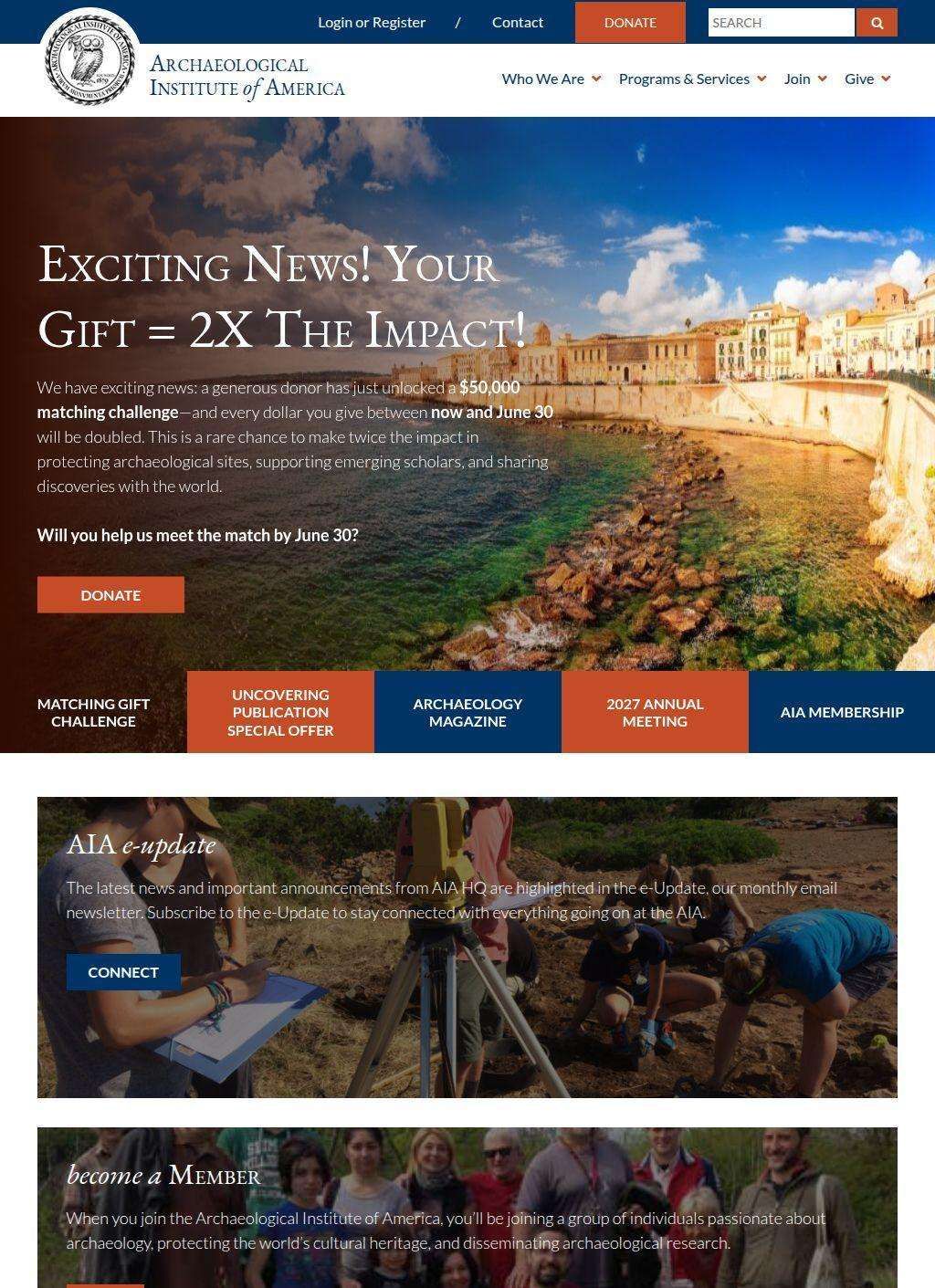
Founded in 1879, the Archaeological Institute of America is the oldest and largest archaeological organization on the continent, and the website reflects an institution that has had a long time to accumulate programs, publications, and commitments. What the Archaeological Institute of America puts online is a fair representation of the full scope of its work: scholarly publishing, public outreach, fieldwork support, education resources, and cultural heritage advocacy. The range on offer is genuinely wide, which is both the appeal and, for a first-time visitor, a mild navigational hurdle.
Scholarly publishing since 1885
Publishing is where the depth shows most clearly. The American Journal of Archaeology has been running since 1885, peer-reviewed and aimed at the scholarly end of the field, while ARCHAEOLOGY Magazine has more than seventy-five years of continuous issues behind it and pitches to a general readership. Those two titles bracket the audience neatly: one for specialists tracking new research, the other for people who want to read about excavations and discoveries without a graduate background. Membership ties into both, with tiers that open up the magazine, journal archives, discounts on events, and career resources for working archaeologists.
Live programming across the continent
Beyond the page, the Archaeological Institute of America puts real weight on live programming, and the Archaeological Institute of America's National Lecture Program alone has been running continuously since the 1890s. The National Lecture Program is in its 129th year, sending scholars to give public talks across the continent, which is a striking run of continuity for any outreach effort. There are also Scholar-Led Tours, an annual International Archaeology Day built around public participation, and an Annual Meeting that brings the membership together, with the 2027 gathering set for Boston in early January. For people who only know archaeology through documentaries, these are the entry points that turn passive interest into something closer to contact with the actual work.
Fieldwork awards and real-time excavation updates
The professional side is no afterthought. On the grant and fellowship front, the Archaeological Institute of America administers fieldwork awards and fellowships for working archaeologists, and its Interactive Digs feature posts real-time updates from active excavations. That is one of the more compelling parts of the site: it lets anyone follow a dig as it unfolds instead of waiting for the published write-up years later. That immediacy is rare in a field where results often take a long time to reach print.
Underneath the national programming sits a network of local chapter societies, each running its own grants and events. This federated structure is meaningful because the organization is also a presence in individual communities, where a local society might fund a regional project or host its own lecture series. It is the kind of layered setup that takes decades to build.
K-12 classroom resources
The education materials round out the picture and deserve more attention than they usually get. There is an Introduction to Archaeology curriculum, classroom lesson plans, summer reading programs, and multimedia resources aimed squarely at K-12 teachers. A teacher looking to bring archaeology into a classroom without reinventing the wheel has a real starting point here. The fact that the Archaeological Institute of America maintains structured K-12 content alongside its scholarly publishing, rather than press releases about discoveries alone, says something about how it reads its own mission.
What does the organization advocate for?
Site preservation and cultural heritage policy form the advocacy strand. The Archaeological Institute of America takes positions on protecting archaeological sites and on the ethics of the field, which is consistent with a body that has been arguing about how this work should be done since the nineteenth century. For anyone who cares about the line between legitimate research and the antiquities trade, this is a relevant voice. An ethics framework gives the rest of what the Archaeological Institute of America offers a backbone that a purely commercial operation would lack.
If there is a weakness, it is that the sheer breadth can make the site feel like several different organizations stitched together: a learned-society publisher, a public-lecture circuit, a grant-making foundation, a tour operator, and a classroom-resource provider all under one roof. A newcomer who arrives wanting just one of those things may have to dig around before finding it. That is a consequence of scope, and most visitors will find the trade worth it once they know what they came for.
Outside reputation: the Archaeological Institute of America is a well-established institution in academic and public archaeology circles. The Archaeological Institute of America does not accumulate public consumer reviews, but the organization's longevity and the continuity of its publications are the kind of track record that speaks for itself more than any ratings tally would. A general search turns up no obvious negative patterns.
Taken together, what the Archaeological Institute of America offers is most rewarding for people with a defined interest: a teacher hunting for lesson plans, a researcher chasing a grant, a reader who wants ARCHAEOLOGY Magazine, or someone planning to attend a lecture or the Annual Meeting. For that person, the site is dense with substance. A casual browser with only mild curiosity may find the volume of programs more than expected and leave before reaching the parts that would have held their attention. The Archaeological Institute of America's standing comes from longevity and the breadth of real work it supports, from the American Journal of Archaeology to the Interactive Digs to the chapter societies, and the website is a fair, if slightly sprawling, window onto all of it. The depth is there for whoever wants to go looking.
Business address
Archaeological Institute of America
2000 Commonwealth Avenue, Suite 415,
Auburndale,
MA
02466
United States
Contact details
Phone: 857-305-9350