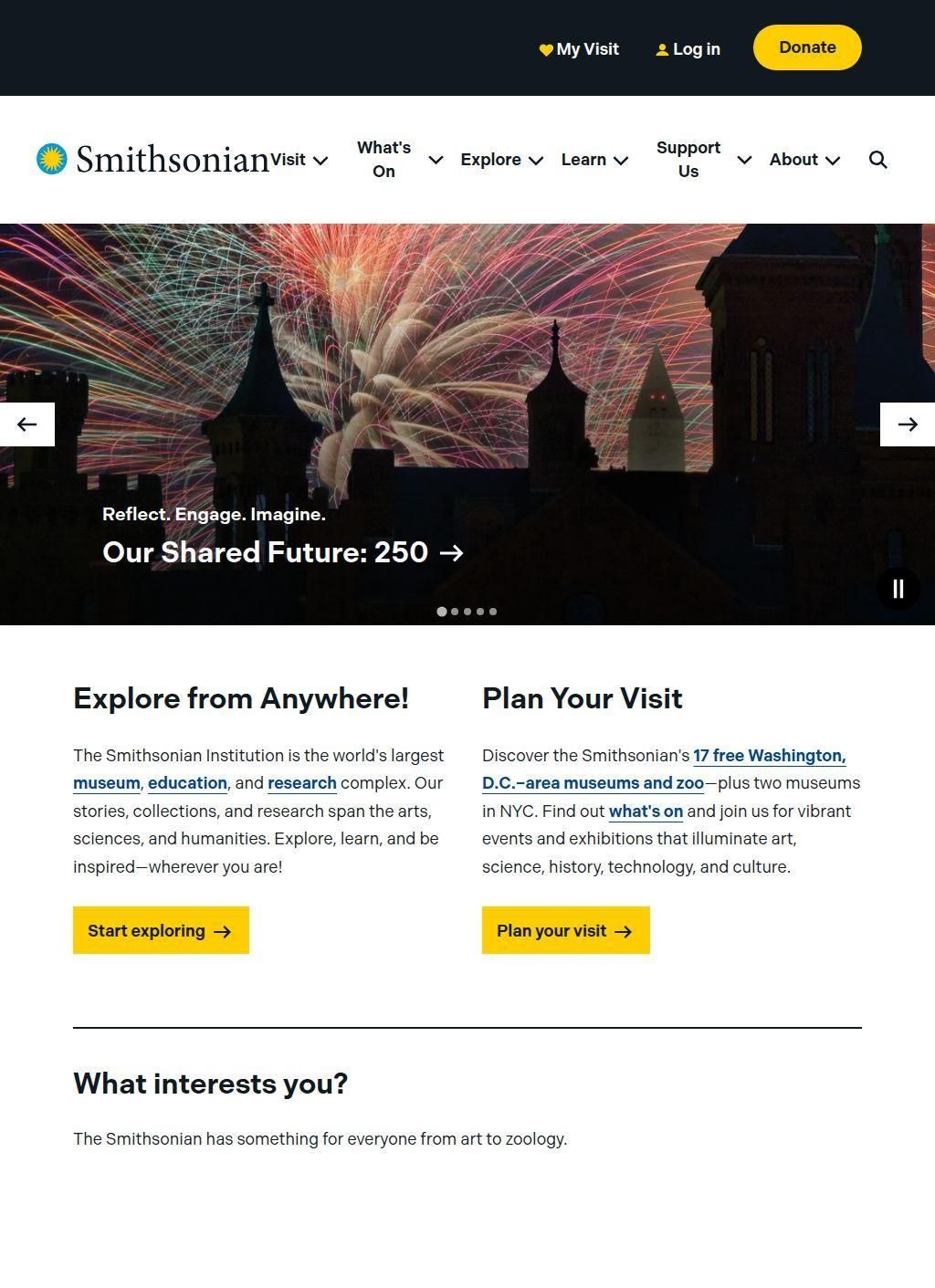
Someone trying to track down a single object, say a daguerreotype, a moon rock, or a specimen of a bird that no longer exists, usually runs into the same wall: the thing they want sits in a collection they cannot reach, described in a catalog they cannot open. The Smithsonian Institution attacks that problem head on through its Collections Search Center, which puts over 13 million records on the open web. Artworks, artifacts, scientific specimens, photographs, manuscripts, and sound recordings all sit in one searchable place, drawn from holdings that span art, design, history, culture, science, and technology. A researcher in another country and a curious ninth-grader hit the same front door.
Collections Search Center
That scale is the point of the place. Established by the U.S. Congress and funded federally, the Smithsonian Institution runs 21 museums, 21 libraries, 9 research centers, the National Zoo, and 2 education centers. Seventeen of those museums plus the zoo cluster around Washington, D.C., with two more in New York City, and every D.C.-area museum and the zoo costs nothing to walk into. Two further museums authorized by Congress in 2020 are still being built out. Few cultural bodies anywhere operate at this breadth, and fewer still hand so much of it over for free.
Museums, libraries, research centers
The named institutions read like a tour of American memory and the wider natural world. The National Museum of Natural History keeps the Hope Diamond and what the brief calls the largest natural history collection on the planet. The National Museum of American History and the National Air and Space Museum sit nearby, alongside the Hirshhorn, the Freer and Sackler Galleries devoted to Asian art, and the National Portrait Gallery. The National Museum of African American History and Culture rounds out a roster that tries, building by building, to cover the country's full story instead of a polished slice of it.
Named institutions across disciplines
For an object hunter, the value is in the spread. A query about provenance might surface a painting in one gallery, a related photograph in an archive, and a sound recording in yet another collection, all returned by the same search. That kind of cross-disciplinary reach is hard to assemble anywhere else, because almost nowhere else holds art, antiquities, and scientific specimens under one roof. The Smithsonian Institution does, and the catalog reflects it.
Cross-disciplinary reach in one catalog
Physical access still matters too. The site points scholars, educators, and the general public toward subject-expert consultations and arrangements to view physical collections, so the digital catalog is a way in rather than a wall around the real material. Someone studying a particular antiquity can read the record online and then pursue the object itself.
From digital models to physical access
The digital side is where the Smithsonian Institution has been pushing hardest. Its Digitization Program Office is steadily moving holdings online, and the 3D Voyager lets a visitor rotate and inspect objects as interactive digital models. For anyone who cannot fly to Washington, that turns a distant specimen into something examinable from a laptop. It is a slow, unglamorous project. Scanning millions of items takes years, but the payoff already shows in those 13 million searchable records.
Scholarly tools and research portals
Scholarly tools sit beside the public ones. Smithsonian Research Online gathers staff publications, and the research centers carry work across every discipline the institution touches. A graduate student chasing a citation and a museum professional checking the history of an artifact both find machinery built for serious inquiry, the sort of apparatus the Smithsonian Institution maintains for scholars who need more than a gift-shop gloss on the collections. The lines between research portal, archive, and public museum blur here, which is exactly what a body of this size should aim for.
Education programs for teachers and students
Education gets the same weight. The site carries K-12 lesson plans, STEM curriculum through the Smithsonian Science Education Center, and online and in-person programs for teachers. A national network of Smithsonian Institution affiliate museums extends that reach past the D.C. mall into classrooms and regional collections across the country. A teacher in a small town can pull a lesson built on real Smithsonian Institution holdings, which is a different thing from a generic worksheet.
Exhibitions and events calendar
The calendar end of the site keeps it current. Upcoming exhibitions and events are listed, and programming tied to America's 250th anniversary gives the whole sprawl a near-term focus. That keeps the Smithsonian Institution from reading as a static archive; the collections grow and the public-facing schedule changes with them.
What is worth weighing is how much of this you can use without spending a cent or leaving your chair. The free admission to the D.C. museums is the headline, but the open catalog, the 3D models, the lesson plans, and the research databases extend that generosity to people who will never visit in person. A heritage scholar abroad, a homeschooling parent, a documentary researcher, and a school class on a field trip are all served by the same Smithsonian Institution, each in a different mode.
It is not a small or simple site, and that cuts both ways. The breadth that makes the Smithsonian Institution so useful also means a first-time visitor can feel lost, with 21 museums, multiple search systems, and several research portals competing for attention. The search center earns the patience it demands, though, and once the structure clicks, the depth pays back the effort. The collections are the deepest English-language store of cultural and scientific material a general user can reach for nothing.
For artifacts and questions of provenance, the Smithsonian Institution sits close to the top of any sensible list. It holds the objects, documents their history, digitizes them for distant access, and opens its experts to inquiry. The one honest reservation is navigational rather than substantive: the material is all there, and learning the layout is the only real cost of entry.
Business address
Smithsonian Institution
1000 Jefferson Drive SW,
Washington,
DC
20560
United States
Contact details
Phone: 202-633-1000