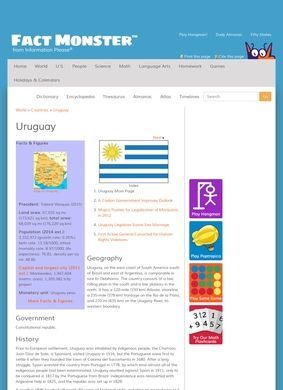
What does a single country page on a student reference site actually give a kid who has a report due Friday? In the case of Fact Monster: Uruguay, the answer is a short, orderly profile: the form of government, the basic geography, a run of history, notes on the economy, and a look at the flag. No adult prose to wade through, no paywall, no login. That is the entire pitch, and for the grade levels it targets it is a fair one.
The page belongs to Fact Monster, a free reference built the way an old print home library was: an almanac, an encyclopedia, a dictionary, and an atlas, stitched together for people between roughly kindergarten and the end of high school. The Fact Monster: Uruguay entry is one of hundreds of country files that sit inside the atlas and almanac side of the operation.
I went in expecting something thinner than it is, and the geography section alone answered more than the two or three questions a young researcher usually arrives with.
Where the Uruguay page sits in a larger reference set
A country profile only works if the surrounding site knows what to do with it, and this one does. The Uruguay page is not a stranded article. It links outward into the same structure that holds every other subject, so a student who lands there for a South America assignment can move sideways into related material without leaving the site or hunting through a search engine.
That linking is arguably more useful than any single page. Below is a rundown of the parts that count most for anyone who lands on Fact Monster: Uruguay and keeps clicking around.
The country profile itself
The Fact Monster: Uruguay file does the plain work well. It lays out the government type, the geography, a compact history, and the economic picture, and it puts the national flag where a student can see it and describe it. This is reference writing pared down to what a report needs: facts a young reader can lift, paraphrase, and cite.
Because the profile keeps to a fixed shape shared across countries, a class comparing Uruguay with, say, a neighbour gets the same categories in the same order every time. That consistency is quietly useful. A teacher can assign the same worksheet to thirty students looking at thirty different nations and trust that each Fact Monster: Uruguay-style page presents the material in a comparable frame. The writing does not talk down, and it does not pad.
Homework help across the subjects
Geography is one door into Fact Monster, but the site earns its keep through the homework help that spreads across math, science, social studies, and English. A student who arrives at Fact Monster: Uruguay can drift into a math explainer or a grammar page in a click, and the tone stays even throughout.
The material is sorted by subject and by grade level, which is the sensible way to organize something meant for such a wide age range. A third grader and a tenth grader are not served the same thing. That sorting is what turns a pile of articles into a resource a family can actually navigate.
Math gets step-by-step reference. Science covers the standard K-12 ground. Social studies is where the country profiles live, so Fact Monster: Uruguay sits naturally beside history timelines and government explainers. English pulls in grammar, spelling, and writing guidance. None of it is flashy. All of it is the sort of thing a parent helping with homework at the kitchen table can put in front of a child without vetting it first.
Word of the day, biographies, and quizzes
Beyond the report-writing machinery, the site has the softer features that keep kids poking around. There is a word of the day, a large stock of biographies, and a set of educational games and quizzes. These are the pieces that make Fact Monster feel less like a textbook and more like a place a curious child returns to on their own.
The biographies matter for the same reason the country pages do. A student researching the history behind Fact Monster: Uruguay can jump to a figure and get a short, readable life without the tangents an adult encyclopedia would throw in. The quizzes turn passive reading into something a kid can test themselves against, and the word of the day is a small daily hook. It is a modest set of extras, and it works precisely because it is modest.
Where the facts come from
Reference for children lives or dies on provenance, so the lineage behind Fact Monster: Uruguay is worth naming. The content descends from Infoplease and Columbia Encyclopedia-style material, the kind long associated with the Pearson and Sandbox Networks family of education properties. In other words, the almanac and encyclopedia underneath the Uruguay page are not scraped from nowhere; they trace back to established reference publishing.
That heritage explains the flat, factual tone. It also explains why a country profile here reads more like a trimmed encyclopedia entry than a blog post. For a teacher deciding whether to point a class at Fact Monster: Uruguay, the pedigree is the reassuring part. The material was edited for reference before it was ever repackaged for kids.
There is a real distinction between a site that writes fresh copy for search traffic and one that adapts a genuine reference corpus for a younger audience. Fact Monster: Uruguay is the second kind, and that shows in how little the page tries to sell you anything.
Now for the honest limits. This is a summary resource, not a deep one. A student who needs current statistics, recent political developments, or anything beyond a foundational overview will outgrow the Uruguay page fast. The profile is a starting point for a young researcher, not a source for a serious secondary-school essay that demands up-to-date figures. Anyone expecting the depth of a full national encyclopedia entry should look elsewhere for the later grades.
The reading level is also fixed low by design. That is the right call for the audience, but it means an older or advanced student may find Fact Monster: Uruguay too spare and move on to denser sources. The site is honest about who it is for, and it does not pretend to be a research library.
What it does inside those limits, it does cleanly. The Uruguay page is fast, uncluttered by the standards of ad-supported education sites, and organized so a child can find the government section or the flag without an adult standing over them. For the K-12 band, a trustworthy reference base paired with a layout kids can actually get around in is most of what Fact Monster: Uruguay has going for it.
Set next to the free reference sites a search will surface, this one has two advantages that keep coming up: the material is graded, and it is sourced from real reference publishing instead of assembled for clicks. A parent who wants a safe first stop for a country report can hand a child Fact Monster: Uruguay and trust the framing.
The catch worth repeating is scope. Fact Monster: Uruguay tells you the shape of the country and little of its present detail, and a student who needs the latter will have to keep going. Used for what it is, an entry point into a broader graded reference set, the Uruguay page holds up. A ten-year-old can open it, read the geography and history sections, look at the flag, and come away with enough to start writing, which is exactly the job the page was built to do.