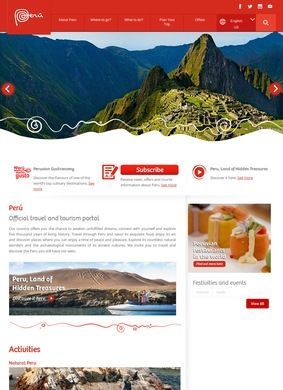
Running an official tourism site for a country this archaeologically dense, geographically extreme, and culinarily celebrated is a genuine editorial challenge. Peru Empire Of Hidden Treasures is published by PromPeru, the government commission responsible for promoting the country's exports and travel, and that institutional origin explains both its strengths and its limits. The site is built to send people to Peru, and everything on it bends toward that goal. Within that frame, Peru Empire Of Hidden Treasures is unusually well organized for an official government travel resource.
Regional destination guides for trip planning
Start with the geography. Peru Empire Of Hidden Treasures breaks the country into destination guides for Cusco, Arequipa, Puno, Piura, the Amazon, and Lake Titicaca, among others. Anyone who has tried to plan a Peru trip knows the problem this solves. The country is large and varied, the distances between regions are substantial, and a traveler picturing only Machu Picchu often has no idea that Lake Titicaca sits at a different altitude in a different climate, or that the Amazon basin is its own enormous undertaking. Splitting the map into named regions lets a reader build an itinerary by place instead of guessing. The regional framing turns out to be more useful than the usual highlight reel, because it gives each area room to stand on its own terms.
Experience categories filter content by interest
Layered on top of the regional map is a second way in: experience categories. Peru Empire Of Hidden Treasures sorts its content into Adventure, Cultural History, Entertainment, Exclusive, Experiential, Gastronomy, and Nature. Two people can visit the same region for completely different reasons. One traveler wants a trek; another wants archaeology; a third wants food. The category system means a visitor can approach the country through whatever interest brought them in the first place, then cross-reference it against where in Peru that interest lives. A destination filter tool connects these two organizing axes, letting someone narrow the field by region and experience type simultaneously. That combination turns what could be a passive browsing structure into something a person with a real trip to plan can put to work.
Gastronomy section documents culinary reputation
The food coverage deserves its own mention, because Peru has earned a serious culinary reputation and Peru Empire Of Hidden Treasures does not treat it as an afterthought. There is dedicated gastronomy content running through the cuisine itself, Peruvian coffee, and the broader culinary heritage. Peru has held the World's Leading Culinary Destination title at the World Travel Awards, and the site documents that standing rather than just asserting that the food is good. For a reader weighing whether to plan a trip around the table as much as the ruins, this section gives real substance to work with. It is one of the parts of the site that goes past brochure writing into something with genuine informational weight.
Archaeological sites beyond Machu Picchu
Peru Empire Of Hidden Treasures covers far more than the single famous name that dominates most travel conversations about the country. Yes, Machu Picchu is there, but so are Kuelap, Chavin de Huantar, Caral, and Chan Chan. That spread is genuinely valuable. Caral is among the oldest known cities in the Americas, Chan Chan was an enormous adobe capital of the Chimu, and Kuelap is a mountaintop fortress that most casual visitors have never heard of. By placing these alongside the headline site, Peru Empire Of Hidden Treasures quietly makes the case that the country has far more depth than its one icon, and it backs that argument with named places a reader can research further.
News updates show site maintenance
There is also a news and stories section that keeps Peru Empire Of Hidden Treasures current. It covers tourism industry events such as Peru Travel Mart 2026 and tracks the country's showing at the World Travel Awards and the World Culinary Awards. For a casual traveler this is secondary, but it does two concrete things: it shows the site is maintained rather than left to age, and it gives context for the awards Peru cites, including its repeated recognition as South America's Leading Destination and its World's Leading Cultural Destination title. Peru Empire Of Hidden Treasures benefits from that currency in a way that static travel guides do not.
Multilingual access for international travelers
Language access is handled sensibly. The English version sits at its own path, with other languages available, so an international audience is not left wrestling with translation. For a site whose entire purpose is reaching travelers from outside the country, that multilingual setup is exactly right. Peru Empire Of Hidden Treasures also maintains a presence across social platforms, which keeps the content pipeline active and gives travelers a way to follow along between planning sessions and the actual trip.
Outside reputation is limited. A search across the main review platforms turns up no independent ratings for Peru Empire Of Hidden Treasures as a business directory or planning resource, which is unsurprising for an official government tourism site. The site does not operate in a market where customers leave star ratings; its standing comes from the authority of PromPeru and from the awards the country has accumulated, both of which the site references with documentation and cited awards, not bare claims.
If there is a fair criticism, it is the one that comes with any official promotion source: everything here is framed to encourage a visit. A reader looking for blunt comparisons, candid talk about seasonal crowding at the famous sites, or the kind of pointed logistical warnings a seasoned traveler swaps with friends will not find that tone in Peru Empire Of Hidden Treasures. The site tells you what is wonderful and where to find it; the harder edges of trip planning, the trade-offs between regions and seasons, you piece together from independent sources. That is not a flaw so much as a boundary, and a sensible visitor reads Peru Empire Of Hidden Treasures for the shape of the country and supplements from there.
Peru Empire Of Hidden Treasures does best at breadth with structure. It is easy to feel overwhelmed by a country this rich in archaeology, food, landscape, and culture, and the site keeps that abundance navigable through a regional split, experience categories, a combined filter, and named attractions that all push in the same direction: turning a vague urge to see Peru into a set of concrete decisions. The gastronomy content and the stories section add weight and currency without cluttering the core planning flow. A first-timer fixated on Machu Picchu will leave knowing about Caral, Chan Chan, and Kuelap.
A food traveler gets a serious gastronomy thread. Someone chasing nature, adventure, or deep cultural history can filter straight to it. Peru Empire Of Hidden Treasures is worth using as a first orientation before the detailed booking work begins; it treats the country as the layered place it is.