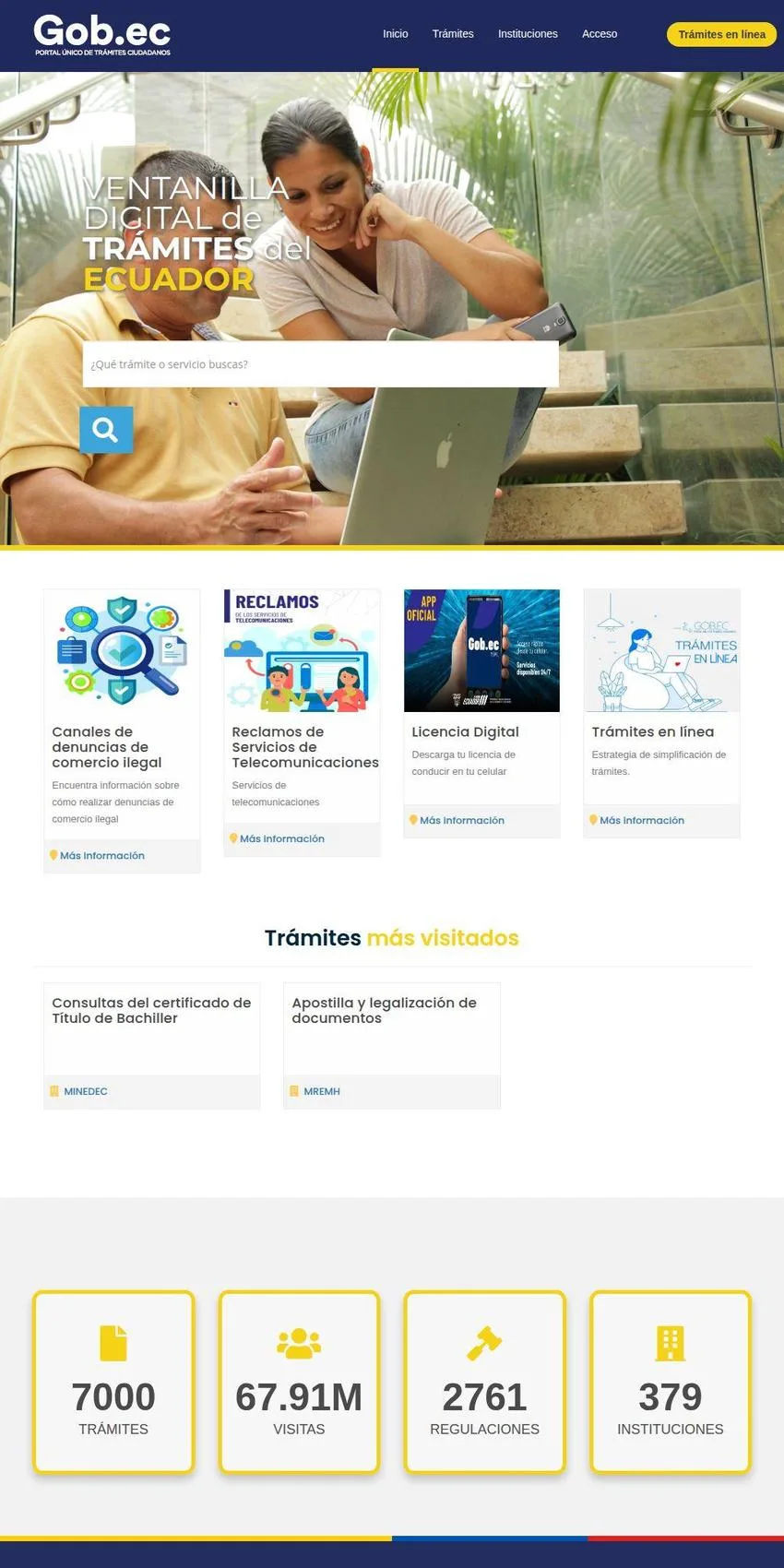
Anyone who needs a criminal record certificate or a driver's license in Ecuador is pointed to GOB.EC, the official guide to procedures and services of the State. Each entry sets out what the procedure requires, what it costs, which offices handle it and which legal norms support it, and thousands of the procedures can be requested and signed online.
The portal is operated by the Ministry of Telecommunications and Information Society, MINTEL, whose electronic government team built it in house with free software.
The single registry of state procedures
Ecuadorian law defines the platform as the Registro Unico de Tramites, the one registry in which public institutions must publish their procedures. Ministries, regulatory and control agencies, the National Assembly, the association of municipalities and bodies from the judicial branch all keep pages there, and by December 2020 more than 350 institutions were publishing through the system. Entries follow a shared template, so requirements, steps, fees and office addresses appear the same way whether a procedure belongs to the tax administration or to a small technical agency. Users can rate each page, and the scores go back to the institution that owns the content.
The law also bars institutions from demanding requirements that do not appear in their published entries, which turns the registry into a reference point in disputes over paperwork.
How the platform developed
Legal foundation
In October 2018 Ecuador issued the Ley Organica para la Optimizacion y Eficiencia de Tramites Administrativos. The law declared the simplification of procedures a policy of the State and ordered the single registry that became this platform. A first version of the site went live in December 2018 so that central government bodies could begin loading their procedures, and about 4,500 of them were registered by March 2019. The President of the Republic presented the portal publicly in April 2019. Online request forms arrived that September, letting users sign submissions electronically instead of delivering paper. An executive decree of February 2020 then confirmed MINTEL as the governing body for simplification across the State.
The pandemic years
The health emergency of 2020 accelerated adoption. In March of that year the site issued the circulation permits known as salvoconductos and answered more than 15 million requests for them. The share of state procedures that could be started or finished online rose from 35 percent at the close of 2019 to 50 percent by April 2020, and passed 70 percent that September. A mobile application for Android and iOS appeared in mid 2020, a chatbot began taking questions in July, and from December 2020 the app could display the digital driver's license and let officers verify it through a QR code.
MINTEL counted close to 72 million interactions on the platform between January and May 2020, and web traffic rankings that year placed it among the most visited Ecuadorian sites. Development continued after the emergency; the site footer currently records version 5.5.0 of the software, and the ministry keeps a public timeline of milestones on its about page.
What the portal contains
The procedure guides sit next to a set of reference tools that the ministry maintains on the same site.
- Step by step instructions for central government procedures, with documents and fees
- A catalog of state regulations offering the full text of each norm for download
- An alphabetical directory of public institutions
- Statistics on the procedures and regulations published
- Online filing with electronic signature and follow up of open requests
A typical entry, such as the one for registering with the tax authority, states who may apply, the documents to present, the fee if there is one, and the channels through which the request can be made. Coverage reaches beyond the executive: civil registry certificates, judicial records and social security matters appear beside permits from transit and health agencies, and each institution page lists its offices and schedules.
Ministry material from 2020 reported that completing a procedure online cost between 1.5 and 5 percent of the price of doing the same in person once travel and queuing were counted, and that processing ran about 74 percent faster. The provinces that used the portal most at that time were Pichincha, Guayas, Azuay and Manabi.
Technology, data and reuse
The system runs on Drupal and other free software, and its source code is published in MINKA, the public software repository of the Ecuadorian State. The ministry notes that the Subsecretaria de Gobierno Electronico developed the platform with its own staff rather than contracting the work out. Content carries a Creative Commons license, so third parties may republish the information, and an open API exposes the underlying data under the government's open data program. The mobile application is distributed through Google Play, the App Store and Huawei AppGallery, and the portal itself operates at all hours, every day of the week.
Coordination sits with MINTEL at its Quito offices on Avenida 6 de Diciembre. The portal forms part of the Ecuador Digital policy, which set targets for the share of central government procedures handled online.


Business address
Ministerio de Telecomunicaciones y de la Sociedad de la Informacion
Av. 6 de Diciembre N25-75 y Av. Colon,
Quito,
Pichincha
170522
Ecuador
Contact details
Phone: +593 2 220 0200