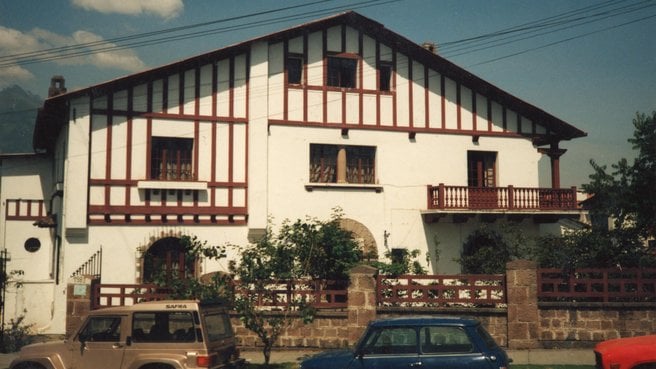
Universidad San Francisco de Quito USFQ opened on September 1, 1988, in a rented house on Avenida 12 de Octubre in Quito. It was the first university in Ecuador organized around the liberal arts, and its name repeats the full colonial name of the capital, San Francisco de Quito.
Founding and early years
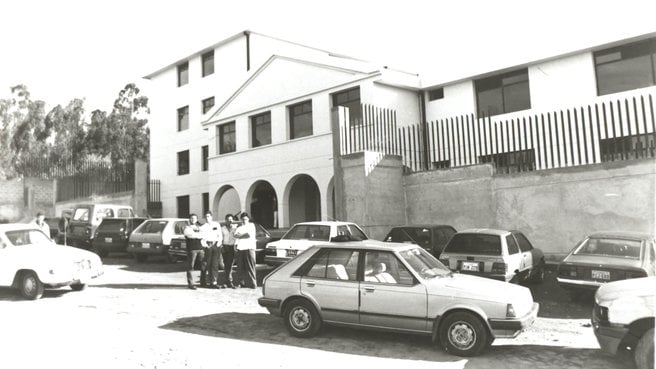
The project began with the Corporacion de Promocion Universitaria, a non profit body that physicists Santiago Gangotena and Carlos Montufar organized with academics and business figures during the 1980s. The national council of universities turned down the initial project, so the founders opened the institution as a college and kept working toward recognition. The first cohort came from 132 families, taught by about a dozen full time professors. A basement cafeteria called the Dragon's Inn doubled as the computer center, its machines donated by Citibank, and classes later moved to temporary quarters at the Academia Cotopaxi school while a permanent home was prepared. Gangotena led the institution for decades as chancellor, and Montufar later served as rector.
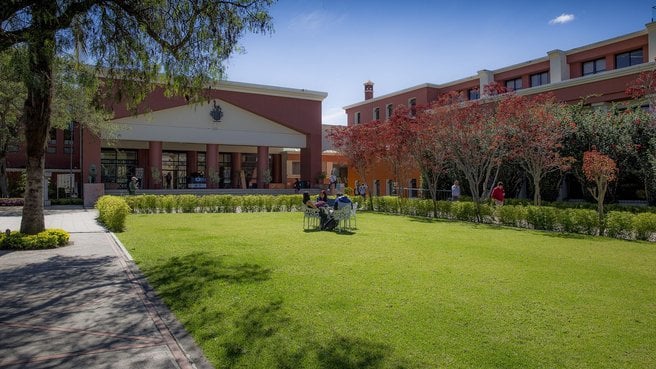
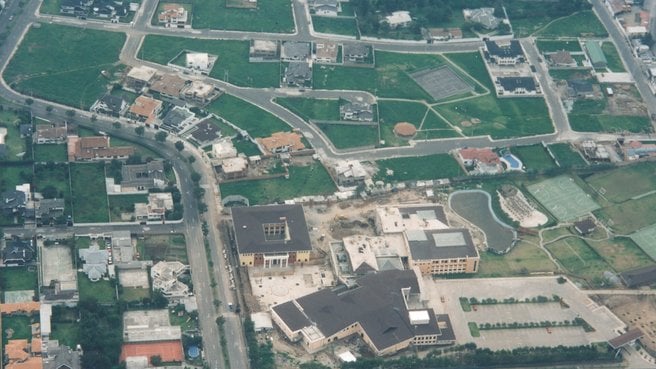
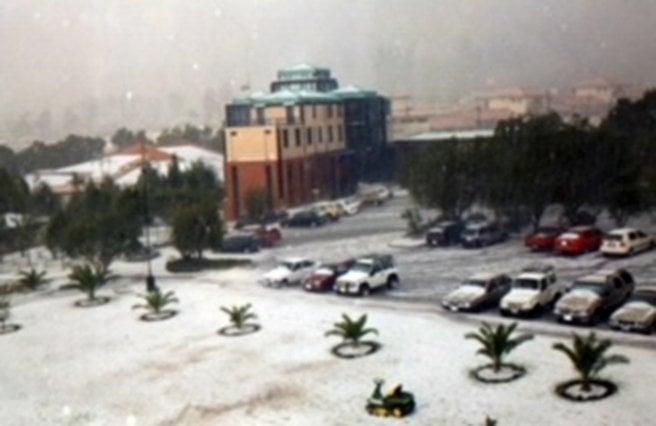
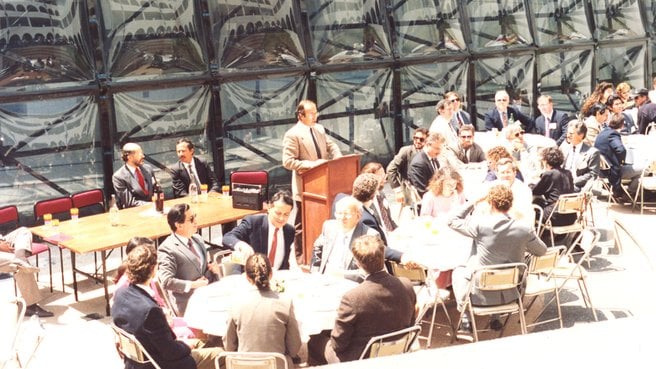
The Ecuadorian State recognized USFQ formally in October 1995. Teaching had started with three colleges covering administration, communication and applied sciences, and by 1992 there were six. The university settled on its present campus in Cumbaya, a valley suburb east of Quito, where the grounds at Avenida Diego de Robles and the Via Interoceanica now carry the name of founder Santiago Gangotena. Photographs from those years show the first buildings surrounded by open fields, and one records the new parking lot whitened by a hailstorm.
Academic profile
Instruction is organized through ten colleges. They cover administration and economics, architecture and interior design, biological and environmental sciences, health sciences, social sciences and humanities, communication and contemporary arts, hospitality and culinary arts, law, music, and a polytechnic college for the sciences and engineering. Undergraduates complete a general education core across the arts and sciences regardless of major, an approach the founders borrowed from universities in the United States, and the catalog runs to roughly fifty undergraduate degrees plus master's and doctoral programs. Degrees are taught mainly in Spanish, with part of the coursework available in English. University fact sheets from recent years count several thousand undergraduates plus graduate cohorts, and about a thousand international students take part in USFQ programs each year. Ecuadorian applicants pass through the university's own admissions process rather than the national examination used by public institutions, and the Cumbaya grounds concentrate classrooms, a library, galleries and performance spaces.
The health sciences college includes schools of medicine, dentistry and veterinary medicine, with clinical practice arranged through affiliated facilities in the Quito area such as the Hospital de los Valles near the campus. The music college belongs to the international network of Berklee College of Music, a Confucius Institute on campus teaches Mandarin, and exchange agreements bring hundreds of international students to Cumbaya each year.
QS has placed the university first in Ecuador in recent editions of its world ranking, within the 801 to 850 band worldwide in the 2025 edition, and the state evaluation agency rated USFQ in category A, its highest band, in national reviews during the 2010s.
Field stations beyond the campus
Tiputini Biodiversity Station
In 1995 the university founded the Tiputini Biodiversity Station together with Boston University. The station sits on the Tiputini river at the edge of the Yasuni reserve in the Ecuadorian Amazon, an area with some of the highest species counts recorded anywhere; surveys in the surrounding forest have logged more than 500 bird species along with hundreds of tree species within single hectares. Facilities include trails, laboratory space and an observation tower reaching the forest canopy, and the station hosts resident researchers, visiting scientists and student groups for work in ecology and conservation. Reaching it takes the better part of a day from Quito, by air to Coca and then by river.
Galapagos programs
A permanent extension in the islands opened in 2002 on San Cristobal, known as the Galapagos Academic Institute for the Arts and Sciences. International students spend semesters there studying subjects such as evolution, marine ecology and the relationship between people and the environment, and the state accreditation council approved the extension in April 2013 through resolution 002-044-CEAACES-2013. The university describes the San Cristobal operation as the main center for higher education and research in the archipelago.
Since 2011 USFQ has also run the Galapagos Science Center on the same island jointly with the University of North Carolina at Chapel Hill. Laboratories there support work running from microbiology to spatial analysis, research that reaches marine, terrestrial and public health questions across the islands, and the two universities mark the center's founding from May of that year.
Program catalogs, admissions calendars and research news appear in the Spanish and English editions of the university's site. Beyond Pichincha, USFQ keeps an office in The Point tower at Puerto Santa Ana in Guayaquil.
Business address
Universidad San Francisco de Quito USFQ
Av. Diego de Robles y Via Interoceanica, Campus Cumbaya,
Quito,
Pichincha
170901
Ecuador
Contact details
Phone: +593 2 506 1700