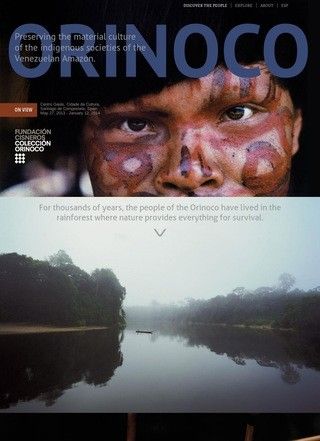
Twelve indigenous groups listed along the top of ORINOCO tell you within seconds what kind of resource this is: Yanomami, Ye'kuana, Hoti, E'nepa, Hiwi, De'aruwa, Puinave, Baniwa, Warekena, Wakuenai, Tsase, and Bare. These are the peoples of the Venezuelan Amazon, and the collection builds its entire structure around documenting their material culture: the baskets they weave, the boats they build, the tools they fish with, the ornaments they wear, the instruments they play, and the objects tied to ritual life. It is a digital ethnographic collection, and it knows exactly what it wants to be. That clarity of purpose is rarer than it sounds on the open web, where archives often drift between being a research tool and being a promotional website for whoever funded them. ORINOCO does not drift.
Two paths through the collection
What makes the site useful is that it offers two honest ways in, and neither feels like an afterthought. You can start with the people and move outward to the things they made, or you can start with a category of object and trace it back toward the communities that produced it. That sounds simple, but for a collection of this kind it is the difference between a museum drawer with a label and a museum drawer you can actually walk around. A lot of digital archives offer only one of those paths. ORINOCO gives you both and lets you switch between them mid-visit without losing your footing.
Profiles of twelve indigenous groups
The "Discover the People" area gives each of the twelve groups its own profile, which is the right call. Lumping a dozen distinct societies under a single "Amazon" banner is the kind of flattening that drains the meaning out of an ethnographic archive, and ORINOCO does not do that. Each group gets treated as its own subject, which lets a reader notice the differences between, say, the basketry traditions of one community and those of another instead of absorbing a vague regional blur. The specificity is the point, and the structure protects it.
Objects organized by type
The "Explore" side organizes artifacts into clear categories: basketry, boats, fishing tools, body ornaments, musical instruments, ritual objects, weapons, and everyday utilitarian items. I find this the more rewarding entry point, because it surfaces patterns you would miss reading one profile at a time. Looking at fishing tools across several groups, or comparing how different communities approach body ornament, turns a static catalogue into something closer to a study aid. The categories are practical and physical, the way the objects themselves are, not taxonomic abstractions imposed from outside the cultures.
Cross-referencing between people and artifacts
Together these two paths cover the same body of material from opposite directions, and the cross-referencing is where ORINOCO pays off. A student researching ritual objects can pivot to the people who use them; a reader curious about the Baniwa can drop into the specific things that define daily and ceremonial life. The collection rewards wandering, and it does not punish you for not knowing where to start. That navigability is a design choice that favors the newcomer without condescending to the expert.
Scholarly references and exhibition history
ORINOCO does not stop at images and labels. The "About" section gathers the exhibition history, publications, references, and credits, which is the scholarly scaffolding that separates a serious archive from a pretty gallery. The references in particular matter, because they tell a researcher where the material is coming from and open a path to follow beyond the screen. A digital collection that cites its sources is one you can actually build on, and the absence of that apparatus in competing resources is something you notice once you have used ORINOCO and then gone elsewhere.
Historical explorers and critical context
There is also a "Travelers" section devoted to the historical explorers of the region, and this is a thoughtful inclusion. The Western record of these communities is inseparable from the people who first wrote about them, often with all the distortions that implies, and putting those figures on the page gives a reader the means to approach the rest of the collection with a more critical eye. It frames the documentation as documentation, made by particular people at particular times, not a neutral window. That kind of reflexivity is what distinguishes an archive that understands its own context from one that does not.
Origins in a physical exhibition
The physical roots of the project add weight too. The collection was shown at the Centro Gaias in Santiago de Compostela, Spain, across a roughly eight-month run bridging 2013 and 2014. Knowing that ORINOCO grew out of a curated exhibition and not a loose pile of uploads tells you something about the care behind it. There was a real show, with real objects, and the website is its lasting form. Digital collections that begin as physical exhibitions tend to have stricter provenance and better object-level documentation than those assembled online first, and that origin is visible in how ORINOCO is structured.
Outside reputation is limited. Searching for ORINOCO across the usual review platforms turns up no user ratings or third-party assessments. That is typical for specialist academic archives, which circulate mostly through citation and course syllabi, not public review culture, and it says nothing about the quality of what is on the page. The exhibition history and publication record are the substantive indicators here.
Material culture versus encyclopedic coverage
Set against a broad reference like Wikipedia's coverage of the same peoples, ORINOCO trades breadth for focus, and the trade is worth making. Wikipedia will give you the historical and political sweep; ORINOCO gives you the things people actually made and used, organized so the objects speak for the communities. For researchers whose interest runs to material culture rather than encyclopedic summary, this is the more specific and rewarding place to work. The collection is particular in a way a general entry never quite manages, and particular is exactly what ethnographic work needs to be.
If there is a reservation, it is that a collection this specialized lives or dies by the depth of its imagery and the quality of its catalogue entries, and that depth is only visible object by object once you are inside. The structure is sound; whether each category is richly populated or just adequately represented is a question the visit itself will answer. What ORINOCO offers from the outside, through its navigation design, its scholarly apparatus, and its exhibition pedigree, is enough to make that visit worth taking.