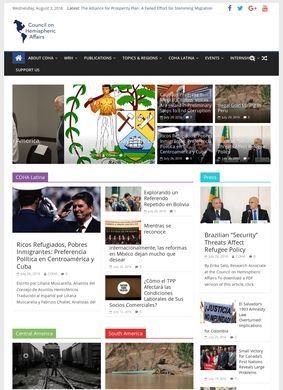
Council On Hemispheric Affairs is a Washington nonprofit that researches and reports on relations between the United States and Latin America. Its stated mission is to promote the common interests of the hemisphere, raise the visibility of regional affairs, and encourage the formulation of rational and constructive U.S. policy toward Latin America.
That is a wide remit for one organization, and the site is built around output. The Council On Hemispheric Affairs runs op-eds and opinion pieces beside longer research articles, publishes book reviews and notices when new titles appear, and keeps a "COHA Recommends" feature that points readers toward outside work its editors rate.
Behind the current writing sits a Washington Report archive, which turns the whole thing into a record you can dig back through.
The mission is openly about shaping better policy, so the writing carries a point of view, and a visitor does well to read it that way.
The range of what it covers
What caught me first was the spread of subject matter. Few outfits this size try to hold so many threads at once, and the Council On Hemispheric Affairs makes little effort to narrow them.
The formats vary as much as the topics. A short opinion piece sits a click away from a long research article, a book review runs beside the release notice for the same title, and the COHA Recommends feature acts as a curated pointer to writing published elsewhere. For a visitor that means the site can be skimmed for a quick take or mined for something more considered, depending on why you arrived.
How the topics break down
The topic index runs across art and culture, corruption, development, economics, education, elections, energy and the environment, geopolitics, health, history, human rights, immigration, media, politics, and security and defense. That is close to the full range of what a policy shop could write about a region. The upside is easy to see. A reader following an election in one country can slide across into the economics, the human-rights record, or the media environment of the same place without leaving the site.
The downside is just as easy to see, because coverage this wide can thin out into shallow treatment, and each article has to earn trust on its own. The Council On Hemispheric Affairs does not pretend the boxes are sealed off from each other; corruption spills into politics, security into human rights, and the tags reflect the overlap.
Countries on the map
Geographically the reach is the entire hemisphere, and the country-by-country structure is where that pays off. Central America is broken out one nation at a time: Guatemala, Honduras, Nicaragua, Panama, El Salvador, Costa Rica, Belize. North America covers Mexico, the United States and Canada. The Caribbean runs from Cuba and Jamaica through Haiti, the Dominican Republic, Puerto Rico, Trinidad and Tobago, and others besides.
South America carries the heaviest load, with Venezuela, Brazil, Colombia, Peru, Chile, Argentina, Ecuador and Bolivia each drawing their own coverage. Given the listing category, the South American coverage on the Council On Hemispheric Affairs is the part most readers will come for. For someone tracking one country, this granularity is worth more than a single regional summary would be, and it suits a student or a journalist who needs to follow one place over time as much as it suits a policy reader.
There is a language dimension too. The Council On Hemispheric Affairs publishes in Spanish, Portuguese and French as well as English, which signals that the intended readership sits partly inside the region and extends well past a North American audience. It also accepts article submissions from outside contributors through a dedicated submissions page, so the roster of voices is not limited to in-house staff. That openness cuts both ways: it widens the range of perspective while making quality uneven from piece to piece.
Credibility, and how you reach them
Judging the Council On Hemispheric Affairs is a different exercise from judging a store or a paid service. The question here is not whether an order turns up but whether the writing, and the body behind it, can be trusted.
Two separate strands turn up once you go looking: what people who worked there say about the place, and what the public filings say about how it runs. Neither answers the other, so both are worth walking through before getting to the plain question of how to reach the organization at all.
What the outside ratings measure
The outside reviews that surface are almost entirely about the Council On Hemispheric Affairs as a workplace, not as a source of analysis. Glassdoor puts it around 4.3 out of 5 for work-life balance, notably lower on culture and values, and lower again on career opportunities, with only about a quarter of reviewers there saying they would recommend working at the organization. Indeed shows a far sunnier aggregate employer score. Handshake hosts an employee-review page as well.
None of that speaks to whether the research is any good, and treating internal staff sentiment as a review of the scholarship would be a category error. The stronger signal for the Council On Hemispheric Affairs is the pair of nonprofit-transparency profiles on Charity Navigator and GuideStar, both holding financial and accountability data with no star rating attached. A prospective donor or a researcher meaning to cite the work can pull those records directly, which is the sort of check that counts for a body trading on its policy judgment.
For an organization that wants a hearing, filings open to public inspection say more than a headline number ever could.
Finding a way to make contact
Contact is kept at arm's length. The landing page shows no phone number and no email address; what it offers is a mailing address, PO Box 34646 in Washington DC, plus a contact page built around a form and social links to Facebook, Twitter and YouTube.
For a research nonprofit that handles correspondence instead of walk-in trade, that arrangement is reasonable, and the absent phone line barely counts against the Council On Hemispheric Affairs. A reader who wants to pitch an article or ask about a published piece has a clear path in. Anyone expecting an immediate reply has less to lean on.
Set the pieces side by side and a shape emerges. The Council On Hemispheric Affairs publishes at volume, spreads its attention over every part of the hemisphere, files its accounts where anyone can check them, and channels day-to-day contact through a single form. The Washington Report archive and the pieces written in Spanish, Portuguese and French are the parts a returning reader is most likely to open.