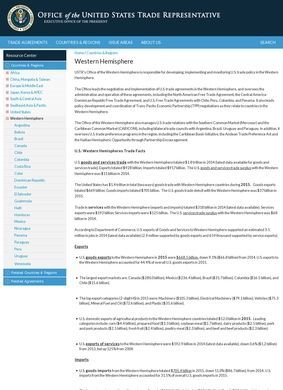
U.S. trade policy for the Western Hemisphere is documented in a lot of places, but most of those places are secondary. This page, run by the Office Of The United States Trade Representative, is the primary source. It covers 19 countries plus the Caribbean, from Canada and Mexico down through Brazil, Argentina, Chile, Peru and the Central American nations. The scope is genuine: if you need to know which agreement governs U.S. commerce with a given country, this section of the Office Of The United States Trade Representative is where that answer sits.
Western Hemisphere trade policy
The stated work of the office runs along four lines: developing U.S. trade policy, negotiating new agreements, implementing what has already been signed, and monitoring ongoing compliance. That last function tends to get less attention than negotiation in coverage of trade agencies, but it is arguably where most of the day-to-day effort goes. A signed treaty is only as functional as the compliance infrastructure behind it, and the page treats monitoring as a continuous obligation, not a post-signing formality.
Four core functions
Six free trade agreements anchor the page. USMCA covers the United States, Mexico and Canada. Beyond that, the Office Of The United States Trade Representative administers bilateral deals with Panama, Colombia, Peru and Chile, plus CAFTA-DR, which ties together the Dominican Republic, Costa Rica, El Salvador, Guatemala, Honduras and Nicaragua with the U.S. Each agreement is presented as a live instrument the office actively manages, not a historical reference. For anyone trying to trace, say, how goods move between the U.S. and Colombia under preferential terms, the relevant treaty is named and placed in operational context.
Free trade agreements
The page also covers the smaller-gauge tools that fill gaps where a full free trade agreement does not exist. Trade and Investment Framework Agreements, bilateral trade councils, and preference programs such as the Caribbean Basin Initiative are all documented here. Seeing them together with the headline treaties gives a clearer picture of how the United States actually structures its commercial relationships across the region, because the difference between a full FTA and a framework agreement is significant in practice and often glossed over elsewhere.
Framework agreements and preference programs
Country-specific detail rounds this out. The Office Of The United States Trade Representative provides per-country profiles that go beyond the treaty level, covering trade facilitation protocols, environmental consultation procedures and anti-corruption measures. The inclusion of environmental and anti-corruption language is worth noting: those provisions are often where friction between trading partners surfaces, and they rarely get summarized this plainly outside the underlying treaty texts. Having them accessible at the country level instead of buried in appendices is useful.
Country-specific profiles
The figures on the page give the scope some weight. U.S. total goods trade with the Western Hemisphere came to an estimated 2.0 trillion dollars for 2024, composed of 889 billion in exports against 1.1 trillion in imports. The trade deficit baked into those numbers also explains why monitoring and compliance get as much attention on this page as negotiation does. The hemisphere is not a peripheral market, and the depth of agreement coverage at the Office Of The United States Trade Representative reflects that volume.
Trade volume and market scope
The page reads as a reference aimed at exporters and importers first, then at policymakers and researchers who need authoritative wording on what the U.S. has committed to. An exporter weighing a move into Central American markets can confirm which CAFTA-DR terms apply. A researcher comparing how the Office Of The United States Trade Representative handles its relationship with Mexico versus Paraguay or Uruguay can pull the framework distinctions from one screen. The material assumes a reader who already knows roughly what a trade promotion agreement is and wants the specifics. It is not an explainer for newcomers to trade policy.
The listing files this under "Americas," with a category emphasis on South America, while the Office Of The United States Trade Representative page covers the full Western Hemisphere, Canada and the Caribbean included. That is a filing quirk, not a fault of the resource. Anyone arriving with a strictly South American question, about Brazil, Bolivia, Ecuador or Venezuela, will find their country represented alongside the northern and Central American partners.
Reference for exporters and researchers
There is a genuine limit here. A page like this functions as a map and an index more than a working dataset. It names which agreement governs a relationship and outlines the broad commitments, but granular tariff schedules, dispute records and case-by-case rulings live deeper in the agency's document archive. The Office Of The United States Trade Representative uses this hub to orient you and point onward, which is the right design for a landing section. A reader expecting a single comprehensive document will need to keep clicking. For the comparative work of figuring out how the U.S. treats one Western Hemisphere partner against another, though, the layout does the job, because the agreements and preference programs are organized so the differences are visible at a glance without requiring separate searches.
The reporting on the office's core functions is honest about the nature of the work. Negotiating, implementing, monitoring, coordinating: these are described as continuous, never concluded, which fits how trade policy actually behaves. Agreements get renegotiated, partners drift in and out of compliance, frameworks need tending. A page that framed this work as finished would be less trustworthy, and the Office Of The United States Trade Representative does not.
As a starting point for understanding U.S. trade across the Americas, this section of the Office Of The United States Trade Representative is well-scoped and honest in its framing. It names the agreements without hedging, ties them to specific countries and supplies a trade figure that puts the whole region in proportion. It will not replace the underlying treaty texts or detailed statistical tables, and a casual visitor may find the assumed knowledge a barrier. Those caveats noted, the Office Of The United States Trade Representative delivers a clear, authoritative orientation to how the United States structures commerce with its hemispheric neighbors. It is the front door, not the whole building, and the page knows that.