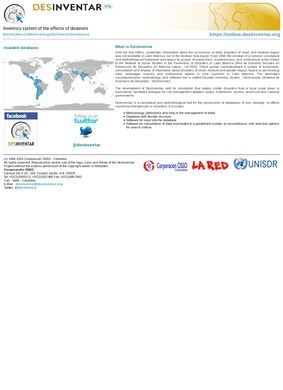
A risk analyst trying to answer a deceptively simple question, how many homes were destroyed by floods in a given Colombian municipality over the last two decades, usually hits a wall fast. National statistics tend to record the headline catastrophes and skip the small, recurring events that quietly add up to far greater cumulative loss. Desinventar exists to close exactly that gap. It is a disaster-loss information system that lets people build, query, and display databases of damage from emergencies and disasters, with a particular focus on the everyday events that larger datasets ignore.
Desinventar comes out of OSSO Corporation, a Colombian research organization, and has been carried for years with support from UNDRR, the UN Office for Disaster Risk Reduction. That lineage matters because it shaped the whole approach: instead of treating each disaster as an isolated headline, Desinventar records losses at municipal, provincial, and national levels so that patterns become visible over time. Someone studying how repeated minor landslides erode a region's housing stock can find the granular records that a single annual report would flatten.
Software tool and online database
What Desinventar actually puts in front of a user splits into a few distinct things. There is a freely downloadable software tool for data entry and local queries, meant for an institution that wants to assemble and maintain its own loss database. Separately there is DesInventar Online, a public portal that opens up national disaster-loss databases for anyone to browse without installing anything. The online side turns the raw records into maps, graphs, and statistical reports, so the output goes beyond rows of numbers into something a policy team or a journalist can read at a glance.
Standardized methodology across countries
Underneath both sits the part I find most useful: a documented methodology. The system ships with a conceptual framework, clear definitions, and data management guidelines, which is the difference between a database that compares cleanly across borders and one that quietly counts the same flood three different ways in three different countries. When you are pulling figures spanning more than twenty documented countries, mostly across Latin America but reaching other regions too, that shared vocabulary is what keeps the comparisons honest.
Who uses Desinventar
The audience here is institutional, and the design reflects it. Researchers and academics use the historical depth to study trends. Government agencies, civil protection bodies, and risk management institutions use it operationally, to see where the recurring damage concentrates and to argue for budget and prevention measures with evidence behind them. Desinventar is built to support that kind of conversation, letting different institutional actors look at the same data and hold a risk management dialogue grounded in records they can all inspect.
That orientation toward evidence-based policy drives the whole effort. A municipality that can show, with twenty years of its own loss data, that a particular drainage problem causes flooding every rainy season has a much stronger case for intervention than one working from memory and anecdote. Desinventar gives that municipality the tooling to assemble the case. The decision to keep both the software and the online access free of charge fits the mission, since the value of the dataset grows as more institutions contribute to and draw from it.
The breadth is genuinely uncommon. Most disaster databases either go deep on one country or stay shallow across many. By standardizing the methodology and then applying it nation by nation, the project manages reasonable depth across a wide span, which is why Desinventar turns up so often in academic work on Latin American disaster risk. A user comparing flood loss profiles between, say, several Andean countries can do it within one framework instead of stitching together incompatible national sources by hand.
Interface complexity and data gaps
It is worth being honest about the experience, though. A system this old and this technical is not a polished consumer product. The interface and the documentation carry the feel of a long-running academic and governmental tool, and a newcomer expecting a modern dashboard may need patience to learn how the queries, filters, and report outputs fit together. The methodology rewards people willing to read it; casual visitors who skip the framework can misread what a given figure counts. This is a working instrument for specialists more than a quick-answer site for the general public.
There is also the reality of any collaborative loss database: coverage and freshness vary by country, because the records depend on the institutions that maintain each national dataset. Some countries are documented thoroughly and kept current, others less so. That unevenness is not a flaw in the tool itself so much as a fact of how the data gets collected, but anyone relying on Desinventar for a specific place should check how complete and recent that particular national database is before building conclusions on it.
Set against those caveats, the substance is strong. The combination of downloadable software, an open online portal, visualization outputs, and a rigorously documented methodology is a coherent package, and the multi-country scope gives it weight that few comparable resources match. For a researcher or a risk-management office working anywhere in its coverage area, Desinventar is close to a default starting point, and the methodology alone is a reference worth consulting even by people who never run a single query.
The verdict lands firmly positive but with eyes open. Desinventar is a serious, purpose-built resource that does something genuinely hard and does it across a remarkable geographic range, and the fact that it remains freely accessible only adds to its standing. The trade-off is a learning curve and country-by-country variation in how much data is actually there. For specialists in disaster risk reduction, those are minor frictions; for a casual visitor hoping for a quick number, Desinventar will feel like more machinery than the question needed. The published depth and the two-decade track record are sufficient to judge it: it is worth the time investment for anyone working in the field, and the methodology documentation alone repays the visit even before a single query is run.