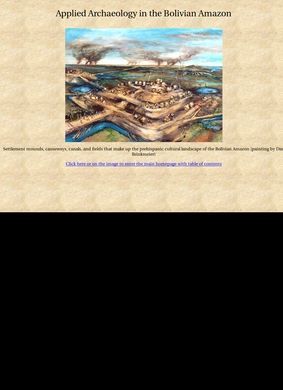
People built large-scale farmland in the seasonally flooded savannas of the Bolivian Amazon centuries before Europeans arrived, raising long platforms of earth above the water so crops could grow through the wet months. That is the central subject of Applied Archaeology In the Bolivian Amazon, a research site hosted at the University of Pennsylvania and written by Clark Erickson, who teaches anthropology there and curates the American Section at the Penn Museum. The page documents his long-running fieldwork in the Llanos de Moxos, the broad plains of the Department of the Beni, where prehispanic communities reshaped the land with raised fields, settlement mounds, causeways, canals, ring ditches, and fish weirs.
Raised fields and landscape engineering
The framing across Applied Archaeology In the Bolivian Amazon is what gives the material its weight. Erickson treats these earthworks as evidence of a working agricultural system, and the "applied" in the title is meant literally. One of the projects described is an experimental rebuild of raised fields with the Bermeo community in the Beni during 1993, putting the ancient construction methods back into the ground to see how they perform. A separate entry covers aerial survey of prehispanic raised fields near Santa Ana de Yacuma from 1994, which is the kind of landscape-scale documentation that ground walking alone cannot capture. Those two strands, the experimental and the aerial, show research that moves between the dirt and the wider pattern, and they anchor a site that could easily have stayed abstract.
Experimental reconstruction with the Bermeo community
The content across Applied Archaeology In the Bolivian Amazon is organized around a homepage with a table of contents that branches into the main Llanos de Moxos work and a second focus on the earthworks of the Baures Region. Both sit inside a set of themes Erickson returns to throughout: historical ecology, landscape archaeology, indigenous knowledge systems, native agriculture, sustainable land use, and the long arc of how people and their environment have shaped each other. Those are not loose tags. The raised-field experiment sits squarely at the meeting point of native agriculture and sustainable land use, and the argument running underneath much of the site is that techniques developed by past Amazonian societies still have something to say about farming difficult ground today. It is a thesis with stakes beyond the academy, and the site presses it without overreaching.
Themes connecting agriculture to environment
For anyone wanting to go past the summaries, the most useful part of Applied Archaeology In the Bolivian Amazon is its library of downloadable PDF publications, which span from 1980 to the point the site was last updated. That range lets a reader trace how Erickson's thinking developed over decades, from early reports through later syntheses, instead of meeting only the polished conclusions. Academic personal sites often hide their actual papers behind dead links or paywalls, so the deep run of free PDFs on Applied Archaeology In the Bolivian Amazon is the real draw. I found myself more interested in that archive than in any single summary, because the papers are where the claims about field morphology and dating can be examined rather than taken on trust.
Free PDF archive spanning four decades
Applied Archaeology In the Bolivian Amazon also lists courses, placing the research in its teaching context and confirming that fieldwork feeds directly into how the subject is taught at Penn. There is a volunteers-wanted notice asking for help with illustration of archaeological landscapes. Reconstructing what a field system or a network of causeways looked like when it was in use is a genuine interpretive task, and the call for illustrators shows that the visual side of the work is treated as part of the scholarship, not decoration added afterward.
Teaching context and collaborative illustration
Erickson's collaborations widen the picture beyond Bolivia. Brief notes cover work with Quechua communities in Peru, Cofan communities in Ecuador, and Arawak descendant communities in Bolivia, which puts living indigenous knowledge alongside the archaeological record. That pairing fits the historical-ecology approach: the people whose ancestors built and farmed these landscapes are positioned as participants in the inquiry, not as background to someone else's study. For a reader trying to understand how raised-field agriculture functioned, the perspective of descendant communities is part of the evidence, and Applied Archaeology In the Bolivian Amazon treats it that way. Applied Archaeology In the Bolivian Amazon does not relegate indigenous knowledge to a footnote; it is woven into the interpretive argument from the start.
Indigenous knowledge from Peru, Ecuador, Bolivia
The funding behind the research is named openly, and the list is substantial: the National Science Foundation, the H. John Heinz Charitable Trust, the University Research Foundation, the American Philosophical Society, and the Interamerican Foundation. Stating funders plainly is ordinary academic practice, but it lets a reader see what a project of this scale required and confirms that the fieldwork in Applied Archaeology In the Bolivian Amazon was sustained over years, not a single short season.
What Applied Archaeology In the Bolivian Amazon does best is connect specific, dated fieldwork to a larger argument about pre-Columbian Amazonia as a heavily managed landscape. The Baures earthworks, the Moxos raised fields, the canals and weirs and ring ditches are presented as parts of one engineered system rather than scattered curiosities, and the experimental and aerial work give that argument something to stand on. The case for taking past Amazonian land use seriously, both as history and as a possible model for present-day cultivation, comes through in the detail of Applied Archaeology In the Bolivian Amazon and not by assertion.
How does the site present pre-Columbian land management?
Applied Archaeology In the Bolivian Amazon is a scholar's research page, dense with text and document links, built for people who already want to dig into the topic, not browse casually. The visual polish is modest. Someone arriving with a general curiosity about the Amazon may find it drier than expected; a student of archaeology, historical ecology, or South American prehistory will find it a direct line to primary material and to a researcher who has spent a career on it.
One practical limit is worth naming honestly. The page records a last modification in 2010, so the present-day status of the projects and the completeness of the publication list past that point are not reflected on the site itself. The work documented in Applied Archaeology In the Bolivian Amazon remains valid as a record of what was done and argued, and the PDFs do not lose their value with age, but a visitor hoping for current updates on the fieldwork will need to look elsewhere. That dating tempers the freshness of the entry without touching the substance of the research already laid out.
Applied Archaeology In the Bolivian Amazon is a strong specialist resource for students, researchers, and serious general readers who want to understand how prehispanic peoples engineered the Beni plains. It backs its claims with named fieldwork, downloadable papers, and an explicit theoretical frame. Focused on one region and one set of questions, the site puts more usable primary material in reach than a typical academic page: PDFs from 1980 forward, two named field projects, and a table of contents splitting cleanly between Moxos and Baures. The papers that make the argument in full are open and free, which is the most useful thing a research site of this type can offer.