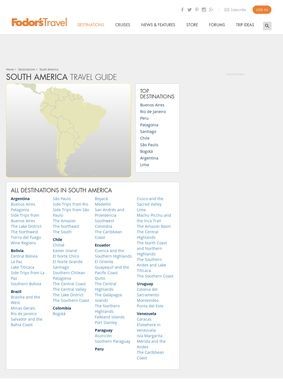
Print guidebooks from Fodor's start at $13.99, and the publisher keeps several South America editions in rotation alongside its web coverage. That pairing of paper and screen is a useful way into what South America Travel Guide is: the Fodors.com platform, owned by MH Sub I, LLC dba Internet Brands, viewed through its continent-specific section. South America Travel Guide sits inside a site that claims coverage of more than 7,500 destinations worldwide, and the continent gets its own slice of that, with country, city and regional guides for travelers trying to map out a trip across a large and varied part of the world.
Destination guides and hotel search
What you find inside South America Travel Guide follows the same template as the rest of the site, which is no bad thing once you know the shape of it. There are destination guides, expert-written articles, hotel recommendations and restaurant listings, plus sightseeing rundowns for the places people tend to fly into. Trip itineraries are on offer for travelers who would rather start from a ready-made route than build one from scratch. Hotel search is wired directly into the site, so the move from reading about a city to checking where to sleep does not require leaving for a separate booking portal.
Cruises, road trips, national parks
Beyond the guides, South America Travel Guide spreads wider than a straight destination reference. Cruise coverage is substantial: news, guides, and a directory of ships, given how many people reach southern Chile, the Amazon, or the Galapagos by water. Road trip guides and national parks content round out the editorial side, and there is a separate stream of travel news. A built-in AI assistant chatbot is meant to help with the planning legwork, the kind of feature that either saves time or gets in the way depending on how much you trust a bot to know which season is wrong for the Pantanal. None of this is unique to the continent, but it gives South America Travel Guide more to lean on than a plain list of cities.
Community forums by region
The forums are where South America Travel Guide stops being a one-way publication and turns into something closer to a noticeboard. Community discussion is organized by region, and South America has its own sub-forum where travelers post questions and trade firsthand accounts. For a continent where conditions shift fast, where a road washes out or a border crossing changes its rules, that peer layer is worth as much as the polished editorial. A guide written months ago tells you what is usually true; a forum thread from a recent traveler tells you what was true last week.
Mixed reviews from print editions
Outside reputation here is split, and it is worth being plain about that. The clearest external data comes from Amazon reviews of the Fodor's South America print editions, and they run mixed. One reviewer gave a book 2.5 stars and called it an "also-ran" next to Rough Guides and Footprint, which is a pointed comparison from someone who clearly knows the competing series. Another reader found the same kind of guide genuinely useful for a first trip to the continent. Those two reactions are not really in conflict: a guide that covers the basics well can feel shallow to a seasoned traveler and just right to a first-timer.
No aggregate ratings from Trustpilot, Google, Yelp or the BBB turned up for Fodors.com as a destination, so the print reviews are the closest proxy available, and a proxy is all they are. A book and a constantly updated website are different products even under one name. The mixed print verdict should temper expectations about depth, but it does not directly grade the web experience, which carries more content and the live forum that the books cannot match.
Website updates faster than printed books
That print-to-screen gap cuts in the site's favor on one count. Where a printed South America guide is frozen at its publication date, the web version of South America Travel Guide can revise hotel picks, refresh news, and lean on the forum for current ground truth. A reader who found the book an "also-ran" might rate the living site differently, because the things that make a guidebook feel dated are exactly the things a website can keep patching.
Contact through forms and social media
On contact, the site is restrained. There is no phone number or physical address on the homepage, which is normal for a large publishing platform. A contact form sits behind the about-us page, and social profiles on Facebook, X, Pinterest and Instagram are present along with a newsletter signup. For a content site, a form plus active social channels is a reasonable contact route, even if nothing about it is surfaced loudly. South America Travel Guide is built to be read, not phoned. This is a reference and planning resource, not a booking agent you call when a reservation goes wrong.
Who South America Travel Guide serves is clear enough from the structure. The main navigation, Destinations, Hotels, News, Cruises, Forums and Trip Ideas, is built around leisure travelers planning trips, and South America Travel Guide slots into that frame as one region among many. The strength of that approach is breadth and a consistent format; the cost is that a continent with as much range as this one gets the same treatment as everywhere else, which can feel general where a specialist guide would go deeper into trekking permits or interior bus networks.
South America Travel Guide works best as a starting point and a sense-check rather than a single authoritative bible for the continent. The editorial gives a competent overview, the forums add the human texture, and the cruise and itinerary tools cover real planning needs. The print arm gives you something to carry once the wifi drops. The Amazon skeptic has a point about depth, and the first-timer who found it useful has a point about reach. Both can be right at once. Travelers planning a broad first pass across South America will find South America Travel Guide genuinely useful; those drilling into one specific corner may want to add a specialist title alongside it.