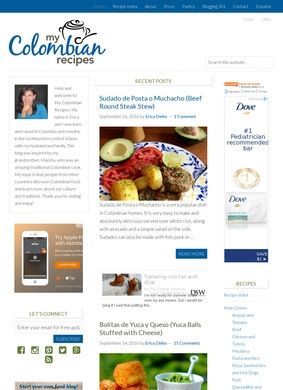
Behind My Colombian Recipes is one person: Erica Dinho, a Colombian who settled in the northeastern United States and started writing down the food she grew up with. That single-author origin shapes everything about the site. There is no faceless test kitchen, no rotating cast of contributors, just one cook documenting the dishes of her home country and the wider Latin American kitchen, recipe by recipe, over many years. The result reads like a personal archive that happened to grow into something far bigger than a hobby blog.
One cook's personal archive
What My Colombian Recipes holds is genuinely deep. The recipe collection runs into the hundreds and is sorted in a way that matches how people actually cook. Main dishes are broken out by what is at the center of the plate: beef, chicken, seafood, the various arepas, soups, and stews. Then there are separate sections for side dishes, appetizers, salads, desserts, breakfast, drinks, breads and cakes, and sauces. Someone hunting for a Colombian sancocho lands in the right place quickly; someone who wants a simple breakfast or a sauce to round out a meal does not have to dig. The categorization is practical, not decorative, and that is harder to get right than it looks.
How recipes are organized
Beyond the recipes themselves, My Colombian Recipes fills in the parts that usually trip up home cooks working outside their own food tradition. There is a Pantry section that explains where to find Colombian and Latin American ingredients, which matters a great deal when a recipe calls for something a standard supermarket does not stock. Cooking videos sit alongside the written instructions for anyone who would rather watch a step than read it. An Amazon Store gathers ingredient and equipment recommendations in one spot. None of this is padding. It addresses the real friction of cooking food from a cuisine you did not grow up with, which is sourcing and technique, and it does so without burying the actual recipes.
Finding ingredients and learning technique
My Colombian Recipes carries no star ratings on the usual platforms, and a quick search turns up none: no Google, Trustpilot, Yelp, or BBB entries surfaced. That absence matters less than it might elsewhere, because the credibility comes from a different direction. In 2021 Erica Dinho published a cookbook, "I Cook Latin Food: The Best Recipes from 5 Popular Hispanic Cooking Blogs," through Penguin Random House. A major publisher committing to the work is a meaningful sign that the recipes can be trusted by someone beyond a loyal readership.
Published cookbook and major press coverage
On top of that, My Colombian Recipes has been featured by The New York Times, NBC News, and Fox News. Coverage across outlets that span the political and editorial spectrum tells you the food itself is the draw, not a niche following. These are not paid placements a small blog can easily manufacture; they are the sort of mentions earned by being a reliable reference point for Colombian cooking in English. Taken together, the cookbook deal and the press add up to a track record that a fresh five-star count could not match.
What social media presence reveals
The audience numbers behind My Colombian Recipes are more modest but consistent with a focused, food-first project. Instagram shows around 15,000 followers across roughly a thousand posts, and there is an active Facebook page plus a parallel Spanish-language presence on the platform. That bilingual footprint is worth noting, since it means the recipes reach Colombians and Spanish speakers directly, extending well past an English-reading audience discovering the cuisine for the first time.
How the shop operates
There is also a commercial layer that is honest about what it is. A Merch Shop sells apparel and kitchen items, and the Amazon Store earns from ingredient recommendations. This is how an independent recipe site keeps the lights on, and on My Colombian Recipes it is presented plainly instead of disguised, which is the right way to handle it. The selling never crowds out the cooking, and a reader can ignore the shop entirely and still get full value from the recipes.
Can you contact the author?
The person behind My Colombian Recipes is reachable through a contact form and a separate "Work with Me" page for collaboration and partnership inquiries. No phone number or street address appears, which is normal and sensible for a one-person operation working from home. For a recipe blog, a working contact route and a clearly separated business-inquiry page are exactly what a potential collaborator needs.
If there is a limitation, it is one of scope, not quality. My Colombian Recipes is built around the food of one country and its neighbors, so anyone after a broad, pan-global recipe index will find it narrow by design. That narrowness is also the point. Depth in a single cuisine, maintained by someone who cooks it as her own, beats a shallow sweep across dozens of food traditions. A cook who wants Colombian arepas, ajiaco, or bunuelos done properly is far better served here than by a general site that treats the cuisine as one folder among hundreds.
The presentation supports the cooking instead of competing with it. Recipes carry the structure home cooks expect, the categories are logical, and the supporting sections on ingredients and technique are placed where they help. There is little wasted motion. A visitor who arrives looking for a specific Colombian dish can usually be cooking within a few clicks, which is the truest test of a recipe site and one My Colombian Recipes passes comfortably. The bilingual reach reinforces that practicality too, since the food lands in front of the people who grew up eating it as well as the newcomers learning it.
It is also worth saying that the single-author model cuts both ways. On My Colombian Recipes the voice is consistent and the standards are uniform, because one person is responsible for every recipe. The flip side is that the pace of new content depends on one cook's time, so this is not a feed that refreshes hourly. For the kind of reader it aims at, that is a fair trade. Reliability and a coherent point of view are worth more than volume here, and the back catalog is already large enough that a cook could work through it for a long time before running short of new dishes.
Set against something like Goya's recipe pages or the Latin sections of a large outlet such as Allrecipes, the difference in character is clear. Those sources are broader and backed by corporate scale, but they treat Colombian food as a small slice of a much larger catalog, often with recipes submitted by many hands and uneven results. My Colombian Recipes trades that breadth for a single trusted cook, a published cookbook behind her, national press to vouch for the food, and a focus that never wavers from the cuisine it set out to document. That focus is the more valuable thing to have for Colombian cooking specifically, and it makes My Colombian Recipes an easy one to recommend to anyone who wants to get these dishes right rather than approximate them.