The Universidad de Chile is the country's oldest university and its main state research institution. Congress created it by law on 19 November 1842, and it opened formally on 17 September 1843, taking over from the colonial Universidad de San Felipe that had granted degrees in Santiago since the previous century. The Venezuelan born jurist and grammarian Andres Bello was its first rector, and the institution still calls itself the Casa de Bello after him.
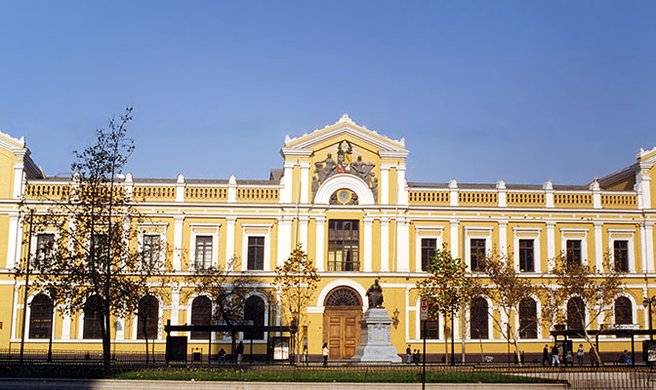
Its central house faces Avenida Libertador Bernardo O'Higgins, the Santiago avenue known as the Alameda. The nineteenth century building is a national monument and holds the rectorate, the ceremonial Salon de Honor, and the Andres Bello central archive, which keeps the first rector's personal library among its collections.
For much of the twentieth century the university kept branches across the whole country. The 1981 higher education reform separated those regional seats into independent universities, leaving the institution concentrated in Santiago while several of today's regional state universities trace their origin to it.
Faculties, institutes and campuses
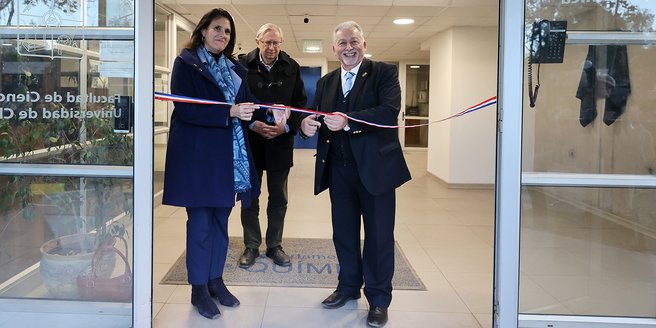
Teaching and research are organized in sixteen faculties and three interdisciplinary institutes. The faculties cover architecture and urbanism, arts, sciences, agricultural sciences, physical and mathematical sciences, forestry and nature conservation, chemical and pharmaceutical sciences, social sciences, veterinary and animal sciences, communication and image, law, economics and business, philosophy and humanities, government, medicine, and dentistry. The institutes work on international studies, advanced research in education, and nutrition and food technology, the last known by its acronym INTA. A general entry program called Bachillerato lets students complete two years of broad coursework before committing to a degree.
Facilities concentrate in five Santiago campuses. Andres Bello lies near the city center, Beauchef holds engineering and the physical sciences, Dra. Eloisa Diaz groups the health fields, Juan Gomez Millas houses humanities, arts, communication, and basic sciences, and Campus Sur contains agriculture, forestry, and veterinary medicine. Built floor space across the university passes 715,000 square meters. The university also runs its own teaching hospital, the Hospital Clinico, next to the health campus in the north of the city.
Students and admission
Enrollment stands at about 46,120 undergraduate and graduate students, and the graduate catalog lists 43 doctoral programs and 121 master's programs. Undergraduate admission runs through the national standardized tests, and the university's own measurement department, DEMRE, builds and administers those tests for the entire admission system, so every applicant to a Chilean selective university sits an exam produced here. Forty four libraries operate across the faculties, and students can join 41 competitive sports teams.
Governance combines a rector, a university council, an evaluation council, and an elected university senate in which academics, students, and staff all hold seats. In 2022 the community elected the first woman rector in the institution's history, and a new rectoral election was under way during 2026.
Research and public standing
The university reports the largest output of basic and applied research in Chile, and international rankings place it among the 500 best universities in the world. Its academics and graduates have collected 215 national prizes, the state honors granted for lifetime achievement in sciences, arts, letters, and journalism. Twenty one presidents of Chile studied in its classrooms, and the Nobel laureate poet Pablo Neruda trained as a French teacher at its former pedagogical institute.
Observatories and seismic monitoring
Since 1927 the university has operated the National Astronomical Observatory on Cerro Calan hill in Santiago, an institution whose records reach back to 1852. The National Seismological Center at the engineering faculty watches earthquake activity for the state and the public, a permanent task in one of the most seismic countries on earth, and its bulletins are the standard national reference after every significant tremor. Climate and mathematical modeling centers add further reference data used by ministries and courts.
Successive institutional accreditation reviews have granted the university the maximum period awarded in Chile, and its exchange agreements span universities on five continents.
Arts, culture and media
Four resident companies perform under the university's arts and culture center: the national symphony orchestra of Chile, the Chilean national ballet, a symphonic choir, and a vocal chamber ensemble. The Teatro Nacional Chileno, descended from the experimental theater founded by university actors in 1941, remains a working professional stage. Two museums belong to the institution, the Museum of Contemporary Art and the Museum of American Popular Art, and a university radio station has broadcast news and culture for decades, joined more recently by an online television channel and podcast series.
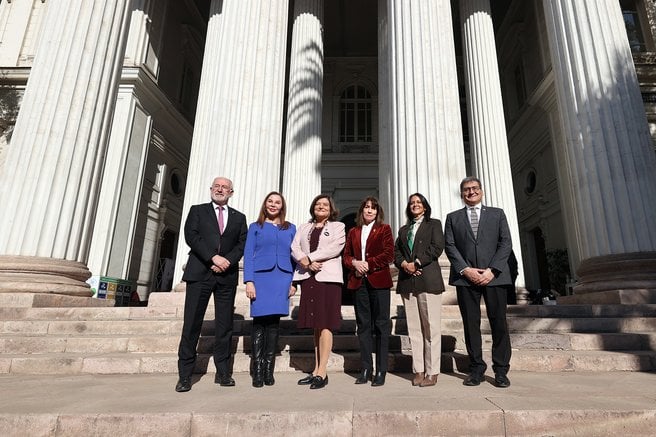
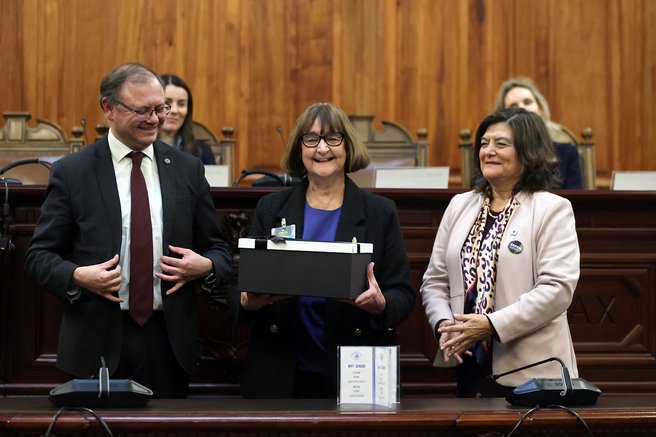
Public engagement extends to open concerts, a published events agenda, continuing education courses, and the university press. Casa Central itself receives visitors during heritage days, when the Salon de Honor and the central archive open to the public. The building remains the setting for degree ceremonies, national prize announcements, and academic tributes, including the honors given to outgoing rectors at the close of their terms.

Business address
Universidad de Chile
Av. Libertador Bernardo O'Higgins 1058,
Santiago,
Region Metropolitana
NA
Chile
Contact details
Phone: +56 2 2978 2000