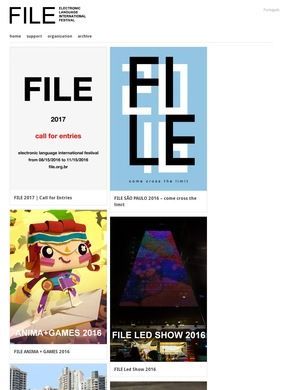
Running since the early 2000s and now past 23 consecutive editions, FILE has built a record in electronic art that very few Brazilian festivals can match. The 2026 edition runs August 18 to October 11 at the FIESP Cultural Center in Sao Paulo, and the portal at file.org.br is where the current program, the open call, registrations, publications and a deep back catalogue all live. This is the Festival Internacional de Linguagem Eletronica, a non-profit organization rooted in electronic art, technology and the overlap between them.
What does FILE cover?
What FILE covers is genuinely wide, and the site does a decent job of letting you see the shape of it before investing any time. Interactive art installations sit alongside video art and animation, which the festival groups under an ANIMA+ strand. There is game art for people who treat play as a medium, and LED and light installations that only make sense once you are standing inside them. Sound gets its own home in the Hipersonica strand, which is a welcome sign that audio art is taken seriously as a discipline and given real program space of its own. Add CGI and AI-generated video, performance, and cinema, and the program refuses to pick a single lane.
Sound art in the Hipersonica strand
The archive section is the part worth pointing a newcomer toward first. FILE's online record of past editions reaches back to 2013, which means you can study how the festival has tracked shifts in digital art across more than a decade. That archive turns FILE from an event you either catch or miss into a standing reference available any time of year. For students or curators trying to understand how Brazilian electronic art has developed, that continuity is worth more than any one headline installation.
Archive and reference materials
The educational side is substantial and is not bolted on as an afterthought. FILE hosts workshops, artist symposiums and lectures, so the festival functions partly as a teaching institution while it is open. The call for entries accepts artists, researchers and developers worldwide, which keeps the program from becoming purely domestic and pulls in work from outside Brazil each year. There is also the FILE Prix Lux award, a recognition track that gives the whole enterprise a competitive dimension and a reason for makers to submit serious work.
Educational programs and international submissions
Publications round out the offering. The festival produces books and other printed material, which is a sensible priority given how much electronic and time-based art disappears once the lights go off and the installation is dismantled. So much of what happens in a festival like this is genuinely ephemeral, and putting the documentation and the ideas into print is how FILE leaves something durable behind. Between the books, the archive and the symposium recordings, the organization has clearly thought about its own afterlife, beyond the few weeks the doors are open each year.
Publications documenting ephemeral work
FILE has not always been anchored to a single city. While Sao Paulo is the long-running base, editions have also taken place in Rio de Janeiro and Porto Alegre, carrying this model of electronic art and technology into different Brazilian audiences. That geographic reach gives FILE a national footprint that a purely venue-bound event could never build. The site reflects this history rather than flattening it into a single-location story.
Geographic reach across Brazilian cities
If there is a reservation, it is about navigation rather than substance. With this many strands, awards, archive years and program threads, a first-time visitor can feel the breadth before finding their footing. Everything is there, but you do need to hunt a little to assemble the full picture in your head. Someone arriving cold might wish for a clearer map of how ANIMA+, Hipersonica, the Prix Lux and the general program relate to one another. Ambition brings that cost, and most people willing to explore will find their way through.
Navigation challenges with multiple program strands
FILE is described as the largest arts and technology festival in Brazil, and after more than two decades of continuous programming that claim has the weight of a track record behind it. FILE sits in the same conversation as established international platforms for digital and electronic art, and its longevity is itself an argument: trends in this field shift quickly, and an organization that has stayed relevant and kept producing across so many of those cycles has demonstrated something genuine about its programming judgment. No search of public review platforms turned up a significant rating footprint, which is typical for a cultural institution of this kind; the published output, the archive, and the breadth of the award record are the real measure.
Artists and developers working in any electronic medium will find the call for entries on file.org.br the most direct way in: check the submission window and categories against your current work, and that is the door into both the Prix Lux and the main program. The August to October run at the FIESP Cultural Center is the obvious moment to engage with FILE in person, but the archive at file.org.br is available year-round and holds a decade of documentation that rewards browsing. FILE has held its position as a reference point in Brazilian electronic art by putting in the years and the programming, and the site makes that accumulated depth accessible without burying it under promotional noise.