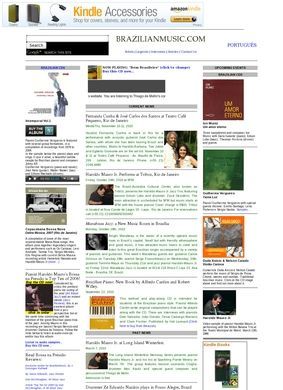
Someone hears a bossa nova track in a film, catches a name in the credits, and wants to know who the player was and what else they recorded. That trail usually goes cold fast, because so much of the genre lives in Portuguese-language pages or in record-store memory. Brazilian Music sets out to be the place where that search actually lands somewhere useful, organizing samba, bossa nova, and Brazilian jazz around the people who made them rather than around genre labels alone.
Artist profiles with audio and video
The artist pages are the core of the site. There are biographical profiles for both living performers and the older figures who shaped the music, written with enough background to tell you why a given musician matters within the tradition. Pianist Haroldo Mauro Jr. and saxophonist Ion Muniz both get their own coverage, sitting alongside other names spanning contemporary and historical players. Audio samples and video clips attach to a lot of this material, which means you can read about an artist and then hear what the writing is describing without leaving the page. That pairing is the part I kept coming back to, since a discography on its own tells you nothing about how a horn line actually sounds. Brazilian Music leans hard on this combination, and it works better than text alone would.
Album reviews and critical analysis
Beyond the profiles, Brazilian Music publishes album reviews and analytical articles. The writing takes positions on records rather than summarizing liner notes, which is harder and more useful. For anyone working through an unfamiliar catalog, having an opinionated guide saves a lot of blind purchases. The criticism on the site has a point of view, which is rarer than it should be in genre coverage.
Interviews with working musicians
There is also an interview segment carrying the label "Mr. Samba," where Brazilian musicians speak in their own words. Interviews are expensive to produce and they age well. A conversation recorded with a working artist holds value long after the news cycle moves on, and Brazilian Music leans on this kind of primary material more than you might expect from a project of its size. It gives the site a dimension that purely encyclopedic resources lack.
How do you buy music on this site?
The commercial side is straightforward. Brazilian Music sells and promotes CDs and MP3 downloads, with digital purchases routing through an affiliated platform, NossaMusica.com. A catalog of compilations and solo albums is featured, so a reader who finishes an article about a performer can move toward buying the record being discussed. The handoff to a separate storefront for downloads is worth knowing about in advance. It is a normal arrangement, though it does mean the transaction finishes on another domain.
Live performance schedules
Event listings round things out. Brazilian Music keeps a schedule of live performances at venues in both Brazil and North America, and each entry includes a venue contact number for that specific show. For a touring genre with an audience split across two continents, that bridge between online discovery and a ticket in hand is genuinely practical. A student in the United States chasing a samba night, or a collector planning a trip, gets a real reason to check back.
No mainstream review ratings available
On outside reputation, the picture is quiet. A search turns up plenty of genre-level material and competing sites, but no Google, Trustpilot, Yelp, or comparable ratings tied to brazilianmusic.com itself. That absence does not tell you the content is weak. It tells you the project has stayed under the radar of the mainstream review platforms, which is common for specialist cultural sites that built their audience before those platforms mattered. A reader weighing whether to trust the album criticism has to judge it on the writing, not on a star average.
Contact is handled through an inquiry form. There is no street address or direct phone number on the landing page, so reaching the people behind Brazilian Music means filling out a form and waiting. One nuance worth flagging: the event listings do carry phone numbers, but those belong to the venues, not to Brazilian Music itself, so they help with a show and not with a question about an order. For a content-and-commerce site, a clearer support route would be an improvement.
Brazilian Music is unapologetically a niche site. The focus is narrow, the editorial commitment is genuine, and the audio and video material makes the writing land differently than it would on a text-only resource. Collectors, students, and musicians studying the form will get more out of it than a casual visitor who stumbled in from a search. The download storefront lives on a partner domain and direct contact runs through a form, which are both worth knowing before you expect instant answers. But for what Brazilian Music is trying to do, the archive holds up.