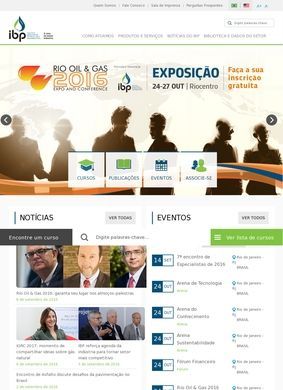
Brazil's oil, gas, and biofuels industry has one clear representative when it needs to coordinate on policy, training, or technical standards: IBP, the Instituto Brasileiro de Petroleo, Gas e Biocombustiveis. More than 68 years of continuous operation have made it the trade body where operators, suppliers, and specialists across the Brazilian energy economy come to work out shared positions. With over 200 member companies spanning the supply chain, IBP is not a niche lobby focused on a single issue but the institutional backbone of the sector.
Five technical commissions guide industry positions
The reach of IBP shows up most clearly in how it organises its work. Five technical commissions handle the substantive questions the industry keeps running into: fuels, sustainability, technology, engineering, and people and culture. That last one is telling. An association that treats workforce and organisational culture as a standing technical concern alongside engineering and fuels is thinking about more than barrels and pipelines. The commissions are the machinery through which member companies hash out shared positions and feed expertise back into the wider sector, mapping onto real fault lines in energy: how to keep fuels supply reliable while sustainability pressure mounts, how to absorb new technology, and how to keep skilled people in the field.
UnIBP provides workforce training and certification
A large part of the value sits in education. UnIBP is the association's sectoral university, running professional education and training built specifically for the oil, gas, and biofuels workforce. Among its programs are mentorship tracks aimed at female leadership in energy, a pointed and useful focus in an industry that has historically skewed male at senior levels. Training is paired with professional certification for practitioners, so an individual can move from learning a discipline to holding a recognised credential in it. For someone trying to build a career in this part of the Brazilian economy, that combination of structured coursework and certification under one roof carries real practical weight.
Knowledge Hub and observatory track sector data
Knowledge sits at the centre too. The Hub de Conhecimento, or Knowledge Hub, gathers sector analysis, technical publications, and a specialised library in one place. Anyone who has tried to find reliable, current data on a regulated industry knows how scattered the sources usually are, so a curated hub run by the trade body itself is a genuine convenience. Alongside it is the Setor Observatory, which tracks industry data and trends, and an exclusive content platform named Alem da Superficie, or Beyond the Surface. The observatory handles numbers and trend-watching while the content platform reaches for deeper analysis that does not fit in a chart. Members get a layered picture of where the sector stands and where it appears to be heading.
iUP Energia addresses energy transition challenges
Innovation has its own home in iUP Energia, a hub pointed squarely at energy transition challenges. This is the part of IBP that grapples with the hard, unsettled question facing every oil and gas association on earth right now: how does a fossil-fuel sector position itself for a future that demands lower emissions and new energy sources? Placing that work in a dedicated hub, rather than leaving it as vague language scattered across press releases, points to an organisation that wants the transition treated as engineering and entrepreneurship work, not slogans.
Major conferences and expos anchor the calendar
Events round out the offering, and these are not small affairs. IBP organises ROG.e, a combined conference and expo, along with OTC Brasil and Rio Pipeline. For a sector that runs on relationships, contracts, and technical knowledge exchange, these gatherings are where a lot of the consequential business and learning happen. They give member companies and independent professionals a recurring set of fixtures to plan around, anchoring the association in the calendar of the global energy industry as much as the domestic one.
How the programs connect to each other
Taken as a whole, the structure has an internal logic. UnIBP builds the people. The Knowledge Hub and the Setor Observatory inform them. The technical commissions turn that expertise into shared positions. iUP Energia pushes on what comes next. The events bring everyone into the same room a few times a year. It reads less like a grab-bag of programs and more like an ecosystem an institution has assembled deliberately over decades, each piece feeding the others.
Member access to exclusive research and analysis
There is a clear answer to the question of who this serves. Member companies get coordination, shared technical work, and a collective voice. Industry professionals get training, certification, data, and the events circuit. Newcomers seeking sector-specific skills get a defined path into a complex field through UnIBP. A business directory listing for IBP only scratches the surface of what the association offers; the depth is in the member portal, which gates exclusive material including Alem da Superficie and the fuller observatory output. The split between open resources and member-only depth is standard for an association funded by its members, and IBP makes that boundary plain.
Assessing what the programs actually deliver
It is fair to ask where the limits are. An organisation this size, representing an industry under intense scrutiny over climate and energy policy, carries the tensions of its sector inside it. The presence of a sustainability commission and iUP Energia shows awareness of that pressure, though awareness and outcome are different things, and the proof of an energy-transition program is in what the member companies build with it. For a prospective member or a professional weighing IBP, the right move is to look past the program names and into the specifics: what a given UnIBP course certifies, what the observatory data covers, and how the commissions reach their positions. The framework is substantial; the value depends on what is behind each piece.
Seven decades of institutional infrastructure
What is not in doubt is the standing. Nearly seven decades of continuous operation, a membership north of 200 companies, a sectoral university, a certification program, a research hub, an innovation arm, and three named industry events add up to an institution woven into how the Brazilian energy sector functions. IBP is not trying to prove it belongs in the conversation. It is, in large measure, the conversation itself. That breadth only accumulates through long institutional life, and it holds across education, research, technical coordination, and convening, with no obvious weak link among them. The weight of the evidence is straightforward: IBP is the primary infrastructure for anyone operating professionally in Brazil's energy sector, and the published record across education, events, and technical coordination gives a clear and consistent picture of an institution doing exactly what it claims.